The Conservative party, Europe and the JCB headquarters in Rocester, Staffordshire, have a long shared history. It was there that William Hague held his final “save the pound” evening rally in his doomed 2001 general election campaign, insisting he could see panic in Tony Blair’s eyes.
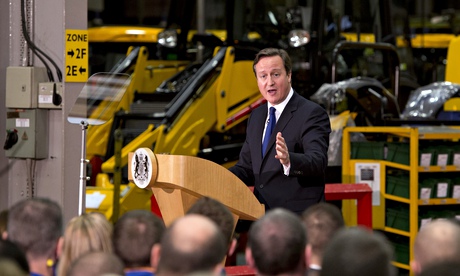
On Friday it was the turn of David Cameron – at the crack of dawn and beside a whirring assembly line – to propose a new Tory settlement with Europe.
The panic this time was in the eyes of British business. Would Cameron use the speech to excavate a giant new hole for himself with the much-canvassed plan to try to impose quotas or an emergency brake on EU migrants coming into the UK?
Almost every European capital would have met such a proposal by saying it was a flagrant breach of the fundamental principles of free movement within the EU, and as such a diplomatic dead end.
The sign above the door marked Brexit would have been lit up and Cameron would have been unceremoniously, if regretfully, guided towards it. British business knows that beyond that door is the unknown, a cold, inhospitable place that UK finance directors want to avoid.
Instead, the light over the exit door remains dimmed. Cameron sent the clearest signal that he wants to stay in the EU.
But it was a close-run thing. John Major has in recent years often been cast in the role of John the Baptist to Cameron. In a speech in Berlin two weeks ago, Major had hinted strongly that some kind of direct block on EU migration would be needed to meet British demands. That option was regularly briefed to Tory papers, as party strategists tried to slow Ukip’s momentum.
Cameron, answering questions on Friday, came up with two plausible public reasons for drawing back.
First, he said, some EU countries with large immigration populations (code for Germany) did not agree. Cameron spoke to Angela Merkel this week to test her response to an emergency brake one more time, and was told he needed to learn to take nein for an answer.
Second, he claimed the brake would be ineffective – saying it was “an archaic mechanism” that would only be operated by the EU commission itself and not by the UK. It would thus deprive the British government of control – the single word, according to Cameron, the British public crave to hear about immigration.
But privately Cameron may also have been urged by George Osborne to get out of this never-ending auction on immigration with Nigel Farage. The Ukip leader, dismissed as a snake oil salesman in nearly Cleggite terms by Cameron on Friday, would always outbid him.
So this was perhaps the day when he decided to stop trying to out-Ukip Ukip, so legitimising that party’s demands, and instead mark out the ideological borders around his own European politics.
With so many audiences to consider, it is a gamble. It leaves Farage free to sell his snake oil to a charmed electorate, and Ukip MP Douglas Carswell derided the Cameron retreat.
Initially, Tory backbenchers seemed supportive, describing the speech as a game-changer. But those on the right, ranging from Bill Cash to Jacob Rees-Mogg, gradually became more vocal – saying there needed to be an absolute cap on numbers, and that the plan to take away tax credits was not enough.
Those Tories who had wanted Cameron to step on to the conveyor belt to EU exit were disappointed. For instance Liam Fox, the former defence secretary, said Britain’s problem with Europe was not just immigration.
Business for Britain, the putative umbrella group for a no campaign in a referendum, was at best lukewarm – saying Cameron was “hardly proposing anything radical” and arguing the plan had to be seen only as a starting point.
So far Tory newspaper editors, personally squared by Cameron this week ahead of the speech, have been beguiled by the welfare crackdown and consequently appear willing to forgive a Conservative prime minister that has managed to preside over an overall increase in net migration since 2010.
They may be more wary when they study Cameron’s determined optimism in the speech that a deal is “doable” or the remarkably warm feelings he expressed about immigration multiculturalism, diversity and the openness. Yes the welfare measures are tough, but in tone this speech was Cameron vintage 2008-9.
In Europe, the first signals were primarily relief. “It could have been a lot worse,” said one German source before insisting any deal would be hard to negotiate, since Cameron’s proposal so clearly discriminates against EU citizens in favour of UK nationals.
Requiring jobseekers to have a job offer may also breach the fundamental principle of free movement. If the guiding principle was to confer benefits only on those who first contribute to the welfare system, then on this basis many UK citizens should be deprived of in-work tax credits because their incomes will, in many cases, have been too low to be required to pay tax, said one EU diplomat.
Cameron himself said his plan would require treaty change, but his officials suggested that if other EU nations rejected his proposal, Britain could negotiate a UK-only opt-out, something that might need only a protocol.
Ironically, much may turn on whether the long-delayed universal credit (UC) is implemented. EU lawyers say UC can be treated differently in legal terms from out-of-work benefits,
British business on Friday night could see both value and danger in the proposals. Cameron has not set the bar for renegotiation of Britain’s continued membership so high that inward investment will dry up. “We are back from the brink,” said the pro-Europe group Business for New Europe.
At the same time, there will be businesses in some sectors, such as agriculture and catering, that will be wary that if Cameron’s plan to deprive migrants of in- and out-of-work tax credits succeeds, the reserve army of cheap eastern European labour will find the UK a less enticing place to work.
Some industries would then be required to hire less motivated or skilled UK workers at higher prices, so depressing productivity and fuelling wage inflation. UK’s decade long covert incomes policy enabled by globalised labour market would be weakened.
But that goes to the heart of the package. How many EU migrants receive tax credits? The statistics suggest about 350,000 but the numbers are imprecise, and oddly have to be obtained via freedom of information requests.
How many EU migrants will avoid the UK if in-work tax credits are no longer available? Is the wage disparity between Poland and the UK still so great that even the loss of £8,000 a year in tax credits will not deter an adventurous European coming to Britain, the jobs factory of Europe?
Are not paths of migration set? Open Europe, the thinktank on which Cameron has drawn for his plan, insists the loss of tax credits for four years will change the calculus.
But it was notable that Cameron gave no figure, and did not specify when the various changes might kick in. Public faith in his ability to control immigration has been badly corroded, so this time he needs to deliver.