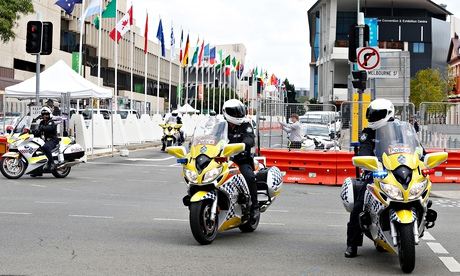
David Cameron flew into Sydney on Thursday for a three-day visit including a G20 summit that is likely to see him clash with the Russian president, Vladimir Putin, over Ukraine and demand more international action to combat the Ebola epidemic in Africa, as well as the threat posed by Islamic State in Syria and Iraq.
Cameron will also address the Australian parliament in Canberra at the invitation of the Conservative prime minister, Tony Abbott, before flying on to Brisbane.
Putin was barred from a slimmed-down summer G8 summit representing the world’s older developed economic powers, and since then Cameron has repeatedly advocated tougher economic sanctions as the best way of stopping the Kremlin’s support for pro-Russia rebels in eastern Ukraine.
Putin engineered a ceasefire before the Nato summit in Wales in September, but since then there has been continued fighting, as well as further decline in the Russian rouble. British officials were describing the bilateral meeting with Putin as a “brush-by”, suggesting it will be relatively short.
There have been repeated reports of fresh Russian troop movements along its border with Ukraine in recent days including those of unmarked artillery convoys. The troop activity came after recent separatist elections that Kiev, the US and the EU consider illegitimate.
The German chancellor, Angela Merkel, reiterated that the EU was planning to add the winners of the vote to existing sanctions lists, but said there were no new economic sanctions planned.
However, the EU’s new foreign policy chief, Federica Mogherini, said foreign ministers would consider increasing sanctions at a regular meeting next week. Cameron has privately admitted that it is very difficult to be certain Putin any longer tells the truth to his fellow world leaders, but he will underline to Putin that he does not want to see a return to the old cold war.
Abbott had also promised to “shirtfront” Putin over the Russian failure to apologise for the downing of flight MH17, or to offer compensation. The two men met briefly at an Asian summit earlier this week, and Putin has said he has no intention of apologising. Cameron’s other chief bilateral meeting is with the newly elected Indian prime minister, Narendra Modi, probably the politician most in demand for bilaterals at the summit.
Formally the annual G20, first established in the wake of the fiscal crisis in 2008, will focus on efforts to prevent the world economy slipping back into recession. The IMF and the Obama administration have expressed fears that Europe, Japan, China and other major emerging markets are not doing enough to spur growth. The G20 will sign a relatively brief communique – possibly as short as three pages – calling for growth to be 2% above trend over the next five years. Details of how this is to be achieved will be set out in a Brisbane action plan setting out short- and medium-term targets.
In practice, such communiques bind G20 member countries to little, and the key players of Germany, Japan and China are likely to continue as before, leaving the US to do the heavy lifting for the global economy.
Cameron is likely to focus on the importance of a US-EU trade deal while Abbott has said he wants a narrow focus on jobs and growth.
Some of the emerging economies are looking to bypass the IMF after a politically weakened Barack Obama failed to win congressional approval for reform that would have given emerging economies greater leverage.
The G20 will also see calls for further action to clamp down on corporate tax evasion – an issue that has been forced on to the agenda over the past two years as successive investigations have revealed how little multinationals pay by shifting profits to low-tax countries or tax havens.
The bulk of the detailed, highly technical work on international tax treaties is being undertaken by the Paris-based OECD, but the G20 will give world leaders a chance to insist they have the collective will to curb evasion. The British chancellor, George Osborne, and Cameron have been relatively forward on the issue, signing disclosure agreements with UK tax havens and setting up public registers on beneficial ownership, a way in which the true owners of companies can be identified.
In October in Berlin, 51 countries including Britain agreed to the automatic sharing of tax information, one of the essential building blocks to reform. Campaigners claim as much as $1tn (£633bn) is drained from the coffers of developing countries by illicit financial flows.
Global Financial Integrity, one of the most prominent Washington-based campaign groups, said before the summit: “Curbing the abuse of anonymous companies and instituting country-by-country reporting for multinational companies are straightforward ways to tackle this global scourge.”
Key elements of reforms will be further progress on a 15-point plan to limit profit shifting and transfer pricing (sales of goods or services within corporations), greater information sharing between tax jurisdictions, requirements on country-by-country reporting and an end to anonymous beneficial ownership.
Cameron is also due to announce plans to extend a fast-track visa system already on offer in India and China to at least five other visa-processing centres including New York, Turkey, South Africa and United Arab Emirates. Decisions on visas in high-priority cases will be made within 24 hours.
The government said wealthy tourists from countries such as UAE spent an average £2,486 per visit while 75,000 Thai tourists spent a total of £117m last year.
Cameron said: “We have got to keep listening to business about what more can be done to support them.” Each super-priority visa will cost £600 above normal prices, the same fee as charged in India and China.
There is uncertainty about the extent to which Abbott will allow the Ebola issue on to the G20 agenda since it is not formally an economic issue, but Oxfam in a press release claimed nine of the G20 countries had failed to provide support adequate to their size.
Four G20 countries – Argentina, Indonesia, Saudi Arabia and Turkey – are yet to make any contribution to the international response. “Brazil, India, Mexico and Russia should be doing a lot more. Meanwhile, France should increase its efforts to provide an adequate leading response in Guinea, rapidly turning its pledges into aid,” Oxfam said.
The charity also pointed out that the World Bank had warned that if the virus spread the economic impact in Africa could range between $27bn and $32bn by the end 2015.
The World Bank will float the idea at the summit of a multibillion-dollar emergency pandemic-fighting fund, arguing the world has been too slow to react to the Ebola outbreak partly because no permanent funded structure was in place.