Afternoon summary
-
Ben Emmerson QC, counsel to the child abuse inquiry, has told MPs that the panel conducting the inquiry needs to be disbanded. Giving evidence to the Commons home affairs committee, he said:
I am as counsel to the inquiry in a position to express an opinion on whether the current arrangements continue to be tenable, and I don’t think they do.
And he suggested that he strongly expects Theresa May, the home secretary, to disband the panel and to announce a new inquiry, with statutory powers. All members of the panel, apart from one, would make suitable candidates to serve on the new panel, he said. But Sharon Evans should be dropped, he suggested.
-
Emmerson said that Evans had caused “a great deal of damage” to the inquiry by leaking information and by speaking to the media without approval. She was in breach of her duty of confidentiality, he said, and had made misleading statements that had an impact on the work of the inquiry. He even said that, in some areas, Evans could not tell the difference between truth and error. And he claimed she had “done no service to the survivor community”.
It may be that in some areas Mrs Evans finds it difficult to distinguish between an accurate statement and an inaccurate one ...
Her conduct has been a massive distraction and has caused a great deal of damage in the final stages of this interim inquiry ...
My professional assessment is that the conduct of Mrs Evans in releasing this information has effectively rendered it impossible for the panel to have full confidential discussions with one another, and has therefore brought about a situation where it’s simply not possible for it to operate in full.
And I would say this; in doing so, while I understand that she is herself a survivor, she has done no service to the survivor community.
-
An internal Home Office report has been released showing the Home Office did decide that Evans had breached confidentiality. The home affairs committee published it on its website. In it Mary Calam, a Home Office director general, told Evans:
Such breaches of confidentiality are extremely serious. They must inevitably undermine the trust of Panel members in each other and therefore the ability of the Panel to operate effectively. They also undermine the confidence of survivors and others who engage with the Panel on the basis that information they provide and discussions they have with Panel members will remain confidential.
Calam also said that Emmerons had not bullied Evans, although Calam said he accepted Evans found his conduct “very distressing”.
-
Ministers are accepting restrictions on fracking demanded by Labour. This news is just breaking and these tweets are from Labour MPs.
Govt u-turn and accept Labour amendment to stop fracking - no fracking without tough protections in place. pic.twitter.com/fGG8R9c4pV
— Tom Greatrex (@tomgreatrexmp) January 26, 2015
U turns don't come much bigger than this - Govt facing defeat on fracking suddenly supports Labs tougher environmental regs #fracking
— Angela Eagle (@angelaeagle) January 26, 2015
Great result for Labour's @tomgreatrexmp as Government fearing defeat does complete u turn on #fracking accepting all Labour's conditions!
— Ben Bradshaw (@BenPBradshaw) January 26, 2015
And this is from the Sun’s Tom Newton Dunn.
Rumour that the Govt is having to accept all Labour's amendments on fracking. Would be a disaster for shale industry.
— Tom Newton Dunn (@tnewtondunn) January 26, 2015
-
Labour sources have indicated that Ed Miliband agrees with David Cameron about the need to include Northern Ireland in the televised leaders’ debates. “We can see no good reason not to treat Northern Ireland differently to the rest of the United Kingdom in these debates,” a source said.
That’s all from me.
Thanks for the comments.
Updated
Having heard all of Sharon Evans’ evidence to the home affairs committee, and all of Ben Emmerson’s, I would guess that, if it has to take sides, the committee is more likely to side with Emmerson.
Q: Would you continue as counsel to inquiry?
Emmerson says there are some fantastic people on the panel. He can see no reason why they shouldn’t go onto the new inquiry. In fact, there is only one who has been a problem.
Q: Would it be fair for you to be counsel to the new inquiry?
Emmerson says he hopes the current problems are not a reason why he should not be counsel to this inquiry. But it is a matter for the home secretary.
David Winnick says he is impressed by Emmerson’s integrity.
Q: Have you got enough time? You are about to start a new inquiry, the Litvinenko inquiry.
Emmerson says lawyers are used to dealing with more than one task. He is starting the Litvinenko inquiry. But he will have a junior in that. And he will not have to be in court every day.
And that’s it.
I’ll provide a summary soon.
Emmerson says he is not a natural political ally of Theresa May. So when he praises her (see 4.39pm), he is being sincere.
Emmerson lists the qualities the inquiry chair needs
Keith Vaz goes next.
Q: What are the main qualities required of a chair?
Emmerson says it must be someone with absolute independence from the executive, and demonstrable ability to hold the executive to account. They must have very considerable forensic skills. They must be passionate about the need to bring justice to survivors, and to scourge the establishment. They must have the imagination to see that this is a once in a lifetime opportunity to address this issue. And they need real courage.
Q: And how long should the inquiry last? We’ve been told five years.
Emmerson says the Australian inquiry is expected to take four years.
Q: Did you advise Fiona Woolf on the drafting of her letter to Theresa May about her conflicts of interest?
Emmerson says he did not have anything to do with what she wrote about her relationship with Lord Brittan.
Q: Your assessment is that the panel is in difficulties because it cannot hold discussions in confidence.
Emmerson says it is his assessment that the panel cannot do its work because of Evans conduct. Although she is a survivor herself, what she has done has not served the interests of survivors, she says.
Q: What would your advice be to the home secretary?
Emmerson says it is not for him to advice the home secretary. He is counsel to the inquiry.
But, as counsel, he can say he thinks the current arrangements are not tenable.
So, either the home secretary can set up a statutory inquiry, with new panel members, or a royal commission.
Q: So there would ahve to be new people?
Not necessarily, he says. Members of the existing panel could re-apply.
Q: It is your personal view that the panel has come to an end.
Emmerson says maintaining the new arrangements, even with a new chair, are not tenable because of Evans’ breaches of confidentiality.
Q: Is that for other reasons? Or is it just because of Evans.
Emmerson says it is because of Evans primarily.
Q: So you would not be surprised if May disbands the current panel?
Emmerson says it is not for him to say. But the home secretary is aware of his views.
- Emmerson says the child abuse inquiry panel needs to be disbanded. He strongly hints that this is what Theresa May will order. Some existing panel members could be reappointed, he says.
Emmerson says that, if members of the panel can not speak in confidence, they will not be able to do their work at all. They must be able to talk to each other knowing their thoughts will not end up in the papers.
Emmerson says Evans’s conduct has been a “massive distraction” and has caused “a great deal of damage”.
Michael Ellis, a Conservative, goes next.
Q: Do you have any doubts about the sincerity and integrity of the panel?
None whatsoever, says Emmerson.
Q: Do you have any doubts about the sincerity and integrity of the Home Office?
Emmerson says the secretariat are extremely committed.
And he says he has been very impressed by the commitment shown by Theresa May. He has been “surprised and encouraged” by the seriousness with which she takes this, he says.
Emmerson says he asked the Home Office last week to lift the duty of confidentiality in his contract preventing him from answering some questions at today’s hearing.
Q: You are saying Evans breached confidentiality at least four times. How many times before she is out?
Emmerson says that is a matter for the Home Office.
Q: Why wasn’t it dealt with?
Emmerson says he is here being criticised because he did try to deal with it.
Conclusion of inquiry into investigation that Calam bullied Evans
Here is an extract from the report Mary Calam, the Home Office director general, produced when she investigated the claim that Emmerson bullied Evans.
It is in the documents bundle (pdf), starting on page 24.
In relation to Ben Emmerson’s conduct towards you, I do not think that it meets the definition of bullying set out above or as commonly understood. I found no evidence that he intended to “undermine, humiliate, denigrate or injure you”. His email of 7 January included an apology “if you felt threatened by (his) emails”. From what I have seen (and noting that I am not a lawyer myself), the content of his advice to you and other Panel members in relation to the question of writing to the Home Secretary and to confidentiality, seems entirely reasonable and proper. He was acting within his responsibilities as Counsel to the Inquiry.
All that said, there is no doubt that you genuinely found his approach very distressing. Be assured that I will draw this to Ben Emmerson’s attention in an appropriate way.
Tim Loughton says the committee is aware of two breaches of confidence by Evans.
Q: You have mentioned others. When did they take place?
Emmerson says he cannot answer that [on confidentiality grounds].
Q: Who is in charge? And where does the buck stop?
Emmerson says Theresa May will decide on a new chair by this Saturday.
He says it has been hard for the panel not having a chair.
Tim Loughton, the Conservative former children’s minister, goes next.
Q: Do you accept that people think this is all a mess?
Emmerson says it is not for him to say what people think.
Emmerson says there are other breaches of confidentiality by Evans that are not in the public domain.
Among the statements that are in the public domain, there are three very misleading statements. They have made it harder for the panel to do its work.
It may be that Evans finds it hard to tell the difference between a factual statement and a misleading one, he says.
Emmerson says Sharon Evans’ leaks made it “very, very much more difficult” for the panel to do its work.
Evans complained about Emmerson to her local MP, Vince Cable. Cable took this case up with Theresa May.
Emmerson says he understands why Cable took this up, but Cable “does not understand law” and “does not know the facts”.
The bundle of documents published by the committee (pdf) includes a letter that Ben Emmerson sent to Keith Vaz ahead of the hearing.
In it, Emmerson complains about Vaz’s conduct. It explains why the exchanges between Emmerson and Vaz sere so tetchy.
Here’s an extract.
During the hearing on Tuesday Sharon Evans made allegations against me of bullying and intimidation and said that she had reported the alleged misconduct to the Home Office. Following the hearing I am informed that you issued a statement via twitter calling on me to consider my position in light of her allegations ... In the circumstances, your call for me to consider my position was issued without any proper inquiry into the facts and was a wholly unjustified imputation of professional misconduct. I would ask you to now formally and publicly withdraw it.
Q: Is it just all a big understanding? I asked one of my clerks today, about how people can think barristers are being aggressive when they are just putting advice forcefully.
Emmerson says Vaz will need to ask Sharon Evans.
He says, as a lawyer, you sometimes have to offer advice that is blunt.
But Evans’ breaches of confidentiality were multiple.
She knew what she was doing when she leaked her letter.
Initially his advice was in “attenuated” terms.
But she continued to breach confidences.
He says she has done it again, briefing the committee.
Vaz says Emmerson should not make assumptions about where the committee is getting its information.
Emmerson accepts that, although he says it is hard to imagine where else the committee got a confidential letter from the Home Office to her.
Vaz says people are concerned so much of this has not been put out into the open.
Emmerson disagrees. He thinks people will concerned how much stuff is coming out.
His advice to Evans had to be “robust”, he says, because she was making multiple breaches of confidence.
Emmerson says his statement had “all necessary clearances” before he issued it.
Q: Did the Home Office clear it?
You will have to ask the Home Office, he says. He is bound by contractual duties. But it had “all necessary clearances”.
Vaz reads from Mary Calam’s letter.
He says Calam set tests for bullying. She found that Emmerson’s behaviour towards Evans did not meet those tests. But she said she accepted Evans found Emmerson’s behaviour upsetting.
Q: There was obviously a problem between you and Evans. She is one of only two survivors on the panel. Is this the right way to have dealt with this?
Emmerson says it is difficult to answer compound questions that have gone on as long as Vaz’s.
He says Emmerson is criticing him for using the words baseless and unfounded.
Q: I was not criticising you. I was just pointing out you used them in your letter.
Emmerson says the complaint about him was investigated and no evidence of bullying was found. That means it was baseless.
And Theresa May said it was unfounded.
So Vaz was “wrong” to say those words were not justified.
Also, the panel, by a majority of 7 to 1, said the bullying and intimidation allegations were wrong. And they said they had full confidence in me, says Emmerson.
Updated
Vaz is now asking Emmerson about the statement he issued last week. (See 3.29am.)
He says the committee has a letter from Mary Calam, a Home Office director, about the Sharon Evans investigation. It does not say Evans’ complaint was unfounded.
Updated
Vaz says these documents are being published on the committee’s website.
Vaz says it is a contempt of parliament to intimidate witnesses to a select committee. A briefing note was prepared before panel members gave evidence to the committee last week.
Q: Did you prepare this?
Emmerson says he was aware of this.
Vaz says this document told panel members not to say they were coached by the Home Office. But the document was prepared by the secretariat, whose are on secondment from the Home Office.
Emmerson says the secretariat is not all from the Home Office. And they are not working for the Home Office now.
If people were asked if they were helped by the secretariat, they would have said so, he says.
Emmerson says on two occasions he has offered advice in relating to the drafting of letters.
The panel decided to follow the procedures that apply to public inquiries, in case they were turned into a public inquiry.
As part of that, panel members had to write letters about potential conflicts of interest.
The solicitor to the inquiry, Simon Regis, advised on the letters. But Emmerson says he was asked for advice on some matters, and offered advice.
The second occasion related to the letter sent by Theresa May to panel members.
Emmerson says Sharon Evans leaked that. He knows that, but it is for the Home Office to explain how it knows.
Two panel members replied to May.
One was Evans. Evans did not consult him, he says.
A second panel member wrote to May. He says he is authorised to say this. The panel member, a woman, showed him the letter. He advised her to make it clear that it was from her alone.
Q: Have other members replied to May?
Emmerson says he does not know if he can answer that without breaking a confidence.
Emmerson says he is counsel to the inquiry.
That means the job is a little wider than just being its legal adviser, he says.
Q: What is your salary?
Emmerson says the committee needs to asks the Home Office. He would not mind them knowing. Theresa May has indicated that the salaries are in line with other public inquiries.
Procedurally, that question needs to go through the Home Office, he says.
Q: What do you do? As well as giving legal advice and drafting letters, do you convene meetings?
Emmerson says it is known from the minutes of panel meetings that he has acted, in most cases, as the facilitator of panel discussions and deliberations.
When Fiona Woolf resigned, the panel was left without a chair.
It could have elected an interim chair.
But it decided not to do that. It collectively asked Emmerson to sit in the chair.
A conscious decision was made, on Emmerson’s advice, that he would not be called the chair. He did not want people to think he was standing in as chair. He does not have a vote. But he facilitates discussions.
It’s a team effort, he says.
Emmerson says this is in the public domain. If Vaz’s clerks had looked on the website, they would have found this.
Vaz says how he runs his committee is a matter for him.
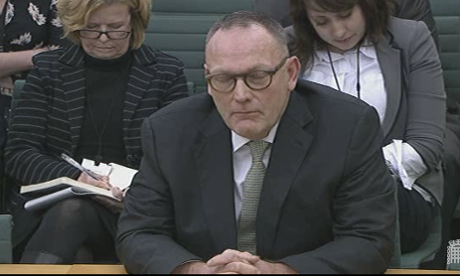
Ben Emmerson says he wrote to the committee at the end of last week saying he was bound by three separate duties of confidentiality.
Vaz says the letter is on the committee’s website.
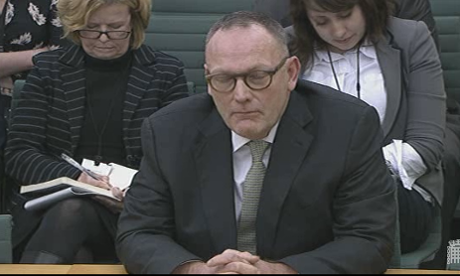
Ben Emmerson CQ is giving evidence now.
Keith Vaz, the committee chair, invites Emmerson to clarify the evidence given last week by Sharon Evans.
After the hearing last week all members of the child abuse panel, apart from Sharon Evans, put out a statement saying they had not been bullied or intimidated by Ben Emmerson.
It said:
Today we outlined that the work of the panel is under way.
The panel has full confidence in the integrity, advice and impartiality of counsel to the Inquiry.
We accept the advice provided was robust but do not accept any statements about bullying. We reject any suggestion that the panel has been intimidated.
Child abuse inquiry counsel, Ben Emmerson, questioned by MPs
Last week MPs from the home affairs committee took evidence from members of the child abuse inquiry panel.
Emmerson is now about to give his own evidence to the committee.
Here’s the statement he released last week after Evans’ evidence.
The effective operation of any public inquiry requires that panel members are able to hold full and frank discussions in confidence and take collective responsibility for their decisions. This is reflected in the terms of their appointment which provide that the unauthorised disclosure of confidential information is a breach of contract justifying immediate termination.
Sharon Evans has repeatedly disclosed confidential information in public and has made a number of public statements that are factually misleading. These were serious violations of her duties as a panel member and undermine the integrity of the inquiry and the confidence of victims and survivors.
It was my clear duty as counsel to the inquiry to bring these breaches to the attention of the panel and the Home Office. I also pointed them out clearly to Ms. Evans herself on a number of occasions, and it was this which led her to accuse me of bullying her.
These allegations of bullying and intimidation are entirely baseless. As the Home Office will confirm, Ms. Evans’ complaints have already been fully investigated and dismissed as unfounded, something she neglected to mention when she gave evidence to the Home Affairs Select Committee this afternoon.
The advice that I gave Ms. Evans was legally correct and entirely necessary in the circumstances.
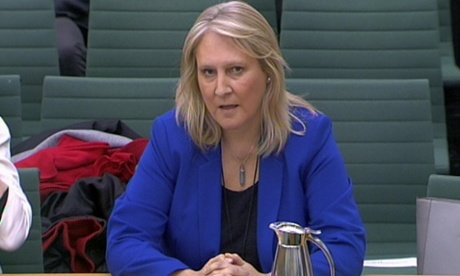
Updated
Nick Robinson, the BBC’s political editor, has been taking part in an online Q&A on Facebook.
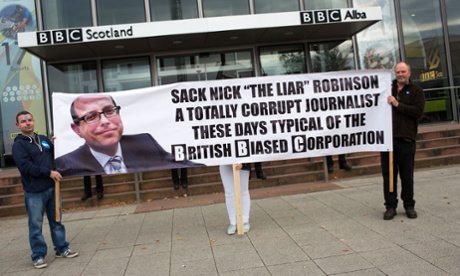
Inevitably, he’s taken questions about the report during the Scottish referendum campaign which infuriated nationalists who thought he was wrongly accusing Alex Salmond of failing to answer a question. That was the episode that led to this demonstration.
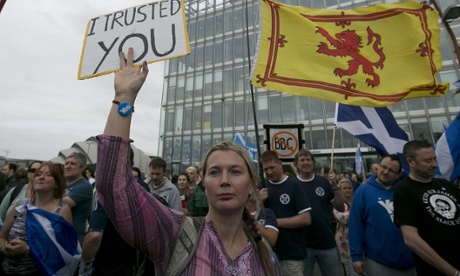
And this is what Robinson said to someone who thought he should be sacked for manipulating the news.
I didn’t choose my words carefully enough on that report - as I’ve said on a number of occasions - but I didn’t manipulate the news. I thought and still think that Alex Salmond chose not to answer the substantive criticisms that were made by business leaders of independence which I quoted to him. However, my phrase “He didn’t answer” made it look to some (though not all) that he hadn’t answered at all. It was a mistake but having spent last week with Nicola Sturgeon and her team it’s one I think it’s time to move on from
There’s more about the row about Robinson’s original report here.
Philip Cowley, the academic, is interesting on John Bercow’s plan for online voting. (See 9.45am.)
The problem with e-voting is that it chases extra handful of % turnout at the rise of huge damage to perceptions of integrity of the system
— Philip Cowley (@philipjcowley) January 26, 2015
If we've learnt anything from the last 15 years, it's that perceptions of integrity matter just as much (more) than % turnout.
— Philip Cowley (@philipjcowley) January 26, 2015
Jim Murphy, the new Scottish Labour, triggered a bit of a row recently by saying that he wanted to use the proceeds of the mansion tax (which will be paid disproportionately by Londoners) to pay for 1,000 Scottish nurses.
Fifteen Labour MPs have signed a joint statement calling for more leftwing policies, including renationalisation of the railways and the promotion of more collective bargaining.
The full statement is on LabourList. Here’s an extract.
When the Thatcher government came to office in 1979, 82% of workers in the UK had their main terms and conditions determined by a union-negotiated collective agreement. The latest figures now show that the coverage is down to just 23%. One very significant result is that the share of national income going to salaries and wages has fallen dramatically from 65% in 1980 to 53% in 2012 – a loss to employees of some £180bn!
Ed Miliband was doing one of his People’s Question Time events in Staffordshire. Labour did not sent an all-round op note saying it was taking place, the Press Association don’t seem to have been there, and it was not covered by BBC News or Sky, and so I haven’t got full details, I’m afraid.
But the Express and Star has a live blog of sorts.
Miliband was asked about Stafford hospital, which was downgraded after the care scandal there.
Asked @Ed_Miliband about downgraded Hospitals, like Stafford, what can @UKLabour do? Ed says decisions on services should be medically led.
— Rowan Draper (@Rowan_Draper) January 26, 2015
Room very full as people await the arrival of @Ed_Miliband at the Aquarius in Hednesford for a People's Question Time pic.twitter.com/EbR4hjpDkp
— Scott Smith (@scott_smith9) January 26, 2015
Lunchtime summary
- A YouGov poll for the Evening Standard has given Labour a 10-point lead over the Conservatives in London. According to the Evening Standard, this suggests Labour is on course to become the largest party nationwide.
- Kris Hopkins, the communities minister, has announced plans to make it harder for pubs deemed a community asset to be converted into something else. He set out the initiative in a parliamentary written answer (pdf).
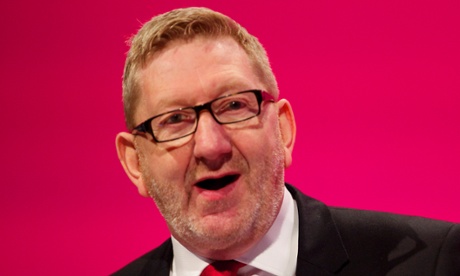
Ed Miliband was lukewarm about Syriza’s victory in Greece in his comments this morning (see 12.31pm), but Len McCluskey, the Unite general secretary, is thrilled. He’s issued this statement.
This stunning election victory is a tribute to the Greek people who have now firmly rejected the disastrous austerity policies imposed on them by the troika of the European Commission, European Central Bank and International Monetary Fund.
The fight of the Greek people against austerity is the same fight that British, Irish and millions of other working people across Europe are waging against the failed politics that protects the rich and well-off at the expense of the poor.
In voting for Syriza and an end to austerity the Greek people have once again made hope possible for millions of other people across Europe. Unite will watch with great interest the developments in other countries, such as Spain, where anti-austerity parties are also making huge gains, and Unite will continue to play its full part in fighting austerity to make another Europe possible.
Professor Ian Brown, associate director of Oxford University’s Cyber Security Centre, has told the World at One that John Bercow’s plan to allow online voting by 2020 (see 9.45am) is “incredibly optimistic”, according to the BBC. He said:
For national elections you really want to be very sure indeed that people aren’t able to break into voting systems and to affect people’s opinion of the trustworthiness of the results, which I think unfortunately would be a very significant risk if we in the UK were to introduce online voting in the kind of time-frame that John Bercow has talked about.
According to the briefing note sent out overnight, David Cameron was planning to say in his speech that the average basic rate taxpayer would be paying at least £8,000 in income tax by the end of the decade as a result of increases the basic rate tax allowance, those implemented already and those planned by the Tories for after the election.
Not to be outdone, Danny Alexander, the Lib Dem chief secretary to the Treasury has produced figures showing that more than 8m households will be £1,330 better off next year from the coalition’s tax allowance increases.
But both claims are spurious because, overall, most people have lost out from the coalition’s tax and benefit changes. It is as if you lent your boss £100, received just £60, and then had to listen to him telling you you should be grateful for being better off.
At the end of last week the Institute for Fiscal Studies spelt this out in detail, in a paper looking at the distributional impact of all the coalition’s tax and benefit changes (pdf).
Here’s a graph summarising the key findings. This shows that, in proportional terms, the poorest 10% (those on the left) have lost most (follow the grey line), although the richest have lost most in cash terms (the black lines).
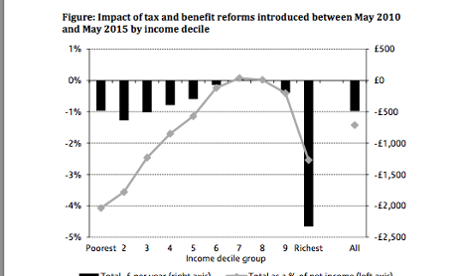
Table 2:1 on page 5 of the report (pdf) is also useful. It shows that annual value of the coalition’s “giveaways” and “takeaways”. As the Tories and the Lib Dems say, increasing the tax allowance has amounted to a big giveaway, worth £8bn. But the impact of that is vastly outweighed by the effect of the VAT increase, a takeaway worth £14bn.
(To be fair, the Tory claims are more measured than the Lib Dem ones. The Lib Dem news release talks about families being “better off”. The Tory briefing note just talked about people paying £8,000 less in tax.)
Updated
Responding to the Digital Democracy Commission report (see 9.45am), Angela Eagle, the shadow leader of the Commons, says Labour would pilot online voting.
This report suggests some interesting ways to improve our democracy and help us meet the challenges of our modern age. It is right they should be considered. We have to do much more to demystify parliament and facilitate public engagement in our political process.
Labour is committed to piloting online voting to see if it can be done securely and affordably. We will also create a new democracy portal to draw together in one place all of the things you need to know before you vote, we will make it easier to register to vote and we will reform the scrutiny of legislation to formalise a role for the public and give a greater role to backbench MPs.
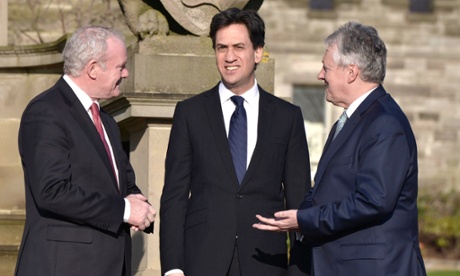
Here’s Ed Miliband’s full quote on the Greek election results.
Just like our elections are a matter for the people of this country, so who the Greek people elect is a decision for them.
It is the responsibility of the British government to work with the elected government of Greece for the good of Britain and Europe and not to play politics.
And it is up to each country to choose its own path on how to deal with the economic and social challenges they face.
We have set out our path for Britain: to make sure our country is fairer and more prosperous and balance the books.
Updated
Here is today’s Populus poll.
Latest Populus VI: Lab 35 (-1), Con 34 (+2), LD 9 (-), UKIP 13 (-), Others 9 (-1). Tables here: http://t.co/MMEgv3KR2Y
— Populus (@PopulusPolls) January 26, 2015
Miliband tells Osborne and Cameron not to 'play politics' with Greek election result
Ed Miliband has been doing one of his People’s Question Time events this morning. This is what he said about the Greek election result.
It is the responsibility of the British government to work with the elected government for the good of Britain and Europe, and not to play politics.
That is a riposte to George Osborne, who used his Today interview this morning to lecture the Greek government on the need to “act responsibly” (see 9.09am.), and to David Cameron, who, like Osborne, has been arguing that the Greek election results show the importance of governments having good economic plans (implying, of course, that a Labour government wouldn’t). (See 12.03pm.)
Cameron's Q&A - Summary
Here are the key points from Cameron’s Q&A.
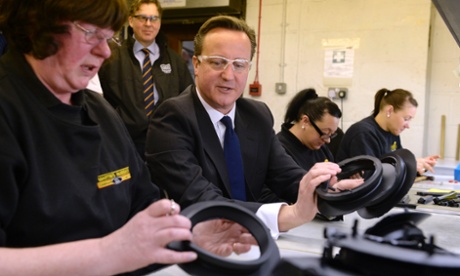
- Cameron raised a new objection to his participation in the proposed TV debates, saying that the exclusion of the DUP was now a flaw. Although he welcomed the inclusion of the Greens, as he proposed, he pointedly refused to commit himself to participating. He also gently mocked the broadcasters, suggesting that too many parties were now included. “I’m sure they know what they are doing,” he said. And he said he did not see why the SNP and Plaid Cymru should be included, but not Northern Irish parties. (See 11.51am.)
- He said that he discovered immediately that the call he received yesterda was a hoax - because the caller told him.
My BlackBerry went in my pocket, I answered it and it claimed to be a conference call established – which I do obviously very frequently – between the head of GCHQ and some of the staff in my office. A voice came through, a voice I didn’t recognise. The voice said he said he was sorry to wake me up, which I thought was strange as it was 11 o’clock in the morning, and so I quite rapidly asked ‘who is this?’, to which the answer came ‘it is a hoax call’, and so I pushed the red button on the BlackBerry which ended the call.
- He said that he wanted fracking to go ahead and that he believed public opposition to it would only disappear when people saw shale gas sites in operation. But there had to be safeguards, he said.
I want to see unconventional gas properly exploited in our country. I think there are good reasons for doing this: we want to have greater energy security, and that should mean making the most of our indigenous energy supplies; we want to keep prices down, I think that’s important; we also want to tackle climate change, and so exploiting some of our own gas rather than shipping it from other parts of the road can make a contribution ...
Until we see wells that are dug, local communities benefiting from not only the financial incentives, but also the business rates that will flow to them - it’s only when that happens that I think we’ll see people in our country, who are understandably sceptical about this new technology, see that it worked in America, it can work here, it can create jobs, it can create wealth and it can make us competitive at the same time.
-
He said the Greek elections underlined the importance of governments having economic plans that work.
What the Greek elections show is that you need to have an economic plan that works. The Greek voters were revolting against failure, economic failure; a country whose economy had shrunk, whose unemployment was unacceptably high and they couldn’t see a secure future. There’s a massive contrast with what has happened here in Britain.
Updated
Cameron on the TV debates
Here is the full transcript of what David Cameron said about the TV debates. He was responding to questions from ITV’s Libby Weiner.
It is worth posting at length because it is actually a rather brilliant example of political flannel. Most politicians can dodge a tricky question, but to do it as effortlessly as this, with humour and apparent sincerity, is rare indeed.
Q: Now that the Greens been included in two of the TV debates, are you going to turn up to debate with them.
Well, we’re making good progress. I was told that it was appalling and outrageous that I had suggested that you could not have one minor party without having the other minor party, and I’m delighted the broadcasters have gone away and thought again. They have actually come up with rather more minor parties than I had in mind. [Laughter.] But, anyway, I’m sure they’ve thought it all through and they know what they’re doing, although I don’t quite see why Northern Ireland seems to be missing out because, as far as I’m concerned, that is as important a part of our United Kingdom as well as Scotland. But we’re making good progress and I’m sure they know what they are doing.
Q: But is that a yes?
Well, I want to take part. And I said they needed to do the minor parties thing. And they have certainly done that.
Q: So they have agreed to your terms. Are you going to say yes?
Well, they were never my terms. I simply said you have a problem if you have one minor party, Ukip, but you don’t have another minor problem, the Greens. And everyone said that is appalling and outrageous and how can the prime minister make such suggestion. I woke up one morning last week to find out everyone agrees with me. It’s very good news. I want these debates to go ahead. And that’s good progress.
What is particularly impressive is the multiple messaging going on here. For headline, public consumption, Cameron is saying:
- I’m still up for debates, and I’m glad we’re making progress.
But what he’s really saying - and he’s not even trying to hide this anymore from those of us how are paid to decode what he means - is:
- I still hope to wriggle out of them.
- I can’t possibly turn up unless the DUP are in too. And not just the DUP, but Sinn Fein as well. (Notice, he talks about “Northern Ireland”, not the DUP.)
- With so many parties involved, hopefully it will become unviable. (Look at the way he is joking about how big the multi-party debate has become already.)
- If if never goes ahead, I’ll be able to blame the broadcasters.
Updated
Cameron's Q&A - Snap summary
Here are the key points from Cameron’s Q&A.
- Cameron raised a new objection to his participation in the proposed TV debates, saying that the exclusion of the DUP was now a flaw. Although he welcomed the inclusion of the Greens, as he proposed, he pointedly refused to commit himself to participating. He also gently mocked the broadcasters, suggesting that too many parties were now included. “I’m sure they know what they are doing,” he said. And he said he did not see why the SNP and Plaid Cymru should be included, but not Northern Irish parties.
- He said that he discovered immediately that the call he received yesterda was a hoax - because the caller told him.
- He said that he wanted fracking to go ahead and that he believed public opposition to it would only disappear when people saw shale gas sites in operation. But there had to be safeguards, he said.
-
He said the Greek elections underlined the importance of governments having economic plans that work.
I’ll beef this up soon with full quotes.
Updated
Q: Will tax cuts be enough to keep the south and south east Conservative?
Cameron says there are 214,000 more people in work in the region.
People can see that the economy is improving nationally, he says.
The Q&A is over.
I’ll post a summary soon.
Q: Will you back plans to put fracking on hold?
Cameron says he wants to see unconventional energy sources exploited. If you look at America, you will see that fracking (although he continues to call it unconventional gas) has promoted economic growth.
I want to see this develop, Cameron says. But, obviously, you need safeguards.
He says some exploratory wells need to be dug.
Until wells are dug, and people see communities developing, public support will not change.
Q: Now the Greens have been included in the debates, will you turn up?
Cameron says we are making progress. People said it was outrageous that the Greens were not included. Now the broadcasters have included even more, including parties he did not propose. But he does not see why the Northern Irish are excluded. They are an important part of the UK.
Pressed whether he will take part, he says, again, we are making progress, and he jokes that he is pleased about people agreeing with him.
Q: What lessons do you draw from the elections in Greece? And what impact will there be on the UK?
Cameron says the Greek elections show that you need to have an economic plan that works. The Greek voters were revolting against failure. There is a “massive contrast” with the UK, where the plan is working. There are 1,000 more people getting a job every day since it has been in office.
But there are danger signs in the world economy. These warning signs underline the need to stick to the economic plan that is delivering, he says.
Q: Can you talk us through the hoax phone call?
Cameron says these things happen from time to time. When they do, it is right to look at security. Having had a day trip to Saudi Arabia, he was taking his family for a walk in his constituency. He had Florence, in his daughter, on his back. His BlackBerry went off. He was told it was a conference call. Someone said they were sorry to wake him up. He thought that was odd, as it was 11am. Who asked who it was? They said it was a hoax call. He pressed the red button and ended the call.
Cameron's Q&A
Cameron is now about to take questions.
BBC News has given up its coverage of the speech, but there is a live feed on the BBC website.
Cameron is now setting out the Conservatives’ tax commitments.
First, the basic rate income tax threshold would go up to £12,500. Some 1m people would be taken out of tax. Anyone on the minimum wage working 30 hours a week would then be taken out of income tax altogether.
Second, the Conservatives would raise the threshold for paying the 40p rate of tax to £50,000. Today one in six taxpayers pay the higher rate of tax. The Tory policy would take 800,000 out of the higher rate tax bracket, he says.
How can we make these promises? Because we have a a strong economy.
Third, the Tories are legislating for tax-free child care, and recognising marriage in the tax system.
Fourth, the Tories would continue to cut the deficit, he says. He claims the Tories have set out exactly what this would involve.
And, fifth, the Tories would go on ensuring that those who can pay the most in tax, and would continue to crack down on tax evasion. He says the government has passed 40 pieces of legislation on this issue. And it has led the international debate on tax evasion and tax avoidance.
The government has set a low rate of corporation tax. But it is right to say to companies that they should pay those taxes, he says.
Updated
Cameron says security is the key theme behind his campaign.
He says promising to cut taxes is not just a vague promise; the Conservatives’ record shows that they can do this, he says.
He says there is a good economic case for tax cuts. But there is a moral case too; people should be allowed to spend their money.
But there is a third reason too; a practical case for tax cuts. He says he is a practical Conservative, and tax cuts would be beneficial.
David Cameron's speech
David Cameron is speaking now. He is in Eastleigh.
He says it has been an interesting weekend.
If anyone thought the worst election outcome was Ed Miliband in Number 10, they have been proved wrong. We now know the worst outcome would be Miliband dependent on SNP support, he says.
Here’s the speech venue.
The PM will take to the stage here in about five minutes. pic.twitter.com/rdlzYrr9ow
— James Johnson (@dailyecho_jj) January 26, 2015
David Cameron is in Hampshire for his speech, and he has already fitted in a visit to Southampton.
David Cameron’s speech on tax cuts is due to start soon.
According to the extracts released overnight, this is what he will say about why he is committed to tax cuts.
I sometimes get asked: why do I believe in tax cuts so much? It’s simple, because I trust people more than I do politicians. I think people know how to spend their money better than those in Westminster do. I believe that if people have worked hard and earned their own money, they should be able to spend it on a holiday, or a nice meal out, or some new clothes for their children – and that it shouldn’t be thrown up the wall to satisfy the latest gimmick dreamed up in Whitehall. This is the right thing to do: it’s your money, not the government’s, and so you should keep it ...
But there’s another reason for tax cuts, and we’re at that moment now – what I would call the tax moment, when after years of sacrifice, the British people deserve a reward. Let me put it like this: in the wake of Labour’s great recession, these past few years have incredibly hard for this country. But after some dark times, we are coming out the other side. And as we do, I’m clear – the people whose hard work and personal sacrifices have got us through these difficult times should come first. So it’s right that where we can ensure people keep more of their own hard-earned money, we should.
Boris Johnson visited Kurdistan last week. In his Telegraph column, he suggests the government should consider sending ground troops to help the Kurds fight Islamic State.
Of course I understand the anxieties of the UK Government: the strong and justifiable aversion to sending British ground troops to the frontline ...
All these political questions are important and delicate, but they strike me as fundamentally questions for another day. The immediate task is to help the Kurds defeat the forces of darkness and hate. It is hard to think of another conflict where righteousness coincides so overwhelmingly with the British interest. In a miserable region, Kurdistan is an oasis of democracy, tolerance, prosperity, openness and relative gender equality. Since John Major’s 1991 no-fly zones, the Kurds have been vehemently pro-West, and particularly pro-British. With the sixth-biggest notional oil reserves in the world, Kurdistan is a huge opportunity – and already has the most successful Jaguar Land Rover showroom in the Middle East.
Now is exactly the time, when things are tough, for us to step up our support: encouraging more trade, and more direct flights from London to Erbil, and above all to spread the news to British business that Kurdistan is really different, and in some ways better. And we should consider intensifying our military support. In a struggle against savagery that washes up on our shores, their cause is our cause.
SSE has become the latest power company to announce it is cutting gas prices. This is from the Press Association.
Energy supplier SSE is to reduce household gas prices by 4.1% on April 30 before extending its energy price freeze until at least July 2016.
The move is the latest cut by one of the UK’s Big Six energy firms, although SSE’s reduction will take effect much later than the company’s rivals, with British Gas due to cut its gas tariffs by 5% from February 27.
In March, SSE pledged to freeze prices until January 2016 after putting up gas and electricity bills by 8.2% in the previous autumn. The UK’s second biggest supplier said today it has extended this guarantee, meaning its gas and electricity prices will not go up before July 2016 at the earliest.
As the BBC reports, five of the six big energy firms have now cut their gas prices.
John Bercow, the Commons speaker, has published the report from his Digital Democracy Commission. The full report is here (pdf), and here’s a summary.
Mostly it’s full of very sensible suggestions about making parliament more accessible. Here are what it describes as its key recommendations.
1. By 2020, the House of Commons should ensure that everyone can understand what it does.
2. By 2020, Parliament should be fully interactive and digital.
4. By 2020, secure online voting should be an option for all voters.
5. By 2016, all published information and broadcast footage produced by Parliament should be freely available online in formats suitable for re-use. Hansard should be available as open data by the end of 2015.
For reporters like me, much of this would be very useful. For example, the report recommends that Commons officials “experiment further with live social media coverage of what is said in debates”. That is going to make it easier to cover something like the Trident debate, which I overlooked last week because I was busy with other matters and no one else was covering.
But I don’t agree with this claim from John Bercow in his foreword to the report.
The sheer weight of information about politics, now available, can act as a wall, keeping the citizen out of the mysterious world of Westminster.
There is a problem with public engagement with Westminster politics. But it is nothing to do with the volume of political reporting now available. The “sheer weight of information” about, say, football hasn’t led to people losing interest. The causes lie elsewhere.
George Osborne's Today interview - Summary
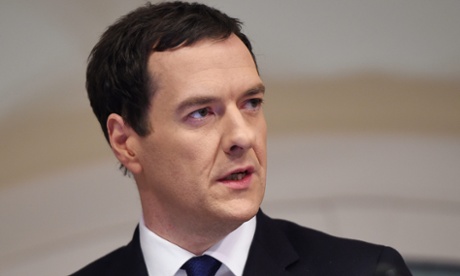
As I mentioned earlier, George Osborne was on the Today programme earlier (although it didn’t sound much like Osborne - either he’s got a croaky voice, or it was another imposter.)
Here are the main points he made.
-
Osborne urged the new Greek government to compromise on some of its demands.
Ultimately, if you take at face value all the things that the new Greek government has promised, including the increases in public expenditure, I think that is going to be very difficult to deliver and incompatible with what the eurozone currently demands of its members. But I hope that both sides now act responsibly. Indeed, you heard the new Greek leader immediately saying ‘look, I want to get into a discussion with the eurozone authorities’. So I think everyone has in the past seen the precipice, a couple of years ago, the Greek exit from the euro, and pulled back.
-
He said higher public spending was not the solution to Greece’s problems.
I don’t think it’s just a question about the public finances. I think that is a panacea, that’s a false hope that it’s just a question of spending more money in these countries. One of the reasons these countries are in a mess is because they weren’t able to bring their public finances under control in the past.
-
He refused to say whether the troika should relax Greece’s debt repayment obligations. Asked if the troika should reschedule the debts, he replied:
I think the obligation on the eurozone is to come forward with an economic policy that delivers jobs and growth not just in Greece, but in other European countries that have really struggled.
-
He said the Greek vote showed that people wanted economic policies that work.
What people don’t like is economic policies that don’t work; in the UK, we have an economic policy that is working.
-
He said he was “not aware” of any reasons why the Conservatives should have shunned Amjad Bashir, the Ukip MEP who defected to the party at the weekend.
The Respect party says that only three years ago Bashir was one of their candidates, before being de-selected, although Bashir denies this. Osborne said:
I was listening to him on the television yesterday, and I thought he was very compelling about the reasons why he wanted a Conservative government ... I’m certainly not aware of something that that I should be worried about.
I’ve taken the quotes from the Press Association and PoliticsHome.
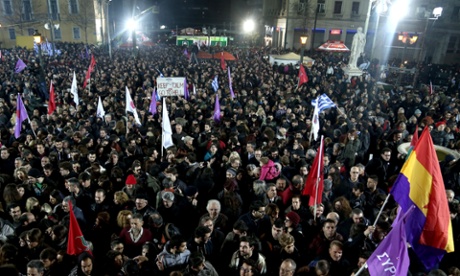
And here’s the full interview.
Hear the full interview with Chancellor @George_Osborne on how Greece's #Syriza win could affect Europe: http://t.co/6EhrWJ2zIH #r4today
— BBC Radio 4 Today (@BBCr4today) January 26, 2015
Updated
#UKGENERALELECTION2015 101 DAYS TO GO
— General Election (@UKELECTIONS2015) January 26, 2015
David Cameron is giving a speech on tax this morning. And, according to the extracts released overnight, he’s going to say that the public should get tax cuts after the election because we deserve a reward. It is as if he views tax cuts as Nectar points.
We’re at that moment now – what I would call the tax moment, when after years of sacrifice, the British people deserve a reward. Let me put it like this: in the wake of Labour’s Great Recession, these past few years have incredibly hard for this country. But after some dark times, we are coming out the other side. And as we do, I’m clear – the people whose hard work and personal sacrifices have got us through these difficult times should come first. So it’s right that where we can ensure people keep more of their own hard-earned money, we should.
The speech is the third in a series Cameron is giving on the Conservatives’ six election priorities - the deficit, jobs, taxes, education, housing and retirement - and, if last week’s is anything to go by, the speech itself may be a bit thin. But, if we get a Q&A, that should be good. It is never hard to think of questions to ask the prime minister, but today there are plenty of good topics to raise. Greece, the hoax caller, the Ukip defector, the Saudi flag tribute and the TV debates could all generate strong news lines.
My colleague Graeme Wearden is writing a separate live blog about Greece. As he reports, George Osborne, the chancellor, was on the Today programme earlier telling the new Greek government to “act responsibly”.
As for the rest of the day, here’s the full agenda.
8.30am: John Bercow, the Commons Speaker, launches his Digital Democracy Commission report.
10.30am: David Cameron delivers a speech on tax.
2.30pm: Iain Duncan Smith, the work and pensions secretary, takes questions in the Commons.
3.30pm: Bill Emmerson QC, counsel to the child abuse inquiry, gives evidence to the Commons home affairs committee.
3.30pm: MPs begin a debate on the infrastracture bill. At some point there will be a vote on fracking, but it will probably be out of my time.
As usual, I will be also covering all the breaking political news from Westminster, as well as bringing you the most interesting political comment and analysis from the web and from Twitter. I will post a summary at lunchtime and another in the afternoon.
If you want to follow me on Twitter, I’m on @AndrewSparrow.
Updated