Afternoon summary
- Theresa May, the home secretary, has refused to accept Labour claims that her decision to scrap control orders in 2012 and replace them with Tpims (terrorism prevention and investigation measures) enabled two terror suspects associated with Mohammed Emwazi to abscond. (See 4.50pm.)
-
The Local Government Association has joined those criticising David Cameron’s plans to provide 200,000 cut-price starter homes by cutting the amount developers have to spend on affordable housing. Peter Box, the LGA housing spokesman, said:
New starter homes cannot be built in isolation and under these plans, starter homes would be built without any wider community needs. Where there is a development of starter homes with implications for local infrastructure, such as schools, community centres, transport links and flood defences, then government funding should be provided to meet these demands.
Further analysis and evidence is needed to convince councils that applying these exemptions would actually be sufficient to fund building on difficult brownfield sites as well as being able to pass on the savings in the form of a 20% discount on completed homes.
That’s all from me for today.
Thanks for the comments.
Labour has sent out a note with three questions that it says Theresa May refused to answer during the UQ. Here they are.
- Will the government get the ISC or the Independent Reviewer of Terrorism legislation to look into whether the scrapping of relocation powers allowed a West London terror network with a history of facilitating travel and funds for people to go to war zones to be re-established with the return to London of 2 of its key members and what wider?
- If so what was the wider impact of the loss of relocation powers during these 4 years 2011-2015?
- Why have the government cut spending on community led Prevent programmes in the DCLG & in the Home Office by 80% at a time of increased need including preventing youngsters travelling to Syria?
May's urgent question - Snap summary
Here is a summary of the key points from Theresa May’s statement.
-
May refused to accept Labour claims that her decision to scrap control orders in 2012 and replace them with Tpims (terrorism prevention and investigation measures) enabled two of Mohammed Emwazi’s associates to abscond. Under control orders, suspects could be relocated. Tpims did not allow relocation until very recently, when they were beefed up. Yvette Cooper, the shadow home secretary, made this allegation (see 3.23pm), but May dismissed it. She replied:
You say the power to relocate has not always been there but what you fail to say is that the cases that have been raised in the media date from the time when control orders and the power of relocation were in place.
Later Labour sources said that, although this sounded like a denial, May was speaking in very general terms, and that she did not deny the specifics of the Observer report saying two of the suspects absconded after control orders were replaced with Tpims. (See 3.23pm.)
-
May said she was never told by the police or the security services that relocating terror suspects away from home would stop them absconding to Syria. She told MPs:
At no point has anybody from the police or security service said to me that if we had the power of relocation, we would be able to prevent people from travelling to Syria.
- She said that new powers in the Counter Terrorism Act to enable the police to temporarily seize the passport of someone trying to leave the country if they are suspected of wanting to travel to Syria to join Islamic State have been used by officers.
- She condemned Cage, the human rights group, for appearing to defend Emwazi at its press conference last week.
-
The Conservative MP Bob Stewart has strongly condemned the media for printing pictures of Emwazi and calling him by a nickname, “Jihadi John”. It was “abhorrent” to treat him as a celebrity, Stewart said.
The urgent question is now over.
On Twitter the Lib Dem MP Julian Huppert has had another go at Labour over backing control orders.
Strong bid for authoritarian award to Labour MP asking why terror suspects should be allowed phones. Hint is the word 'suspect'.
— Julian Huppert (@julianhuppert) March 2, 2015
Labour’s Andrew Gwynne says the fact that May had to reintroduce the relocation element of control orders shows that her 2011 reforms were wrong. Will she apologise?
May says the situation has changed since then. The government has responded to changing circumstances, she says.
May says the government was right to place a duty on universities to prevent radicalisation.
Michael Ellis, a Conservative, asks about the comments about Emwazi made by Cage.
May says there can be no excuse for the barbarism that has been shown. She condemns the remarks made by Cage.
Labour’s Stephen Doughty asks if arrangements are in place with Turkish carriers, including Turkish Airlines. May did not answer when Yvette Cooper asked this, he says.
May says the government has arrangements in place with a number of airlines.
Labour’s David Winnick says the person responsible for the beheading of kidnapped British citizens should be brought to justice.
May agrees. There is an ongoing police investigation, she says.
Bob Stewart, a Conservative, says it is “abhorrent” that the media are using pictures of Mohammed Emwazi, and giving him a nickname. He is being treated like a modern Jesse James.
May says she cannot comment ongoing investigations.
Julian Huppert, a Lib Dem, says May should not listen to Labour. Is May taking forward the recommendations from David Anderson, the independent reviewer of terrorist legislation?
May says some of Anderson’s recommendations informed the Counter Terrorism Act. Anderson is doing a wider reviewer on terror legislation, she says.
Keith Vaz, the Labour chair of the Commons home affairs committee, says it is not clear why, when the three schoolgirls left on Tuesday, the authorities in Turkey were not alerted for another three days.
May says the Metropolitan police have said when they told the Turkish authorities the girls were missing.
May says, again, that some of the cases quoted in the press go back to a time when control orders with relocation were in place.
David Davis, the Conservative MP, says May should not listen to Labour about control orders. Seven people absconded while they were on control orders, including some who went abroad.
Updated
May is responding to Cooper.
She says Cooper’s figures about Prevent do not take into account how the government changed it. Cooper needs to say whether or not she supports the changes made to it.
May says Cooper has made comments outside the comment about Tpims and individuals (referring to Mohammed Emwazi and his friends).
May says she cannot comment on individuals. And Cooper does not understand how the system works, she says. May does not place people under Tpims. She says it is up to the police to bring a case to her. She approves it if it is robust.
May says Cooper said recently that Tpims, with relocation, were the same as control orders.
She says that the control order regime was being weakened by the courts when the government decided to replace them.
The cases quoted in the media relate to the time control orders, with relocation, were in place, she says.
Yvette Cooper says an estimated 600 British citizens have gone to Syria, including schoolgirls.
She asks about the handline of a West London network of terrorist individuals. Three of them were subject to control orders, according to court papers.
May’s decision to cancel control orders and relocations was introduced in 2012.
After that, people could not be relocated, even though the police thought this was the best way to disrupt networks.
Two men absconded, and other people in the netword are thought to have gone to Syria.
Will May accept that her decision to get rid of control orders made it harder for the police to disrupt this network and prevent people going to Syria.
On the schoolgirls whe recently went to Syria, did the government have an agreement with Turkish airlines to try to stop this?
When were checks made in Turkey?
What help was Bethnal Green academy given to try to prevent radicalisation?
May said, when she got rid of control orders, that previous policies had failed.
Updated
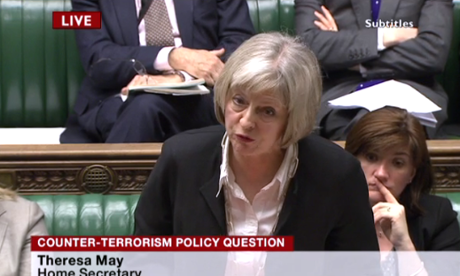
Theresa May is speaking now.
She says she cannot comment on operational matters.
But the threat level is at severe. This means a terrorist attack is highly likely.
The government advises against travel to Syria. Anyone going there is putting themselves in danger.
She lists some of the measures introduced by the government, including the counter-terrorism act. This gives the power to border staff to stop people travelling abroad if deemed suspicious. This power has already been used since the act was passed recently, she says.
The Prevent programme has been placed on a statutory basis, she says.
The government has committed to exit checks. These will be in place by April.
The government is taking robust action.
But tackling extremism is a job for everyone, not just the police and security services, she says.
Updated
Labour’s Yvette Cooper asks for a statement on travel to Syria.
And this is what Lord Carlile, the former independent reviewer of terrorist legislation, said on the subject on BBC Breakfast this morning.
The government should never have abandoned control orders, or at least the relocation power under control orders. It was abandoned for, as far as I can see, merely political reasons against advice on the merits in 2010. If control orders with relocation had been in place, rather than the much weaker and less useful Tpims, as they’re called, I think that Mr Emwazi and certainly two of his associates might well have been subject to control orders with relocation.
Now, the government has acknowledged that mistake by reintroducing relocation now under Tpims, but we need to make sure that those powers are good enough.
Theresa May's statement on Mohammed Emwazi and control orders
Theresa May, the home secretary, is shortly to answer an urgent question from Labour about Mohammed Emwazi and control orders.
Yesterday the Observer said that two members of Emwazi’s terror network absconded after the control orders they were under were replaced with Tpims (terrorism prevention and investigation measures), the less draconian alternative introduced by the coalition. Here’s an extract from the story.
It is understood that three members of Emwazi’s network had been subject in 2011 to control orders brought in by the last Labour government, which meant they had to live outside London. However, those control orders were disbanded by the coalition; they were instead subject to Tpims – terrorism prevention and investigation measures – which allowed them to return to London and re-engage with Emwazi.
Two of the men on these weakened orders – known only as BX and CC in court documents – later absconded. Emwazi fled to Syria shortly afterwards.
[Yvette Cooper, the shadow home secretary,] said: “We need to know whether Theresa May’s decision to ignore all our warnings and weaken counter-terror powers has made it easier to organise and recruit for Isil [Isis].
“Suggestions of possible links between those carrying out atrocities on behalf of Isil [Isis], and those behind the 21/7 planned attack on London, are very concerning.
“It has been clear from the outset that Tpims are too weak, and it is striking that only one person is currently on a Tpim, despite everything we have been told about the increased threat. At the very least, the prime minister should now ask the intelligence and security committee to examine the period following the scrapping of control orders. Parliament needs to know whether the legislation to alter counter-terror powers affected the UK’s ability to prevent known terrorists continuing to develop networks in London.”
Here are two blogs on the housing speech that are worth reading.
We have our concerns about aspects of the Coalition’s approach to housing. Help to Buy, for example, is in effect a mortgage subsidy which too often serves to push prices up still further, and the ConHome manifesto called for it to be ended. We won’t be welcoming Cameron’s decision to extend the scheme still further, therefore – it simply isn’t the best-targeted measure or the best use of scarce taxpayers’ money.
All in all, then, it’s two cheers for this latest outing by the Prime Minister. Placing home ownership, housing supply and the needs of younger people at the centre of the manifesto are all welcome steps – hopefully there’ll also be some exploration of new paths to ownership, as we proposed, before the campaign is out.
On the face of it, the answer to the question “who pays?” for the 20 per cent “subsidy” could be “the local council.” Either that or the new estate will not have the sort of links that are normally required for new housing.
Priced Out dismisses Cameron's plan as 'another short-term gimmick'
I did not know that there was a campaign for lower house prices (don’t tell the Daily Mail), but there is. It’s called Priced Out (it describes itself as a campaign for affordable house prices) and it has published a solid critique of David Cameron’s speech. Here’s an extract. It’s from its director, Duncan Stott.
It is frustrating to see the Conservatives focussing on yet another short-term gimmick. We expect that these starter homes would have been built anyway, so the plan is unlikely to lead to the increase in new homes that we desperately need. By removing the need for developers to contribute affordable homes and community infrastructure, the scheme is likely to ignite more local opposition to housebuilding, thereby stifling housing construction. We also see no plan to ensure that the 20% discount is genuine - there is a real danger that the developer simply inflates the non-discounted price, meaning the supposed discount is just a ploy.
Back to housing, and here’s a comment on David Cameron’s speech from Gavin Smart, interim chief executive at the Chartered Institute of Housing.
We’re currently building less than half the number of new homes we need – the result is a housing crisis in which millions of people are being priced out of a decent home. So we welcome the focus on supply and affordability that the starter homes scheme represents. But we are very concerned about these sites being exempt from section 106 agreements, which usually require social or affordable homes to be built as part of a development, for people on lower incomes. This smacks of building for one group of people at the expense of another. Social housing is critical if we are going to solve the housing crisis – there are always going to be people who can’t afford to buy and we must provide decent, affordable homes for them too. If all the focus is on home ownership, we are never going to build mixed communities.
The actor, Michael Sheen, is best known for playing Tony Blair, but he did not sound anything like the former prime minister yesterday as he delivered a passionate speech at a St David’s Day rally in honour of the NHS and its founder, Aneurin Bevan.
Lunchtime summary
-
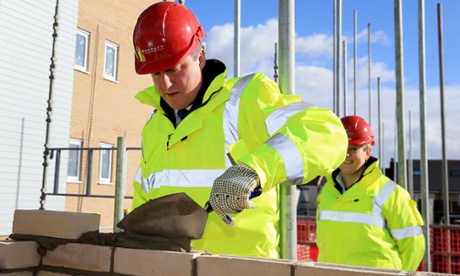
David Cameron and Ed Miliband have been promoting their rival plans to promote housing. In a speech in Colchester, Cameron confirmed that he wanted to enable builders to provide 200,000 cut price homes for builders under 40. But Labour has questioned whether the plans are viable (see 10.36am and 11.33am) and Ed Miliband, speaking at one of his People’s Question Time events in Hove, said Labour’s alternative plans (see 10.36am) would be more effective. Miliband said:
Under this government we are building fewer homes than at any time since the 1920s and record high numbers of families are being forced to rent. For far too many people the dream of home ownership is disappearing into the distance. Labour has a better plan to build hundreds of thousands of new homes, ensure that local first time buyers are given priority and get a fairer deal for millions of families that rent.
Experts have also said that Cameron’s plans would also cut the amount of money available for infrastracture and for affordable housing. (See 10.57am and 12.16pm.)
-
Cameron has dismissed concerns expressed by the head of the US army that Britain is not spending enough on defence. Speaking after his housing speech, he said Britain had the fifth largest defence budget in the world, and the second largest in Nato.
You can see that very specifically today in Iraq, where the second largest contributor in terms of air strikes and air patrols is Britain by a very large margin. You have to add up several other countries to get to the scale of what we are doing, second after the Americans.
But alongside that fact, it’s also worth remembering what is coming out in terms of British equipment in defence in the coming years: we are building two aircraft carriers which will be the biggest ships the Royal Navy has ever had in its possession, we have go the Type 45 destroyers, the hunter-killer submarines, we have just signed the next stage in the order for the Type 26 frigates.
Look at the RAF, a lot of it based in my constituency in RAF Brize Norton. We have got the A400Ms coming on stream, the Voyagers are now refuelling aircraft, brand new aircraft, above the skies in Iraq. You have got the Joint Strike Fighter next to come. So it’s an incredible programme of equipment that will make sure we have some of the most capable armed forces anywhere in the world.
In terms of spending, the promise we have made is that the equipment budget, which is £160bn over the next decade, that will grow by 1% in real terms in each year of the next parliament. We have made that very clear and also we have said we don’t want to see further reductions in our regular armed forces ...
And as for working with the Americans, I know because I spend time with President Obama and others, how much they appreciate the fact that Britain is a very strong and capable partner and able to fight with them, when it’s in our national interest, anywhere in the world.
-
Downing Street has said Cameron still wanted to get net migration below 100,000. Asked if Cameron agreed with Kenneth Clarke, who said the target should be abandoned (see 7.30am), the prime minister’s spokesman said:
You won’t be surprised to know that he takes a different view from Ken on this one. It won’t be the first time that he and Ken haven’t had exactly the same views.
But the spokesman described it as “an ambition”, rather than as a target. He went on:
The ambition remains the right one, but it’s clear it’s going to take more time, more work and more difficult long-term decisions in order to get there.
-
Public sector workers across Northern Ireland are to stage a 24-hour strike in a dispute over budget cuts and jobs. As the Press Association reports, members of the GMB union working in education, the civil service, transport, the Rivers Agency, Forestry Service and Environment Agency will walk out on March 13. Other unions are believed to be considering joining the strike.
Here’s Campbell Robb, chief executive of the housing charity Shelter, on David Cameron’s plans for 200,000 cut-price starter homes.
The bottom line is that you don’t solve an affordability crisis by getting rid of affordable housing.
Our housing shortage has been decades in the making, and all those struggling to cope with expensive and insecure private renting are bearing the brunt.
200,000 homes over the course of a parliament sounds good on the surface, but in reality this is giving with one hand and taking with the other. Removing the requirement on developers to build affordable housing is extremely worrying, and won’t help those currently struggling with sky high housing costs.
Politicians of all parties need to convince voters that they can solve this crisis once and for all. More piecemeal schemes won’t do - we need a big bold plan that will fix our broken house-building market for the long term, and finally put a stable home back within reach for generation rent.
This is from Chris Giles, the Financial Times’s economics editor.
Without being able to peer into David Cameron’s soul, it is hard to know for sure what he felt most passionate about during his speech, but Giles is probably onto something. Cameron certainly did seem at his most animated when he was talking about his children marching over green fields.
David Cameron's housing speech is most passionate...when he is rejecting changes to the green belt #shame
— Chris Giles (@ChrisGiles_) March 2, 2015
I’ve posted a lot of housing graphs today, but this one is worth having too.
Government house-building has tanked since the 70s http://t.co/Mj92Sx3EzF pic.twitter.com/vGfcVSHQyh
— Ampp3d (@ampp3d) March 2, 2015
However, the best graph on housing is probably this one, from a superb (but very long) essay on housing by James Meek in the London Review of Books last year.
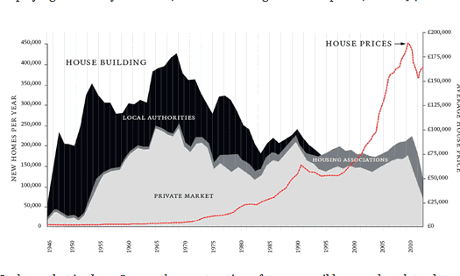
UPDATE at 1.57PM: Actually, Shelter tell me this is their graph.
Updated
Q: Your government has failed to hit its building targets. Why should people trust what you say today?
Cameron says, on the starter home plan, builders are in favour. They want to build these homes.
More generally, local councils have not had incentives in the past to approve housing. Now they do get economic incentives, he says.
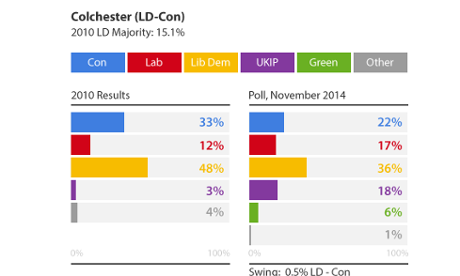
Cameron concludes by saying that Colchester, where he is speaking, could be the difference between having a Conservative government and having a Labour government. He names the Conservative candidate, Will Quince.
Colchester is a Lib Dem seat, with Sir Bob Russell as MP. According to an Ashcroft poll from November last year, Russell is still favourite to win.
The Q&A is over now. I’ll post a summary soon.
Q: How can you reassure people who are worried about seeing green space built over?
Cameron says the government’s plans for neighbourhood planning have given communities more control over building.
Q: What do you say about the concerns raised by the head of the US army?
Cameron says Britain has the fifth largest defence spending in the world, and it is the second biggest contributor to the fight against Islamic State.
And new defence equipment is being build and coming on stream, he says. There is an “incredible” programme of new equipment.
The government is planning to spend £160bn on defence equipment over the next parliament. And spending is due to go up 1% every year.
He says the Americans know Britain is a strong partner.
Q: Housebuilding is lower than it has been for years. Isn’t your policy a failure?
Cameron says housebuilding hit an all-time low since the 1920s in 2009, under Labour. Since then it has been recovering.
Talks to house builders, he says. They say Help to Buy has made a difference. It has got the housing market moving, and even his opponents know that.
Q: In the light of the “Jihadi John” affair, are you planning new legislation?
Cameron says the government has passed two bills on terrorism over the last year. His view is that the government must do whatever it takes. As technology develops, the government must respond, he says. He says he has often said the government must be able to access terrorists’ communciations.
Cameron's Q&A
Cameron is now taking questions.
Q: How will your starter home policy be funded?
This policy will work, says Cameron, because developers and builders are saying they will deliver it.
They can offer a discount because some of the regulatory costs will be cut, he says, such as section 106 agreements.
Cameron says he recently visited a brick factory in Accrington.
That’s a reference to this.
Really? Was one of David Cameron's favourite moments of past 5yrs visiting a brick factory in #Accrington? Really? pic.twitter.com/5O0dLHmOB4
— Joseph Willits (@josephwillits) February 9, 2015
Fifth, says Cameron, he will ensure local people have more control over planning.
He wants to get Britain building, he says. But he is also a prime minister who wants local councils to take decisions about what happens in their areas.
People said neighbourhood planning would block planning. But, on average, neighbourhood plans are leading to an increase in house building, he says.
He says he supports the countryside. Protecting the green belt is paramount. He wants most new housing to be on brownfield land, he says.
He wants his children, and other people’s children, to be able to walk and play on green fields.
Put simply, the green belt is protected with us.
Fourth, says Cameron, the Tories would continue to back right to buy.
It is one of the best Conservative ideas of the last century, because it is about aspiration, he says.
People who criticise right to buy normally do so from the comfort of being a home owner, he says.
Third, says Cameron, the Tories would extend the equity loan part of the Help to Buy scheme until 2020.
People said it would only help people in London. But 90% of people using it are outside London.
And people said it would only help those with homes already. But 80% of people using it are first-time buyers.
Second, says Cameron, the government would build more homes, including new starter homes for first-time buyers under 40.
Insufficient house building has been a problem for years, he says.
But he says the government is making progress towards its target of getting 100,000 homes build a year.
It has reformed the planning system, he says.
If house building continues to increase at the current rate, we will be building 200,000 homes a year not by 2020, as Labour plan, but by 2017.
He confirms the starter home plan, and he says a website was launched this year allowing people to register an interest.
Over 31,000 have already registered for the #StarterHomes scheme. Have you? http://t.co/fLnyvXBjGk
— Brandon Lewis MP (@BrandonLewis) March 2, 2015
Cameron says the Tories are making five pledges on housing.
First, they will keep interest rates low, he says.
The government is managing the economy properly. That is why interest rates are low.
If you compare rates now with what they were in 2010, the saving on a £120,000 loan is worth £155 per month, he says.
David Cameron's housing speech
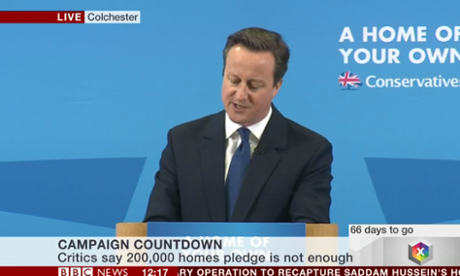
David Cameron is giving his housing speech now.
He says anyone who own a home will remember when they first took ownership.
But too many people are denied this opportunity, he says.
Shelter says Cameron's plan could reduce availability of affordable housing
Shelter, the housing charity, says David Cameron’s plan for cut-price starter homes could actually reduce the amount of affordable housing available. Here’s a blog from Pete Jefferys, a Shelter policy officer, and here’s an extract.
Our main concern from today’s announcement is whether these Starter Homes will be built in addition to existing plans, or whether they will actually cannibalise planned affordable housing. The BBC are reporting that developers will be able to swap affordable housing for Starter Homes on their existing and future plans. Not only would this mean that many Starter Homes won’t be additional (they’ll just be instead of homes that would have been built anyway), but it also swaps a low rent or shared ownership home for a home costing up to £450,000 in London. That’s more than 10 times the average salary in London and even outside, it’s more than average house prices in almost every region.
This would be a massive shift. Instead of councils being able to negotiate genuinely affordable, low rent homes from developers – they would be able to build homes for sale, albeit ones with a discount.
In the most recent year with data (2010/11), the majority (62%) of affordable housing built was from these sorts of planning agreements with developers. If this new proposal simply swaps these low rent and shared ownership homes for much more expensive Starter Homes then people struggling with their housing costs will be worse off, not better.
Updated
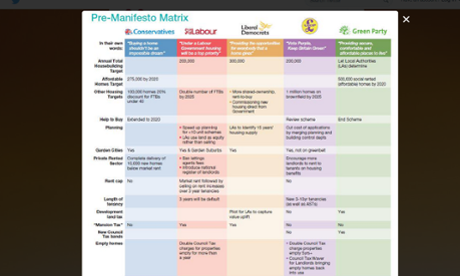
Here it is (for anyone who can expand their screen).
Updated
Faisal Islam, Sky’s political editor, has been using Twitter to argue that all the political parties have failed on housing.
So... Housing policy. A graveyard for both main parties in recent years, despite all manner of policy wheezes...
— Faisal Islam (@faisalislam) March 2, 2015
1. The parliament about to end will be by far the worst on record for housebuilding.... pic.twitter.com/Y0AHjjTVXG
— Faisal Islam (@faisalislam) March 2, 2015
2. numbers include two record low years for housebuilding outside wartime. 10/11 could pin on last govt, not 12/13: pic.twitter.com/ZeLQyyg32c
— Faisal Islam (@faisalislam) March 2, 2015
3. barely reported but important double dip in housebuilding. unsurprising given majority of funding slashed/ planning framework ripped up..
— Faisal Islam (@faisalislam) March 2, 2015
4. But there was the inheritance of a broken banking system, bankrupt housebuilders, and deficit for Govt to contend with in 2010
— Faisal Islam (@faisalislam) March 2, 2015
5. Gordon brown suggested 300,000 homes a year (in England) when he became PM. When he left office, barely above 100k...
— Faisal Islam (@faisalislam) March 2, 2015
6. v latest figures on starts, show hbuilding market is back at about 44k a quarter, for first time since crisis... BoE and help to buy
— Faisal Islam (@faisalislam) March 2, 2015
Those postwar DCLG housebuilding completions lows in a chart (via DB): pic.twitter.com/TIRZ9amy35
— Faisal Islam (@faisalislam) March 2, 2015
Generation Rent, the group campaigning on behalf of those who rent privately, has put forward its own plan to free up some space for housing today.
@andrewsparrow one for your liveblog perhaps? http://t.co/CZcnx8pE18 pic.twitter.com/Cx7z5xrQCx
— Alex Hilton (@alexhilton) March 2, 2015
Labour sources are highlighting further objections to David Cameron’s plan for cut-price starter homes, reinforcing the claim made by Ed Miliband that it’s a “pie-in-the-sky” scheme. (See 10.36am.)
First, they say the costs don’t add up. The Tories say they would fund the 20% discount by removing the obligation on developers to fund affordable housing through section 106 contributions. This would save £15,000 per home, say Labour. And developers would also not have to contribute to local infrastructure through the community infrastructure levy (CIL). This would save £6,000 per home, say Labour. But the average house price in England is £218,000, and so a 20% discount would actually cost £43,000, Labour claim.
Second, Labour say there is nothing in the Tory plans to stop developers creating a supposed 20% discount simply by jacking up prices in the first place, with knock-on effects for the entire housing market and anyone hoping to buy.
Going back to polling projections for a moment, Electoral Calculus have also produced some new figures. Based on polls published in February, they expect Labour to get 301 seats and the Conservatives to get 265.
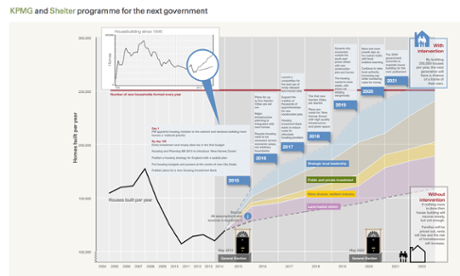
And while we’re on the subject of housing, here’s a summary of a report jointly produced by Shelter, the housing charity, and the consultants KPMG recommending measures the next government should take to improve the supply of housing.
This graphic (if you can read it) highlights the key proposals.
Updated
Chartered Institute of Housing expresses concerns about Cameron's housing plans
David Pipe, policy officer at the Chartered Institute of Housing, has written a useful blog about Cameron’s plans for 200,000 new starter homes. He highlights four potential problems. Here are the first two.
1 - It may be difficult to find suitable sites. The proposals assume that land released for starter homes will be brownfield sites, not already earmarked for housing and available at low cost (in order to enable the 20% discount for the purchaser). However in practice many brownfield sites require expensive work to make them suitable for housing, or may simply not be well suited because of their location or a lack of infrastructure.
2 - The developments may not remain attractive places to live in the long term. In part the 20% discount is intended to be provided through cheap land and the exemption from Section 106 and CIL requirements, but we are concerned that developers will still need to find further cost savings and that this might encourage developments which are high density and/or low spec. Although the government is proposing to set up a new Design Council to encourage and promote good design among starter homes, it would not have any powers to insist on or to enforce the very highest standards. We also know that successful communities include a mix of different property types, sizes and tenures, and are concerned that developments which are built exclusively for young first-time buyers will not have the necessary balance.
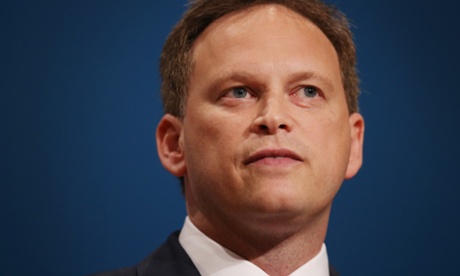
As Patrick Wintour says in his overnight story on David Cameron’s speech, and Ed Miliband says in his statement (see 10.36am), Grant Shapps, the Conservative chairman, failed in an interview yesterday to explain properly who would fund the 20% discount on the new starter homes being promised by Cameron.
Here’s an excerpt from that interview. Shapps was being interviewed by Dermot Murnaghan on Sky.
Murnaghan: But of those 100,000 starter homes with a discount which you say here is going to be at least 20 per cent, then we get into Natalie Bennett territory, have you costed this? The average house price in England and Wales is £180,000 so 100,000 houses, that’s £18 billion worth of housing stock, you’re offering a 20 per cent discount so doing the maths here, £3.6 billion, where are you getting that from?
Shapps: Look, the one thing you know with all our policies because we’ve been …
Murnaghan: But this is about a commercial transaction, presumably these are privately built houses, now somebody is going to take this loss, this 20 per cent loss, so who takes it? It’s not the buyer so who takes it?
Shapps: The way the Help to Buy scheme has worked very effectively over the last couple of years, it’s enabling people to get on to the housing ladder by getting proportionate mortgages which weren’t available in the market, so you’ll recall at one point you couldn’t get a mortgage for more than say 70 per cent of the property value. We are now making that available, with assistance from the government through our Affordable Housing Programme.
Murnaghan: But the £3.6 billion?
Shapps: Look, there has been way more than £3.6 billion put into housing, let me just explain that …
Murnaghan: But you are selling houses on the cheap here, you are selling houses at 20 per cent below market value, it says here in your press release, who is paying the difference?
Shapps: So it’s part of our overall housing programme so if I explain that in the last five years …
Ed Miliband dismisses Cameron's housing plans as 'pie-in-the-sky'
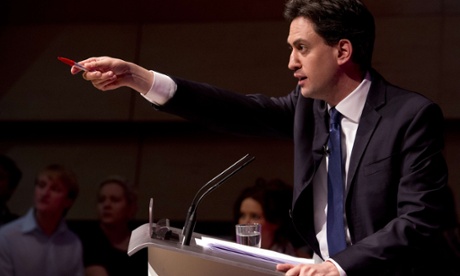
Ed Miliband is holding one of his People’s Question Time events in Hove later this morning. According to remarks released in advance, he will dismiss David Cameron’s plan for 200,000 cut-price starter homes for first-time buyers as an uncosted “pie-in-the-sky” scheme.
Yesterday the Conservative party chairman went on TV in an effort to convince people they had a plan for housing. But instead, he couldn’t answer basic questions about where the money will come from or how their latest pie-in-the-sky scheme will work.
And he will reaffirm Labour’s commitment to building 200,000 new homes every year by 2020 and to control rent increases for private sector tenants.
In contrast, Labour has a comprehensive housing plan, not unfunded promises. Our plan is the first of its kind in a generation. It will build hundreds of thousands of new homes where families want to live, ensure that first time buyers from the area are given priority access rights when these houses go on sale, and get fairer deal for millions of families that rent.
And here’s the Labour party summary of those rent/housing plans.
Labour will ensure fairer rents:
- Legislate for 3-year tenancies giving renters security and peace of mind
- End excessive rent rises by putting a ceiling on rent increases during the new 3-year tenancies
- Ban unfair letting fees, saving the typical tenant £625 over the course of the next parliament and Generation Rent £2.5 billion
Labour will increase the number of new homes built every year to 200,000 by 2020 with priority for first-time buyers by:
- Giving local communities stronger powers to build the homes needed in the places people want
- Getting the public sector back into building
- Tackling land banking through new use it or lose it powers
- Shaking up the housing market by backing SME builders through Help to Build
- Building the next generation of Garden cities
- Granting first time buyers from the area priority access rights when these new homes go on sale.
Updated
Here are today’s polling figures from Populus.
Latest Populus VI: Lab 34 (+1), Con 32 (+1), LD 8 (-1), UKIP 14 (-2), Greens 5 (-1), Others 7 (+2). Tables here: http://t.co/C3wG8HpSXN
— Populus (@PopulusPolls) March 2, 2015
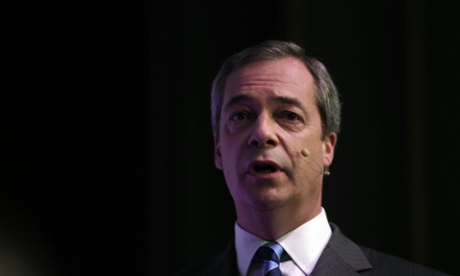
Nigel Farage says he wouldn't be a good prime minister
Nigel Farage was on Good Morning Britain this morning. Here are the key points. I’ve taken the quotes from PoliticsHome.
-
Farage said he wouldn’t be very good at being prime minister. Asked if he was keen on leading the country, he replied:
I don’t think that’s my role in life. I don’t think I’d be very good at it, either.
-
He said that immigration could “enrich” the UK. Rejecting claims that Ukip was anti-immigrant, he replied:
If you control immigration sensibly and do it properly it can be a benefit to the country and it can enrich the culture too – no arguments about that.
Asked to name one area where immigration had improved the UK, he cited food.
Just look at the food. I’m just about old enough to remember when it was awful, when going out was really quite difficult.
-
He said his family wished he had never gone into politics.
To be honest with you, I think my whole family would rather I’d never gone into politics, I’d stayed doing what I was doing. I can’t even pretend to have a normal family relationship at this moment in time, because I don’t.
-
He said his one word assessment of David Cameron, Nick Clegg and Ed Miliband would be “vanilla”. His assessment of himself would be “marmite”, he said. “Some people love it.”
I’ve posted a clarification to my earlier post about election projections to make it clear that I was not suggesting the Lib Dems definitely would vote with the Conservatives against Labour after the election; I was just floating that as a possibility. See 9.26am.

The Electoral Commission has launched a new Facebook advertising to encourage 18-year-olds to take part in the election. It says an analysis of the 1 December 2014 electoral registers found that there had been a 33% fall in the number of ‘attainers’ (16 and 17 year olds) on the registers compared with figures published in February/March that year. This is from Michael Abbott, the commission’s head of campaigns.
We saw at the Scottish Independence Referendum that young people can be one of the most passionate and engaged groups in our democracy, but they need to know that they can only have a say if they’re registered. Turning 18 is an important rite of passage for young people, and gaining the right to vote in a General Election year is a huge part of that.
Looking at projected seat numbers (see 8.28am and 8.48am), the normal question that arises is which party leader could get a majority.
There are 650 seats in the House of Commons. A crude calculation suggests you need 326 votes for a majority. But given there are five Sinn Fein MPs who do not take their seats, a speaker and three deputy speakers, in practice there are 641 voting MPs, and so actually you need 321 votes for a majority.
Rather than looking at whether David Cameron or Ed Miliband could put together a coalition that can command a majority, it might be more useful to think in terms of whether there is a majority against them. Because if Cameron or Miliband can’t get a Queen’s Speech motion passed the Commons, they can’t form a government.
Labour would vote against a Cameron Queen’s Speech and it’s almost inevitable that the SNP would too. All four forecasts/projections suggest that Miliband would be able to block a Cameron Queen’s Speech
Anti Cameron vote
Guardian: 322 (Labour and SNP)
Fisher: 323 (Labour and SNP)
Election Forecast: 321 (If you included SDLP and Plaid Cymru, who would almost certainly vote against the Tories, as well as Labour and the SNP)
New Statesman: 327 (Labour and SNP)
I have not made allowance for that Labour would probably provide two deputy speakers, meaning that in practice that two seats would need to be deducted from their total. But, equally, some of the minor parties like the Greens or Respect would almost certainly vote with Miliband against a Tory Queen’s Speech too.
The same figures suggest Cameron would be unable to put together a majority to block a Labour Queen’s Speech.
Anti Miliband vote
Guardian: 314 (Conservatives, Lib Dems, Ukip and DUP, who I’m assuming would get eight seats)
Fisher: 313 (Conservatives, Lib Dems, Ukip, DUP)
Election Forecast: 320 (Conservatives, Lib Dems, Ukip, DUP)
New Statesman: 308 (Conservatives, Lib Dems, Ukip, DUP)
UPDATE AT 9.47AM: I’m not saying the Lib Dems definitely would vote with the Conservatives after the election; in fact, I think it’s more likely than not that they wouldn’t. But I’ve included them because it is conceivable that they could vote with the Tories against Labour. I’m sorry I did not make that clear earlier.
Updated
And here are some other election forecasts/projections.
From Steve Fisher at Elections Etc
Labour: 283
Conservatives: 279
SNP: 40
Lib Dems: 23
Ukip: 3
Greens: 1
Conservatives: 284
Labour: 279
SNP: 37
Lib Dems: 27
Ukip: 1
Greens: 1
(These are both academic forecasts, using models that look at current polling and take into account poll trends in the run-up to an election)
From the New Statesman’s May 2015
Conservatives: 271
Labour: 271
SNP: 56
Lib Dems: 25
Ukip: 4
Greens: 1
(This is a projection based on current polling, but taking into account Lord Ashcroft’s seat by seat polling.)
Today's Guardian seat projection - Tories 275, Labour 271
The Guardian has started publishing a daily seat projection for the next House of Commons, based on what the polls are saying, based on national and local polls, with adjustments. Alberto Nardelli launched the project on Friday, and he explains his methodology here.
Conservatives: 275
Labour: 271
SNP: 51
Lib Dems: 27
Ukip: 4
Greens: 1
There are 66 days to go until the general election.
Here’s today’s “election fact” from the Press Association.
Universities returned their own Commons representatives until 1950. Oxford, Cambridge and Combined English Universities each had two Members. The University of Wales, Queen’s Belfast and London had one each and Combined Scottish Universities three. The granting of representation to universities was pioneered by King James I in 1603. Graduates comprised the electorate. Over the years university MPs included many big names. Among them were later prime ministers Sir Robert Peel and William Ewart Gladstone at Oxford and Cambridge’s Sir Isaac Newton, thought by some to be the greatest scientist of all time. More recently AP Herbert, author of Misleading Cases, sat for Oxford until the seats were abolished. He piloted the Matrimonial Causes Bill, a major divorce law reform, through the House.
Ken Clarke says Cameron's migration target 'a mistake'
And the Times has got a story quoting two Conservative former ministers saying David Cameron should drop his target (which he’s repeatedly missed) of getting net migration below 100,000.
This is what Kenneth Clarke, a former home secretary, told the paper:
I am afraid that the net migration target has proved to be a mistake. It has been defended to me as almost returning to the figures to those when I was home secretary. This is true, but we weren’t in a globalised economy then to the extent we are now.
We will have to drop the target. It would not be possible to achieve it without damaging our economy quite severely.
And this is what Lady Warsi, the former Conservative chairwoman, said:
If you set yourself unrealistic targets you are setting yourself up to fail, and, in the long term, turn the whole thing into a bigger issue by fuelling the perception that the government can’t get a grip.
American army chief says US ‘very concerned’ about British defence cuts
Monday's Telegraph front page: US military chief: Britain cannot cut more troops #tomorrowspaperstoday #bbcpapers pic.twitter.com/NbNbQJ4Dwx
— Nick Sutton (@suttonnick) March 1, 2015
There’s a good story on the front page of the Daily Telegraph. They are splashing on an interview with General Raymond Odierno, the head of the US army. He says the Americans are very worried about British defence cuts.
Here’s an excerpt.
Gen Odierno disclosed that the cuts have forced the US to undertake an urgent review of how British troops could fight alongside their forces in future conflicts. “I would be lying to you if I did not say that I am very concerned about the GDP investment in the UK,” he said.
Referring to the recent conflicts in Iraq and Afghanistan, he said: “In the past we would have a British Army division working alongside an American division. Now it might be a British brigade inside an American division, or even a British battalion [approximately 1,000 soldiers] inside an American brigade.
“We have to adjust our programme to make sure we are all able to see that we can still work together.”
Updated
Here’s Patrick Wintour’s preview story about David Cameron’s speech. And here’s how it starts.
David Cameron will announce on Monday he wants 200,000 cut-price starter homes to be built for young first-time buyers in a scheme branded by some industry insiders as “RyanAir housing”.
The homes will be funded by lifting obligations on house builders to also provide affordable homes or build new infrastructure, such as roads or health services.
Cameron’s target doubles his plan announced last year to build 100,000 starter homes and comes as Ed Miliband prepares to re-emphasise a rival Labour plan to get young people on to the housing ladder.
The starter homes would be sold at a discount of 20% and the purchasers would not be allowed to sell them at full market value for at least five years, although they may be entitled to rent them out. They would largely be built on brownfield sites, previously used for industrial or commercial purposes and not already earmarked for housing.
David Cameron is giving a speech on housing today. But if the news does not fill you with great excitement, you’re probably not alone. According to James Forsyth in the Mail on Sunday yesterday, even Cameron himself is finding the election campaign a bit dull.
In his more candid moments, David Cameron admits the Tory General Election campaign isn’t the one he dreamed of. He has even confessed to allies it might be a bit boring.
Why? Because there is virtual radio silence on two of the things that he is most passionate about: the ‘big society’ and National Citizen Service, drowned out by the relentless focus on the Tories’ long-term economic plan and their argument that the choice is between competence with them and chaos with everyone else.
Cameron has decided that ignoring some issues that are closest to his heart is a price worth paying. In private, he has pointed out to supporters that, in 2010, he ran a campaign that put the ‘big society’ front and centre and produced new, exciting ideas every week.
But it just didn’t work: the Tory vote went backwards during the campaign. So, this time, he has decided to run with the issues that the research tells him will be most effective.
Still, I’m not going to be deterred. I’ll be covering the housing spech in detail.
Here’s the agenda for the day.
Morning/afternoon: Cameron gives a speech on housing.
1.30pm: Oliver Letwin, the Conservative minister for government policy, gives a speech at the launch of the Localis report on Local Enterprise Partnerships.
2.30pm: Nicky Morgan, the education secretary, takes questions in the Commons.
As usual, I will be also covering all the breaking political news from Westminster, as well as bringing you the most interesting political comment and analysis from the web and from Twitter. I will post a summary at lunchtime and another in the afternoon.
If you want to follow me on Twitter, I’m on @AndrewSparrow.