Summary
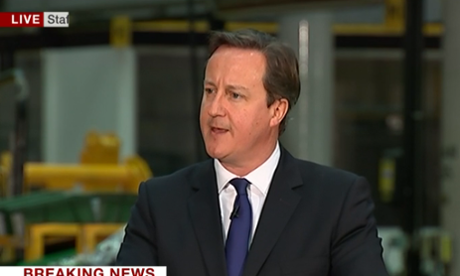
- David Cameron has said his plan to curb immigration from Europe would require changes to EU treaties. As Patrick Wintour reports, the admission, which will concern many EU countries, came as the prime minister set out measures to ban immigrants from receiving state benefits, including tax credits and social housing for a minimum of four years. But he held back from calling for a quota on EU immigrants, insisting he believed in the principle of the free movement of workers, an admission likely to be seen as a climbdown from earlier plans considered within Downing Street. The initial response from Tory Eurosceptics was muted. The full text of the speech is here, on the Conservative party website. And here’s a summary of his proposal on Facebook.
- The European Commission has said Cameron’s plans should be considered “calmly and carefully”. (See 1.36am) Generally, so far, the reaction to the speech across Europe has been non-committal, although the Czech Europe minister has used Twitter to point out that Czech airmen in World War Two did not have to wait four years to serve with the RAF. (See 2.24pm.)
- Ed Miliband has said Cameron has no credibility on immigration. (See 11.48am.) Labour has argued that its plans for dealing with immigration would be more effective. (See 1.57pm.)
-
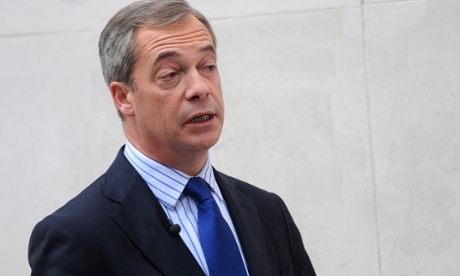
Nigel Farage, the Ukip leader, has accused Cameron of trying to deceive the British public by pretending to be able to control immigration while remaining in the EU. (See 11.56am.)
That’s all from me for today.
Thanks for the comments.
John Baron, a Conservative MP, has said that he thinks David Cameron’s speech has not addressed the key problem created by immigration.
The danger of [Cameron’s] approach is that we are feeding into the narrative linking immigration to our benefits system. Any benefit reforms are welcome, but in my experience the vast majority of immigrants are genuinely seeking work rather than benefits.
The main concern remains the pressure large-scale immigration puts upon our already overstretched public services. I am not convinced the prime minister’s comments directly address this central issue, even if one overlooks the practical hurdles and possible opposition from other EU member states.
This is a tweet from Tomas Prouza, the Czech Europe minister.
These Czechs "worked" in the #UK for less than four years. No benefits for them? #CameronOnMigration pic.twitter.com/hBAW4b0Xwd
— Tomas Prouza (@CZSecStateEU) November 28, 2014
I picked this up from this very good Open Europe blog, rounding up European reaction to David Cameron’s speech.
Updated
Bright Blue, a thinktank promoting liberal conservatism, has welcomed David Cameron’s speech. This is from its director, Ryan Shorthouse.
The prime minister’s immigration speech was pragmatic not populist, rightly showing clear blue water with UKIP’s anti-immigration agenda. Two important arguments were made. First, he argued strongly and passionately that immigration has been largely beneficial for Britain both economically and culturally. Second, he has recognised - after the failure to achieve the net migration target - that it is important to make promises on immigration that he can keep. Changing the EU principle of the free movement of people is not possible or desirable, and so he rightly committed the UK to this principle.
The debate on immigration should move away from figures to fairness. The majority of people in this country believe that fairness is about being rewarded when you have contributed. There is popular support for Cameron’s commitment to making EU migrants wait some years until they have contributed before they can claim benefits. We can and should go further in making our welfare system more contributory.
Today, Bright Blue launches its new report, Give and take: how conservatives think about welfare. One of our policy recommendations is to give more money through a Contribution Supplement in Universal Credit to those claimants who have worked for longer and have longer National Insurance records. To assure the public that our immigration and welfare systems are effective and fair, we should be recognising contribution in them a lot more.
Nick Clegg has said that there are “very serious question marks” about some of David Cameron’s plans, but that others are sensible.
I think some of the ideas from David Cameron are sensible and workable. There are some very serious question marks about whether others will ever really happen in practice and whether they are deliverable. I’ve always said the freedom to move around Europe is not the same as the freedom to claim. That’s why we’ve introduced a number of changes in this Government to tighten up the benefit rules and I’ve made a number of further proposals.
I think the danger for the Conservatives is that they repeat mistakes of the past, where they’ve over-promised and under-delivered on immigration, as they did on the net immigration target, which they’ve missed, and that does a great deal of damage to public confidence in the immigration system. That’s why I think it’s always important to focus on changes which are workable, credible, and deliverable in practice.
As an example of of one of the Cameron proposals that may be unworkable, a Lib Dem source cited the proposal to make EU jobseekers leave the UK if they do not get a job after six months.
David Cameron's speech - A reading list
Here are some blogs on the speech that are worth reading.
David Cameron’s dispiriting rhetoric on immigration is about as far removed from Obama’s compassionate reminder that America was built on immigration and will continue to thrive on immigration as it is possible to get.
His latest contribution is simply accelerating a race to the bottom between the three main parties over how swiftly they are prepared to push for the removal of the welfare safety net from a marginal number of low-paid and jobless European migrants in Britain.
David Cameron's speech - Labour's response
Here’s the most considered response to the David Cameron speech I’ve seen from Labour. It’s a lengthy statement from Yvette Cooper, the shadow home secretary. Here’s how it starts.
David Cameron’s “no ifs, no buts” net migration target is in tatters. There have been weeks of posturing, pandering and making more promises he can’t keep - all of which he has been forced to abandon today. Instead we need a practical plan, as Labour has set out, to make sure that immigration is controlled and managed so the system is fair.
In Berlin Angela Merkel, the German chancellor, has not commented on the speech.
No comment from merkel re Cameron speech. Fair to assume relief that no demand for cap. Spiegel online headline 'Cameron blackmails EU'
— jenny hill (@jennyhillBBC) November 28, 2014
But Der Spiegel is accusing David Cameron of blackmailing the EU.
"Cameron blackmails the EU": front page of @DerSPIEGEL right now. http://t.co/rvqn5LZ8sl
— Tom Nuttall (@tom_nuttall) November 28, 2014
Viviane Reding, a MEP from Luxembourg and a former European commissioner for justice, has used Twitter to criticise David Cameron for his speech.
#cameronspeech casts doubts over fundamental right to #freemovement. #EU shouldn't turn blind eye to attempts to negate 60y-old principles
— Viviane Reding (@VivianeRedingEU) November 28, 2014
Question is simple: does UK want to stay within #SingleMarket? If yes, they need to comply with all the rules that go with it #cameronspeech
— Viviane Reding (@VivianeRedingEU) November 28, 2014
In his Q&A David Cameron criticised the Lib Dems for being unwilling to tackled immigration. He said:
I have been in a coalition government with a group of people who are not knowingly enthusiastic about controlling immigration. For instance the changes we have just made, which are important - saying we are going to make it more difficult to get a driving licence, to get a bank account, to get a council house, to have privately-rented accommodation - that was like pulling a tooth.
I got it through, and it is coming into place. But, for instance, the checks I want private landlords to make, they start in the next couple of weeks in the West Midlands. I want them to be all over the country tomorrow but I’m in a coalition and sometimes that is frustrating, trying to bring the brethren who care less about these issues along with you.
On Twitter Sean Kemp, a former aide to Nick Clegg, has retaliated. He argues that Cameron’s claim that the state of the EU economy was to blame for his not meeting his “net EU migration below 100,000” target (see 10.35am) was implausible.
David Cameron made his 'no ifs...' pledge in 2010. Is he honestly saying he couldn't see EU economic problems at that point?
— Sean Kemp (@Sean_Kemp) November 28, 2014
European Commission says Cameron's plans should be discussed 'calmly and carefully'
The European Commission has said David Cameron’s plans should be discussed “calmly and carefully”. This is what the commision’s chief spokesman, Margaritis Schinas, told a news conference when asked if the Cameron proposals would be allowed under EU rules.
These are UK ideas and they are part of the debate. They will have to be examined without drama and should be discussed calmly and carefully. It is up to national lawmakers to fight against abuses of the system and EU law allows for this.
Lord Green of Deddington, aka Andrew Green, the MigrationWatch UK chairman, has broadly welcomed the speech.
We welcome the prime minister’s speech in which he reaffirmed his commitment to a net migration target. Without measures taken so far, net migration would undoubtedly be even higher than its present level.
That said, there is much more to be done. Restricting access to in-work benefits is welcome and will be perceived as fair by the public although it is difficult to say what impact this will have on numbers. The taxpayer cannot go on subsidising employers that rely on low-paid overseas labour for their business model.
We also welcome the commitment to reform the absurd and much abused rule that makes it easier for an EU national to bring their non-EU spouse to the UK than it is for a Brit to do the same.
The Labour MP David Lammy has accused David Cameron of ramping up the rhetoric on migration.
Just a little reminder, on the back of Cameron ramping up the rhetoric on immigration, that a third of all nurses in London are immigrants.
— David Lammy (@DavidLammy) November 28, 2014
But Sunder Katwala, director of the British Future thinktank and a former Fabian Society general secretary, has accused Lammy of misreading the speech.
@DavidLammy Not sure he did. Essentially you are in agreement on free movement, I think, so need to cooperate on it http://t.co/CWxNPUekh0
— Sunder Katwala (@sundersays) November 28, 2014
Labour’s line on the speech has been at times confusing. On the Daily Politics Rachel Reeves, the shadow work and pensions secretary, seemed to be arguing both that David Cameron was pandering to Ukip and the right (the argument Pat McFadden is advancing in his Cif article - see 9.30am), but also that, in proposing curbs to in-work benefits for EU migrants, Cameron was just following an idea already floated by Labour. A Labour spokesman later clarified this position. Cameron’s pandering to the right came a few weeks ago, when Number 10 floated plans to impose a quota on EU migrants ahead of the Rochester byelection, the spokesman said.
We have now found that, having marched his troops all the way up to the top of the hill, Cameron has marched them back down again.
Labour is also saying that Cameron can’t be trusted on immigration because he has broken his promise to get it below 100,000. This is the line that Ed Miliband used in his soundbite on this issue (see 11.48am), and at least this has the benefit of simplicity.
Damian Green, the Conservative former Home Office minister and one of the most pro-European figures in the party, has welcomed David Cameron’s speech.
Sensible realistic and pragmatic remarks on Europe and immigration from PM. Being in a reformed EU best for Britain.
— Damian (@damiangreenmp) November 28, 2014
Most of them would, he says. And that means Cameron would probably have to compromise.
A crucial factor in determining what is politically realistic is the nature of the current EU legal rules. Where Cameron’s proposals reflect the status quo, they are obviously realistic. Where they would require EU legislative change, they will require only a qualified majority of EU Member States in favour, plus a proposal from the Commission and agreement of the European Parliament. But where would need an EU Treaty amendment, they would have to be agreed by all Member States and ratified by each national parliament. That isn’t impossible, but it won’t be very easy; and it means that Cameron will more likely have to compromise on the proposals made today.
Jonathan Portes, director of the National Institute of Economic and Social Research, has posted this graph with figures for how many East Europeans are claiming tax credits.
Impact of today's proposals? E. European migrants claiming tax credits, by year of arrival by @StrongerInNos pic.twitter.com/ECjPOAAr0F
— Jonathan Portes (@jdportes) November 28, 2014
My colleague Rafael Behr has been tweeting on the speech.
Cam using same line on immigration target as deficit: right plan, taking longer than expected, need more time. The cowboy builder's pitch.
— Rafael Behr (@rafaelbehr) November 28, 2014
Speech seems well calibrated for party though. Only militant Cam-hating Tory MPs will be dissatisfied and they'll prob stay quiet today.
— Rafael Behr (@rafaelbehr) November 28, 2014
My Twitter is broken. Not picking up that flood of exuberant Tory MPs cheering PM's new line on Europe and immigration.
— Rafael Behr (@rafaelbehr) November 28, 2014
Somewhere in that speech is dawning realisation that hardcore anti-immigration voters not coming back; needs to tack back to Euro-pragmatism
— Rafael Behr (@rafaelbehr) November 28, 2014
Jacob Rees-Mogg, the Eurosceptic Conservative MP, has been giving interviews about the speech. He has been positive about it, but partly because he welcomes David Cameron’s hint that he could advocate an out vote in a referendum.
And he thinks imposing a cap on EU migrants (see 11.39am) is not off the agenda. According to PoliticsHome, he told BBC News:
[The speech] sets out some of the important steps that will need to be taken in any renegotiation and that the prime minister is willing, if he doesn’t get what he wants, to leave the European Union. And that’s a big step forward …
I think it’s a good thing that he set out the problem so clearly, so precisely; has set out what he thinks is needed to solve the problem. I don’t think it would be impossible to add a cap in at a later stage. We’ll have to wait and see.
Often the best way to judge a speech is by the reaction; does it annoy or delight the right people? On that basis, this was a pro-European speech.
British Influence, the pro-European pressure group, likes it. (See 12.16pm.) But Business for Britain, a much more Eurosceptic pressure group, is disappointed. This is from Matthew Elliott, its chief executive.
The PM has set out significant reforms that deserve serious consideration. However, following yesterday’s migration statistics, the public will be hoping the government acts sooner rather than later. For aspects that don’t require approval of other EU member states the government should act now, to show they are capable of delivering real change.
Immigration policy is of great concern to voters, so rebuilding confidence in it is a key aspect of winning public support for the new renegotiated deal. After a long wait, we have our first red line, but it is only a starting point and we will see how the EU reacts to these proposals. In other areas of EU reform though, the PM will have to be far more ambitious.
Green party says Cameron should not be presenting immigration as a problem
Natalie Bennett, the Green party leader, says David Cameron should not be presenting immigration as a problem.
This is a speech addressing non-existent problems - the government has not been able to produce evidence of systemic ‘benefits tourism’ or ‘health tourism’.
We have major problems in Britain with low wages, with housing shortages and high costs, with crowded schools and hospitals. These are not caused by immigration, but by failures of government policy. An inadequate minimum wage, inadequately enforced, is a key issue. Another is housing policy - continuing the privatisation policy that is Right to Buy, failing to allow councils to borrow to build new council homes, encouraging runaway private sector rents. And the NHS needs investment, schools need to be brought back under local authority control to allow sensible planning and resource use. These are the issues Mr Cameron should have been talking about today to address the real needs of Britain, instead of choosing to pander to the electoral priorities of Ukip.
Tory Eurosceptics won’t be happy; British Influence, a pro-European pressure group, has welcomed the speech. This is from its director, Peter Wilding.
This is a speech which brings the PM back from the brink. He didn’t give in to the self-harming negotiating strategy whispered by the ‘outers’ on his backbenches. He spoke for a positive, engaged Britain.
Britain’s partners share our concerns on immigration. Many have welfare systems which are tougher than ours. And even though there will be tough negotiations ahead on the detail of these plans they are not unsympathetic to the PM’s position.
My colleague Alberto Nardelli has been looking at the financial impact of today’s proposals from David Cameron. He quotes one estimate saying the savings that would be achieved from these measures “are likely to be at most a few hundred million on an overall UK tax credit bill of about £30bn.”
SNP says Cameron's speech is 'depressing and alarming'
The SNP says David Cameron’s speech is “depressing and alarming”. This is from the SNP MP Pete Wishhart.
This long awaited speech from David Cameron is both depressing and alarming. By using the language of ‘ruling nothing out’ if his negotiations with the EU fail, he is making it absolutely clear before he has even started talking to EU leaders that he is edging the UK closer and closer to the exit door. He has now made it explicit that he is prepared to lead the UK out and that means Scotland could be removed against our will ...
It is yet another example of the Westminster establishment pandering to Ukip’s agenda and adopting the language of Nigel Farage - it is aimed at calming Cameron’s panicking backbenches. He is casually jeopardising Scotland’s future in the EU and all because he is terrified of the advance of the Ukip– it is not leadership, it is the absolute opposite.
Open Europe says Cameron wrong to say his plans require EU treaty change
In his question and answer session David Cameron said that getting the EU to agree the welfare changes he wanted would require treaty change.
In its response to the speech, Open Europe, a thinktank which has been pushing for EU migrants to lose access to in-work benefits (but for three years, not four as Cameron proposed), says that it does not think treaty change is necessary.
But it backs the plans. This is from its chairman, Lord Leech.
The prime minster has struck exactly the right balance between preserving the benefits of free movement of workers to the UK economy and ensuring that that the system is fair for the British public. This would both respect the right of free movement and protect British low-wage workers ...
This is a pragmatic solution that must be part of our future negotiations with our EU partners. It is one that should win favour with European leaders who increasingly recognise that their electorates too demand reform and that public support for the EU is at an all-time low.
Nigel Farage accuses Cameron of 'trying to deceive the British public'
Here’s the full quote from Nigel Farage, the Ukip leader, on the Cameron speech.
Even the Labour party managed to apologise for mass immigration being way over expectations. We heard none of that. What we saw was a prime minister playing catch up, once again behind the curve, very scared of the Ukip vote, realising he’s out of touch. It’s taken him ten years, ten long years to understand the scale of the problem with in-work benefits.
I am pleased that he said what he said, but of course, that would be considered to be discriminatory, there will be countries like Poland who take Britain to the European Court of Justice, whose job is to uphold the treaties.
The most significant thing is that the prime minister right through the speech used the world ‘control’. Once again, it’s a prime minister, I am afraid, trying to deceive the British public. The fact is, while he may have taken away, potentially, one or two of the pull factors, you cannot control immigration as a member of the European Union because we have total open borders with the other member states. The prime minister himself said that is something he isn’t going to challenge.
I’ve taken the quote from PoliticsHome.
Updated
Simon Walker, the director general of the Institute of Directors, has welcomed David Cameron’s proposals.
David Cameron rightly says that there are no simple solutions to what has become a politically disruptive issue. IoD members have welcomed - and benefited from - immigrants from other EU member states who work diligently and effectively, often in jobs for which there are few British applicants.
But business cannot be deaf to broader public concern. There is genuine disquiet about pressure on schools and hospitals in many parts of the country. It is important that all immigrants come to the UK with a purpose and a willingness to contribute productively to the community.
The IoD wants to see hard-working and able European workers growing the British economy. That is not the same as extending an already-debilitating benefits culture to those entering the country.
Tough though it will seem, public concerns about immigration have been effectively answered by this package.
UPDATE: After I tweeted a link to this post, using the line in the final paragraph, Ben Page from Ipsos MORI tweeted me to say the IoD was wrong.
@AndrewSparrow well no. Problem is for considerable proportion large scale immigration is bad per we. Most pre 1990 immigrants say too many
— Ben Page, Ipsos MORI (@benatipsosmori) November 28, 2014
Updated
Ed Miliband says Cameron has no credibility on immigration
Here’s the full quote from Ed Miliband on David Cameron’s speech.
David Cameron has absolutely no credibility on immigration. This is somebody who made a promise at the last general election. He said ‘No ifs, no buts, we will get net migration down’ and it’s gone up.
He actually said ‘Kick us out in five years if we don’t deliver’. Well, I certainly agree with that.
Honestly, David Cameron has no credibility on immigration and, frankly, people aren’t going to believe his new promises when he has broken his old promises.
And, on the subject of “no ifs, no buts”, the Sunday Times’s Tim Shipman has a good stat.
Amusingly, Cameron's speech contains 35 ifs and 44 buts...
— Tim Shipman (@ShippersUnbound) November 28, 2014
Cameron's immigration speech - Snap verdict
Snap verdict: What was remarkable about David Cameron’s speech was what was not in it. Over the last few weeks there have been speculation about Cameron demanding quotas for EU migrants, or perhaps the use of the emergency brake procedure to keep EU migrants out (an idea Sir John Major proposed), but, from what he said today, there was not the slightest hint that these ideas have even been on the agenda. The speech was measured, rather than confrontational, and even his line about ruling nothing out in the event of not getting his way (see 10.33am) was different in tone from today’s Telegraph splash headline, “I’m ready to lead Britain out of Europe if migrant reforms fail”. The speech was also notable for the long passage at the start stressing the contribution that immigrants have made to Britain. “We are Great Britain because of immigration, not in spite of it,” he said. Although his proposals to ban EU migrants from getting in-work benefits for four years sound drastic, they are not dramatically different from ideas that have already been floated by Labour and the Lib Dems and it is well short of what the Sun has been demanding in its “Draw a red line on immigration or else” campaign”. The Sun has reported on the speech relatively neutrally this morning, as if it has not yet decided whether to commend Cameron for adopting its policy (which he hasn’t), or lambast him for being feeble.
It’s also worth pointing out how Cameron’s plans for the EU renegotation have changed. In an article in the Sunday Telegraph in March, he highlighted seven priorities, only two of which related to immigration. Now the renegotation seems to be entirely about immigration.
Has Cameron got much chance of getting what he wants from the EU? It is too early to know for sure, but it does not seem impossible.
But will this counter the threat from Ukip? Faced with a threat from populist insurgents, political scientists argue that mainstream parties have three options: Hold (fight what the insurgents are saying); Defuse (remove the problem fuelling insurgent support); or Adopt (copy their ideas wholesale). Cameron’s speech is mostly in the Defuse territory, although there was a splash of Hold at the start of the speech. It is certainly a considered, serious response, but Ukip’s rise is not simply driven by migration and, even if it were, as Sir Gerald Howarth said earlier (see 9.13am), people want action now. Don’t expect Ukip’s poll ratings to fall anytime soon.
Updated
Ed Miliband says that David Cameron has no credibility on immigration.
People aren’t going to believe his new promises when he’s broken his old promises.
Nigel Farage, the Ukip leader, says it would have been nice to have had an apology. Speaking on BBC News, he says even Labour has apologised.
It has taken David Cameron 10 years to realise how serious this problem is, he says.
He says Cameron talked about “control”. But you cannot control EU migration while you are a member, Farage says.
Q: Why has non-EU migration reached 160,000?
Cameron says the government has taken various steps to cut non-EU migration. But there are “huge pressures” on the system.
That’s it. Cameron says he has got to leave now to go to the funeral of his uncle, Sir William Dugdale, who fought at Anzio, rode a horse in the Grand National and was chairman of Aston Villa.
Q: Can Andrew Mitchell return to government? And does PC Toby Rowland deserve an apology?
Cameron says it is never right to be abusive to be a police officer. We have had a court case. We should accept the verdict and move on.
Q: Open Europe research shows that, even without tax credits, Poles and Bulgarians will still have an incentive to come here.
Cameron says reducing in-work benefits would make a considerable difference.
Q: Will this require EU treaty change?
Yes, says Cameron. There is a debate about how much treaty change. But there is no doubt in his mind that treaty change will be required.
Q: [From Quentin Letts - Cameron says he never normally takes a question from a sketch writer] Why has this taken so long? This is like an aching tooth. If you had acted earlier, Ukip would not have done so well.
Cameron says he has taken measures on immigration. But he is in a coalition government with a party that is not enthusiastic about taking steps to curb migration.
For example, the Lib Dems were reluctant to agree the migration measures just coming into force now, he says.
He says he wants to be prime minister after 7 May. But he does not want to be elected on promises that cannot be kept. These measures are achievable, he says.
Q: What will business leaders feel about losing a supply of cheap labour?
Cameron says he looks forward to having a debate with business about this.
But he does not see these proposals as a threat.
Q: What new controls are you proposing?
Camerons says the biggest control is to reduce the massive incentive that in-work benefits provide. They can be worth £8,000 a year, he says.
He says this is simple to explain to people coming from the EU.
If you come here and do not get a job, you will not get unemployment benefit.
And if you do get a job, you won’t get in-work benefits for four years.
And, even after four years, if your children are living abroad, you won’t get child benefit for them.
He says he will go to Europe and what he is proposing is “plain, decent, reasonable common sense”.
The overwhelming majority of British people will support him, he says.
Q: You say you rule nothing out if you do not get what you want. Does that mean you would be prepared to advocate leaving the EU?
Cameron says it means what it says. Changing welfare rules is absolutely crucial to his renegotiation.
He does not want to fail. He does not expect to fail. But, if he does fail, he will rule nothing out. He will hold a press conference like this and tell people what he recommends.
Nothing, absolutely nothing, is ruled out.
Cameron's Q&A
Cameron is now taking questions.
Q: Will you apologise for not meeting your promise to get net migration below 100,000?
Cameron says, when he made that promise, he did not know that the EU economy would perform so badly.
Cameron says he rules nothing out if he does not get his way in the renegotiation
Cameron says he does not want to leave the EU.
Those who say we would certainly be better off outside the EU only ever tell you part of the story.
Of course we would survive, there is no doubt about that.
But we would need to weigh in the balance the loss of our instant access to the single market, and our right to take the decisions that regulate it.
And we would of course lose the automatic right for the 1.3 million British citizens who today are living and working elsewhere in Europe to do so.
That is something we would want to think carefully about giving up.
But he does not rule it out.
If you elect me as Prime Minister in May, I will negotiate to reform the European Union, and Britain’s relationship with it.
This issue of free movement will be a key part of that negotiation.
If I succeed, I will, as I have said, campaign to keep this country in a reformed EU.
If our concerns fall on deaf ears and we cannot put our relationship with the EU on a better footing, then of course I rule nothing out.
But I am confident that, with goodwill and understanding, we can and will succeed.
Cameron says the EU is built on 'a gift for compromise'
Cameron says the EU needs to compromise.
Across the European Union we are seeing the frustrations of our citizens, demonstrated in the results of the European Elections.
Leadership means dealing with those frustrations, not turning a deaf ear to them.
And we have a duty to act on them, to restore the democratic legitimacy of the EU.
So I say to our friends in Europe. It’s time we talked about this properly. And a conversation cannot begin with the word “no”.
The entire European Union is built on a gift for compromise, for finding ways round difficult corners, for accepting that sometimes we have to avoid making the perfect the enemy of the good.
People say free movement is a fixed principle, he says.
It will be argued that freedom of movement is a holy principle – one of the four cardinal principles of the EU, alongside freedom of capital, of services and of goods – and that what we are suggesting is heresy.
To which I say: hang on a moment. No one claims that the other three freedoms have yet been fully implemented. Far from it.
It is still not possible for a British optician to trade freely in Italy, or a French company to raise funds in Germany. It is still not possible for consumers to access their Netflix or iTunes accounts across borders in the EU.
And freedom of movement itself is not absolute. There are rules for when new Member States join the EU precisely to cope with excessive numbers.
So why can’t there be steps to allow Member States a greater degree of control, in order to uphold a general and important principle, but one which is already qualified?
Cameron rejects claims that these proposals are impossible to achieve.
To those who claim change is impossible, I respond with one word, the most powerful word in the English language.
Why? Why is it impossible? Why is it impossible to find a way forward on this issue, and on other issues, that meet the real concerns of a major Member State, one of the biggest net contributors to the EU budget?
I simply don’t accept such defeatism.
I say to our European partners. We have real concerns. Our concerns are not outlandish or unreasonable. We deserve to be heard, and we must be heard.
Cameron says he will try to negotiate these arrangements for the EU as a whole.
Yes, these are radical reforms. But they are also reasonable and fair.
And the British people need to know that changes to welfare to cut EU migration will be an absolute requirement in the renegotiation.
I am confident that they will reduce significantly EU migration to the UK. And that is what I am determined to deliver.
My very clear aim is to be able to negotiate these changes for the whole EU, because I believe they would benefit the whole EU. They take account of the particular circumstances of our own welfare system, and they go with the grain of what other Member States with high numbers of EU benefit claimants are considering.
And of course we would expect them to apply on a reciprocal basis to British citizens elsewhere in the EU.
But if negotiating for the whole EU should not prove possible, I would want to see them included in a UK-only settlement.
Cameron says EU migrants should have to wait 4 years for tax credits and social housing
Cameron says his third aim is to cut the number of EU workers coming to the UK.
We will insist that when new countries are admitted to the EU in the future, free movement will not apply to those new members until their economies have converged much more closely with existing Member States.
Future accession treaties require unanimous agreement of all Member States. So the UK will ensure this change is included.
But he also wants to cut migration from current EU member states, he says.
Our welfare system is unusual in Europe. It pays out before you pay into it. That gives us particular difficulties, especially in respect of benefits while you are working – so called ‘in work benefits’. Someone coming to the UK from elsewhere in the EU, who is employed on the minimum wage and who has two children back in their home country, will receive around £700 per month in benefits in the UK. This is more than twice what they would receive in Germany. And three times more than in France.
No wonder so many people want to come to Britain. These tax credits and other welfare payments are a big financial incentive, and we know that over 400,000 EU migrants take advantage of them.This has got to change.
So I will insist that in the future those who want to claim tax credits and child benefit must live here and contribute to our country for a minimum of four years.
If their child is living abroad, then there should be no child benefit or child tax credit at all no matter how long they have worked in the UK and no matter how much tax they have paid.
And we will introduce a new residency requirement for social housing – meaning that you can’t even be considered for a council house unless you have been here for at least four years.
This is about saying: our welfare system is like a national club.It’s made up of the contribution of hardworking British taxpayers.
Cameron says he wants EU jobseekers to have a job offer when they come to the UK
Cameron says his second aim is to ensure EU workers have a job offer when they cme to the UK.
This government inherited an indefensible system where the State – our taxpayers - paid EU jobseekers to look for work indefinitely and even paid their rent while they did so.I
n total that meant the British taxpayer was supporting a typical EU jobseeker with £600 a month.
We have already begun to change this. We’ve scrapped housing benefit for EU jobseekers.
And we have limited benefits claims to three months for those EU migrants who have no prospect of a job.
But now we are going to go further.
We are overhauling our welfare system with a new benefit called Universal Credit.
This will replace existing benefits such as Jobseekers’ Allowance that support people out of work.
And its legal status means we can regain control over who we pay it to.
So as Universal Credit is introduced we will pass a new law that means EU jobseekers will not be able to claim it.And we will do this within existing EU law. So instead of £600, they will get nothing.
We also want to restrict the time that jobseekers can legally stay in this country.
So if an EU jobseeker has not found work within six months, they will be required to leave.
Let’s be clear what this will mean.
At the moment 40 per cent of those coming to work in the UK do not have a job offer when they arrive - the highest proportion in the EU.Many of these will no longer come.
EU jobseekers who don’t pay in will no longer get anything out.
And those who do come will no longer be able to stay if they can’t find work.
There was a time when freedom of movement meant Member States could expect workers to have a job offer before they arrived and this will return us closer to that position.
Cameron says he wants to tackle abuse of free movement
Cameron is now setting out the principles behind the reform he is proposing.
First, it must tackle abuse of free movement, he says.
We want to create the toughest system in the EU for dealing with abuse of free movement.
This includes stronger powers to deport criminals and stop them coming back.
And tougher and longer re-entry bans for all those who abuse free movement including beggars, rough sleepers, fraudsters and people who collude in sham marriages.
We must also deal with the extraordinary situation where it’s easier for an EU citizen to bring a non-EU spouse to Britain, than it is for a British citizen to do the same.
At the moment, if a British citizen wants to bring, say, a South American partner to the UK, then we ask for proof that they meet an income threshold and can speak English.
But EU law means we cannot apply these tests to EU migrants. Their partners can just come straight into our country without any proper controls at all.
And this has driven a growing industry in sham marriages, with this loophole accounting for most of the 4,000 bogus marriages that are thought to take place in Britain every year.
Cameron says he supports free movement of workers
Cameron says he wants to address these problems, without overturning the EU’s principle of free movement.
Now dealing with this issue in the EU is not straightforward, because of the freedom of movement to which all EU Member States sign up.
I want to be clear: Britain supports the principle of the free movement of workers.
We benefit from it, and 1.3 million British citizens exercise their right to go and live and work, and in many cases retire, in other European countries.
Accepting the principle of free movement of workers is a key to being part of the single market.
A market from which Britain has benefited enormously.So we do not want to destroy that principle or turn it on its head.
Those who argue that Norway or Switzerland offer a better model for Britain ignore one crucial fact: they have each had to sign up to the principle of freedom of movement in order to access the single market and both countries actually have far higher per capita immigration than the UK.
But freedom of movement has never been an unqualified right, and we now need to allow it to operate on a more sustainable basis in the light of the experience of recent years.
That does not mean a closed door regime or a fundamental assault on the principle of free movement.
What it does mean is finding arrangements to allow a Member State like the UK to restore a sense of fairness and bring down the current spike in numbers.
An alarm has gone off at the JCB factory where Cameron is speaking. He jokes about hsi speech setting alarm bells off at the European Commission.
Cameron says pressure on services is raising 'real issues of fairness'
Cameron says some EU leaders wonder what the problem is. They too would like a growing economy.
But the pressure on services is great, he says.
In some areas, the number of migrants we are seeing is far higher than our local authorities, our schools and our hospitals can cope with.
They are much higher than anything the EU has known before in its history.
And they are far higher than what the founding fathers envisaged when the European Economic Community was established in 1957 or what Margaret Thatcher and Helmut Kohl envisaged when they signed the Single European Act in 1986 ...
There are secondary schools where the turnover of pupils can be as high as one third of the entire school in a year.
There are primary schools where dozens of languages are spoken with only a small minority speaking English as their first language.
There are hospitals where maternity units are under great pressure because birth rates have increased dramatically.
There are Accident and Emergency departments under serious pressure.And there is pressure on social housing that cannot be met.
And in a country with a generous, non-contributory welfare system, all this is raising real issues of fairness.
And they find it incomprehensible that a family coming from another EU country can claim child benefit from the UK – at UK rates - and send it back to children still living in their home country.
When trust in the EU is already so low, we cannot afford to leave injustices like this to fester.
Updated
Cameron says most EU migrants come to the UK to work
Cameron explains why migration from the EU is rising.
In the 1970s, when Britain was the sick man of Europe, more people were leaving Britain than coming here.
Today, they are coming for perfectly understandable reasons.We are currently the jobs factory for Europe.
Our unemployment is tumbling, and is now about half the level of France and a quarter the level of Spain.
Cameron says most EU migrants come to the UK to work.
And let me be clear: the great majority of those who come here from Europe come to work, work hard and pay their taxes.
They contribute to our country.
They are willing to travel across the continent in search of a better life for them and their families.
Many of them come just for a short period – a year or two – before returning home.
And once economic growth returns to the countries of the Eurozone, and those economies start to grow and prosper, the economic pendulum will start to swing back.
Cameron defends having a net migration target
Cameron confirms the government is missing its net migration target.
But our action to cut migration from outside the EU has not been enough to meet our target of cutting the overall numbers to the tens of thousands.
The figures yesterday demonstrate that again.
As we have reduced the numbers coming to the UK from outside the EU, the numbers from inside the EU have risen.
In other words, our squeeze in one area has been offset by a bulge in another.
But measuring net migration is worthwhile, he says.
Some people disagree with the whole concept of a net migration target, because they say you can be blown off course by the numbers emigrating each year.
But there are two reasons why I think it’s worthwhile.It measures the overall impact of migration in our country.
And emigration figures from Britain are relatively constant.
But I accept the logic of the argument about emigration.
So as well as sticking to our ambition, we will set out additional metrics in the future so that people can clearly chart progress on the scale of migration from outside the EU - and from within it.
Cameron promises a further migration crackdown after the election
Cameron says the Conservatives are planning further measures after the election.
We will revoke licences from colleges and businesses which fail to do enough to prevent large numbers of migrants they sponsor from overstaying their visas.
We will extend our new policy of ‘deport first, appeal later’ to cover all immigration appeals where a so-called right to family life is invoked.
We will rapidly implement the requirement, included in our 2014 Immigration Act, for landlords to check the immigration status of their tenants.
Cameron says immigration would be even higher without the government's measures
Cameron says the government’s plans have made a difference.
Even after yesterday’s disappointing figures, net migration from outside Europe is down by almost a quarter, and falling close to the levels seen in the late 1990s.
Without our reforms, in the last year alone, 50,000 more migrants from outside the EU would have come to the UK.
Cameron is now talking about some of the measures the coalition has already taken to control immigration.
So we took action to cut numbers and tackle abuse on every visa route for those coming to Britain from outside Europe.
We imposed an annual cap on economic migration of 20,700.
We clamped down on bogus students and stopped nearly 800 fake colleges bringing people in.
We insisted that those wishing to have family come and join them must earn at least £18,600 per year and pass an English language test.
In addition, we have made Britain a much harder place to exist as an illegal immigrant ...
We have tightened up across the board: not only at the border, but inside the country too by stopping illegal immigrants from opening a bank account, obtaining a driving licence, and renting a home.
These are measures that other parties did not support but which I believe are essential and need to be carried forward further.
And the government is bringing back exit checks at the borders. These will be in place from April, Cameron says.
Cameron blames Labour for immigration rising
What caused the increase, Cameron asks.
Certainly, a lax approach to immigration by the last Government, which they themselves have since admitted.
For example, their points system included an entire category for people outside the EU with no skills to come to the UK.
It was too easy for foreign nationals to become citizens.There was a huge increase in asylum claims.
There were disproportionate numbers of jobs going to foreign workers.The welfare system allowed new EU migrant workers to claim immediately, without having paid in, which is in contrast to many other countries.
And, of course, there was the decision by the last Government not to impose transitional controls on the eight new countries which entered the EU in 2004.
Cameron is now setting out “the facts” on immigration.
Over the last ten years, immigration to the UK has soared, while the number of Britons going to work abroad has remained roughly the same.
As a result, net immigration – a reasonably good way of measuring the pressure of immigration – has gone up significantly.
To give you some idea of the scale.
In terms of the net figures. In the thirty years leading up to 2004, net migration in the UK was around one million.
In just the next seven years, it was 1.5 million.
The gross figures are that 8.3 million people came to the UK as long-term migrants in the thirty years leading up to 2004.
And a further 4 million came in the next seven years.
Cameron says people want controlled immigration
Cameron says there is a parallel between the Europe argument and the immigration argument.
On the EU, most British people don’t want a false choice between the status quo or leaving.
They want reform and a referendum.
On immigration, they don’t want limitless immigration and they don’t want no immigration.
They want controlled immigration.
And they are right.
'There are no simple solutions'
Cameron says language in this debate is important.
In taking on these three views we also need to choose our language carefully.
We must anchor the debate in fact not prejudice.
We must have no truck with those who use immigration to foment division, or as a surrogate for other agendas.
We should distrust those who sell the snake oil of simple solutions.
There are no simple solutions.
Cameron says he wants to improve skills to reduce demand for foreign labour
Cameron says the third fallacy is the argument that immigration policy is just about border controls.
The problem hasn’t just been a simplistic one of too many people coming here it’s also been too many British people untrained and too many British people without the incentive to work because they can get a better income living on benefits.
Even at the end of the so-called boom years, there were around five-million people in our country of working age but on out-of-work benefits.
And this was at the same time as the last government enabled the largest wave of migration in our country’s history.
I want young British people schooled enough, skilled enough, keen enough to work so there is less demand for foreign workers.
Put simply, our job is to educate and train up our youth, so we are less reliant on immigration to fill our skills gaps.
But isolationism is wrong, says Cameron
The second fallacy, says Cameron, is to argue for isolationism.
People who make this argument try to dress it up as speaking up for our country.
But this isolationism is actually deeply unpatriotic.
Yes, Britain is an island nation.
But we have never been an insular one.
Throughout our long history, we have always looked outward, not inward ...
And for the sake of British jobs, British livelihoods and British opportunities we must fight this dangerous and misguided view that our nation can withdraw from the world and somehow all will be well.
Immigration is a real problem, says Cameron
Cameron says there are three dangerous views we need to confront.
First, it is wrong to say immigration is not a problem.
[It is wrong to argue that] mass migration is an unavoidable by-product of a new world order of globalisation.
That globalisation is an unalloyed good - and those complaining about immigration just need to get with the modern world.
Often the people who have these views are those who have no direct experience of the impact of high levels of migration.
They have never waited on a social housing list or found that their child’s classroom is overcrowded or felt that their community has changed too fast.
And what makes everyone else really angry is that if they dare to express these concerns they can be made to feel guilty about doing so.
'We are Great Britain because of immigration, not in spite of it'
Cameron takes a veiled swipe at Ukip.
And we must never give in to those who would throw away our values, with the appalling prospect of repatriating migrants who are here totally legally and have lived here for years.
We are Great Britain because of immigration, not in spite of it.
Cameron says he is proud of Britain's openness
Cameron explains why is is so passionate about this.
And let me tell you why I care so passionately about getting this right – and getting the whole debate on immigration right in our country.
When I think about what makes me proud to be British yes, it is our history, our values, our creativity, our compassion but there is something else too.
I am extremely proud that together we have built a successful, multi-racial democracy.
A country where in one or two generations people can come with nothing and rise as high as their talent allows.
A country whose success has been founded not on building separate futures, but rather coming together to build a common home.
We have always been an open nation, welcoming those who want to make a contribution and build a decent life for themselves and their families.
From the Jewish communities who came to Britain before World War One to the West Indians who docked at Tilbury on the Windrush and helped to rebuild our country after World War Two.
Even at times of war and danger, when our island status has protected us, we have offered sanctuary to those fleeing tyranny and persecution.
We will never forget the Polish and Czech pilots who helped save this country in its hour of need and the Poles who went on to settle here, help build post war Britain and indeed contribute so much to our country today.
And we are proud of the role we played in providing a haven to the Ugandan Asians in the early 1970s who now count among their number four Members of the House of Lords, some of the UK’s most successful businessmen, a BBC News presenter and the owner of a company providing china to the royal households.
Our openness is part of who we are.
David Cameron's immigration speech
David Cameron is starting his speech now.
Just as the government has a long-term plan for the economy, so it has a long-term plan for immigration, he says.
Immigration benefits Britain, but it needs to be controlled. It needs to be fair. And it needs to be centred around our national interest.
The speech is running about 15 minutes late, according to the BBC.
Here’s the scene where Cameron will be delivering it.

Pat McFadden, the shadow Europe minister, was presumably thinking of MPs like Sir Gerald Howarth (see 9.13am) when he wrote an article which has just gone up on Comment is free. He describes the Eurosceptics as “Tory Trotskyists” and he says they remind him of Militant.
Like the old Militant, they have a highly developed sense of betrayal. And like Militant, they scarcely pause to glance at any concession thrown their way because nothing will satisfy them until they have achieved their single goal – in this case Britain leaving the EU.
Cameron should stop pandering to them, McFadden says. Instead, he says Cameron follow the example of Neil Kinnock and face them down.
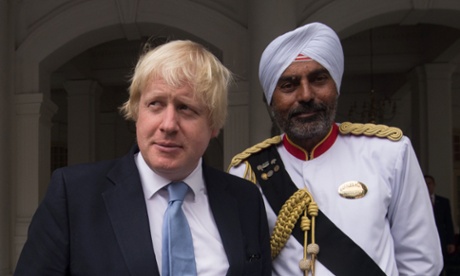
Boris Johnson, the Conservative mayor of London, is in Singapore, on a trade visit. He has welcomed David Cameron’s proposals, but warned him not to be negative about immigration.
I haven’t had a chance to read in detail what the Prime Minister is saying today but I think he’s on pretty much the right lines ...
What David Cameron is proposing seems very sensible - you would have a four-year hiatus before you could get such benefits.
But what would be a bad idea, for us in the UK, would be for the UK to send out a signal we are somehow hostile to talent and hostile to brilliant people who want to come and make their lives in our country - 40% of Londoners were born abroad. The dynamism of the London economy is intrinsically bound up with its ability to attract talent. The last thing we should be is negative.
Sir Gerald Howarth, the Conservative former defence minister, told the Today programme that David Cameron’s proposals were welcome as far as they, but that people wanted action now, not after an EU renegotiation.
We need action this day and our view is that we need to restore to the UK Parliament, immediately, control over our borders and if the Liberals don’t like it then let’s go to the country ...
In so far as it goes these are good measures. But, of course, if the objective is to cut the numbers, will tackling some of the pull factors as he is proposing to do with the benefits system - assuming he can negotiate that with our EU partners - will that be sufficient?
This is the number one issue in the country, immigration, and many of my colleagues feel very concerned about this, they want something now. We believe that it’s not acceptable for our European partners to tell us how to control our borders.
He also said Cameron should make it clear he was prepared to leave the EU if he did not get what he wanted.
That is the logical corollary. This is such an important issue, if we don’t get what we want then what is the point in staying in a club where we are effectively a prisoner, where we are unable to do that which the British people want us to do?
David Cameron is going to make his long-awaited speech on immigration this morning. It will be central to his hopes of stopping Conservative votes sliding away to Ukip at the general election, and it going to establish what will be his central demand if he wins the general election and gets the chance to embark on his much-trailed EU renegotiation.
The speech has already been trailed extensively in advance. Here’s the Guardian’s story. And here’s how it starts.
Migrants from the European Union will have to work in Britain for a minimum of four years before they can claim benefits, David Cameron will propose on Friday in a major speech setting out a vision of how the EU can control the free movement of workers – and how he is willing to leave the union if he does not get his way.
In an attempt to restore his shattered credibility on immigration, the prime minister will say that Britain’s EU membership is now dependent on nation states being able to withhold almost all benefits from EU migrants.
The proposal – which would affect more than 300,000 EU migrants working in Britain and claiming tax credits – is designed to reduce the disparities in takehome pay between that earned by EU migrants working in Britain and in their birthplace, and is aimed squarely at the low-skilled end of the labour market.
The plan to make Britain a less attractive place is an implicit acknowledgement that cutting back on EU migrants’ access to out-of-work benefits – the main thrust of coalition policy so far – is ineffective, since migrants come to work rather than as “benefit tourists”. The proposal, which would require a rewriting of the EU’s social security rules, and possibly treaties, is to be delivered in an address in the West Midlands and will in effect set out Cameron’s terms for recommending Britain continue its 41-year-old membership of the EU in a referendum scheduled for 2017.
Insisting his proposals are not outlandish and deserve to be heard, Cameron will promise: “I will negotiate a cut to EU migration and make welfare reform an absolute requirement in renegotiation.”
But there will be huge interest today in the reaction to what he is saying.
The speech is at 9.30am in the West Midlands.
If you want to follow me on Twitter, I’m on @AndrewSparrow.