Afternoon summary
-
The Muslim Council of Britain has written to Eric Pickle criticising his letter to Muslim leaders for implying that Muslims have not done enough to challenge terrorism. (See 3.15pm.) Mohammed Shafiq, chief executive of the Ramadhan Foundation, a Muslim organisation, has condemned the letter much more strongly. He said:
I wish to express my dismay at the letter sent by the communities secretary Eric Pickles. This letter is patronising and factually incorrect and typical of the government only looking at Muslims through the prism of terrorism and security.
For the record, Muslim leaders, imams and organisations have been engaged in work to expose the terrorist ideology and promote the Islamic teachings against terrorism since 9/11. We do not need to be patronised by a government that claims it wants to give young Muslims an alternative to the extremist narrative and then refuses to discuss foreign policy.
-
Chris Bryant has responded to singer James Blunt’s withering attack on his comments about the preponderance of public school-educated people in the arts. Here’s an extract from his open letter to Blunt.
Dear James,
Stop being so blooming precious. I’m not knocking your success. I even contributed to it by buying one of your albums. I’m not knocking Eddie Redmayne, either. He was the best Richard II I have ever seen.
If you’d read the whole of my interview, you’d have seen that I make the point that the people who subsidise the arts the most are artists themselves. Of course that includes you. But it is a statement of the blindingly obvious that that is far tougher if you come from a poor family where you have to hand over your holiday earnings to help pay the family bills.
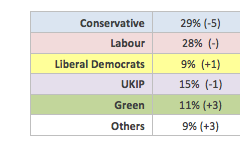
According to Mike Smithson, it is the first poll for more than 30 years to put both main parties under 30 points.
The last time that both CON & LAB were sub-30% in any poll was in 1981 when the Alliance got more than 50% - a position that didn't last
— Mike Smithson (@MSmithsonPB) January 19, 2015
-
The four surviving original manuscripts of the Magna Carta are to go on display together in the House of Lords as part of a year-long series of commemorations to mark the 800th anniversary of the document which laid the foundations of the rule of law, John Bercow, the Commons Speaker has announced. The manuscripts - two held by the British Library and one each by Lincoln and Salisbury Cathedrals - will be on display in the Palace of Westminster for just one day on February 5. Tickets were allocated through a ballot organised by the British Library.
That’s all from me for today.
Thanks for the comments.
It’s the time for pundits to start making their election predictions. In the last few days, I’ve seen three.
Peter Kellner, the YouGov president - Tories ahead by 16
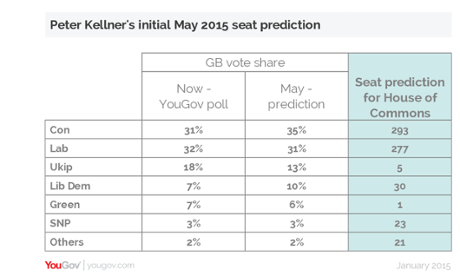
Iain Dale, the publisher and LBC presenter - Labour ahead by 23
Labour: 301
Conservatives: 278
Lib Dems: 24
SNP: 18
Ukip: 5
Stephen Tall, the Lib Dem blogger - Conservatives ahead by 8
Conservatives: 291
Labour: 283
Lib Dems: 32
SNP: 22
Ukip: 3
On the media issue of the day (Chuka V Dermot), the political commentariat on Twitter seem to be siding with Chuka.
From the Daily Mail’s James Chapman
Surely better for @ChukaUmunna to say he has not read extremism letter rather than busk it on a sensitive issue http://t.co/v8HmCPCDFO
— James Chapman (Mail) (@jameschappers) January 19, 2015
From the Daily Mirror’s Kevin Maguire
Can't stand precious people but @ChukaUmunna was perfectly reasonable. Like him more for this http://t.co/BBiK0MrfLQ
— Kevin Maguire (@Kevin_Maguire) January 19, 2015
From LBC’s Iain Dale
Well done 2 @ChukaUmunna for walking out on Murnaghan. He was being a dick & Chuka called him on it. Surprised it doesn't happen more often.
— Iain Dale (@IainDale) January 19, 2015
Dale has also expanded on this in a blog.
From the Daily Mirror’s Jason Beattie
Would we have preferred @ChukaUmunna to say:'I haven't read it but I am going to give a banal answer which will sound good but add nothing'?
— Jason Beattie (@JBeattieMirror) January 19, 2015
Maybe politicians should storm out of interviews more often. If they need any inspiration, here’s the classic example.
Muslim Council of Britain responds to Eric Pickles
The Muslim Council of Britain has now responded to Eric Pickles’ letter to Muslim leaders. Shuja Shafi, the MCB’s secretary general, says the letter “could have been worded differently” and that he was “puzzled” why the MCB did not even get a copy.
The full text of Shafi’s letter has been posted here, on BuzzFeed. Here’s an excerpt.
We take the point that your letter was written in good faith, and we agree with your assertion that British values are indeed Islamic values. However, we do take issue with the implication that extremism takes place at mosques, and that Muslims have not done enough to challenge the terrorism that took place in our name.
This is why we responded to the media, and an assertion in some quarters, that you were somehow endorsing the idea that Muslims and Islam are inherently apart from British society. We reject such notions.
We also reject suggestions that Muslims must go out of their way to prove their loyalty to this country of ours.
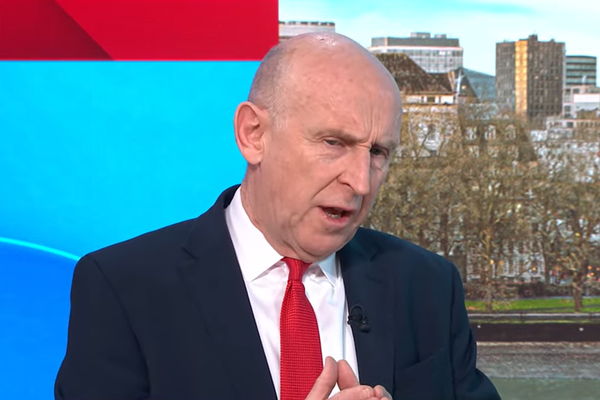
But Hazel Blears did better when asked about the Eric Pickles letter than Chuka Umunna, the shadow business secretary, who became very testy when Sky’s Dermot Murnaghan asked him about it on air earlier. As my colleague Rowena Mason reports, Umunna was so exasperated he started to leave while the camera was still rolling.
Chuka Umunna walked out of a television interview on Monday after he was asked to give his view on the controversial letter sent to 1,000 Muslim leaders by communities secretary Eric Pickles.
Umunna was frustrated because he was pressed live on Sky News over whether he would describe the letter as “patronising” when he had not actually read it and was booked to talk about the prime minister’s speech about the economy.
The shadow business secretary began by saying Muslims are already “seeking to marry up and illustrate how Muslim values are actually British values too” but he declined to use the word “patronising” to describe the government’s attitude because he had not read the actual text.
Asked whether he would like to come back on the show in half hour, after having read it, Umunna hit back at the “ridiculous” request and then subsequently walked off screen while the camera was still on him.
“I think you’re being a bit ridiculous right now,” he told the interviewer. “Your viewers can form their own views. I was asked to come and speak about David Cameron’s speech on the economy and what was happening around the labour market. Nobody told me I was going to come on to this programme and asked to agree whether I thought the government was patronising Muslim people and Muslim leaders. I’m not just going to speak off piste without actually having read a letter. I don’t think you are being terribly fair. Your viewers can make their own decision.”
You can watch the footage here.
Updated
On the World at One Hazel Blears, the Labour former communities secretary, said it was frustrating that the radicalisation issue had degenerated into a row about a letter.
I think it is important that he’s written to all the mosques to try and take sure that all the imams up and down the country are reminded, really, of the important role they can play in trying to combat these dreadful message of extremism.
But I am a little frustrated that here we are having a row a letter, when we’re facing an extreme terrorist threat, when the imperative on all of us is to get on with some practical work on the ground, to combat these messages, but most of all, to build the resilience of young people and their families so that when these extremists try and draw them into this ideology, they’re able to resist it.
Lunchtime summary
-
A Conservative MEP has joined the Muslim Council of Britain and Lord Sacks, the former chief rabbi, in expressing reservations about the tone of a letter sent Eric Pickles to Muslim leaders. Sajjad Karim said that, although the letter was well-intentioned, Pickles seemed to be implying that Muslims could be held responsible for extremism. (See 1.41pm.) On the World at One Harun Khan, the deputy general secretary of the MCB, also said Pickles was placing an “undue” emphasis on mosques
If we look at arrests and people being arrested for example under, say, anti-terrorism laws et cetera, you will find hardly anybody who has actually been specifically radicalised by an imam in a mosque. And I think this [is] undue attention on a mosque ...
It would have been more balanced in the letter if - for example, there’s been a lot of hate crime against Muslims this week, it doesn’t actually say [in the letter] what’s being done to combat that type of hatred.
Cameron has strongly defended the letter. (See 11.03am.) The row is really one about tone, and about what Pickles was implying, rather than anything he said directly, and it shows how easy it is for community cohesion initiatives to backfire. (On a related issue, for a really sharp satire on how Muslims are under extra pressure to be “condemny”, this Jon Stewart sketch is priceless.)
-
Ed Miliband has described British Gas’s decision to cut household gas prices by 5% as “too little, too late”. He said:
A 5% fall is too little and it is too late. It is not nearly good enough. Wholesale prices have fallen by 20%.
But Cameron claimed the move showed the folly of Miliband’s price freeze policy.
This is excellent news and we should be absolutely clear that this price cut would not be happening if we’d listened to Labour and put in place their 20 month price freeze. If we’d frozen prices, you would not have got this benefit to hardworking families up and down the country who want to see their energy bills come down - and with this news, that’s what is going to happen.
(This is specious. No one who heard Miliband announce his proposed price freeze really thought he would freeze prices if suppliers wanted to cut them. He used “freeze” to mean “cap”.)
- Cameron has reaffirmed the Conservatives’ commitment to creating “full employment” and dismissed “myths” about the coalition’s employment record. Almost all jobs now being created are full-time, he said, and less than 5% involve zero-hours contracts, he said in a speech in Ipswich. But Miliband said Cameron’s “empty promises of full employment will mean nothing to so many people struggling with empty wallets as a result of the low-wage economy.”
Updated
Tory MEP criticises Pickles' letter to Muslim leaders
Here are the key points from the Tory MEP Sajjad Karim’s interview on the World at One. (See 1.17am.)
-
Karim said that, although Eric Pickles’ letter (see 9.32am) was written with a “constructive intent”, Pickles was wrong to imply that Muslims could be held responsible for extremism.
Most of the letter is actually very constructive. However, it is rather unfortunate that an underlying message which, I don’t think was the intention to convey, but it certainly has been put out in a way that you are looking to try and place a responsibility on a section of our community that it is impossible for them to fulfil. And, equally, you are in many ways holding that section of our responsible for matters that actually are well beyond their control.
-
He said Pickles’s suggestion that Islam was a new part of the British identity was “ill-informed” because he has forgotten how important Islam, Hinduism and Sikhism were to subject of the British empire.
[Faith in Islam] is part of British identity. In fact, this is not something that is new. This is something that has been part of the British identity for many centuries. Certainly, when one looks at the history of the Indian sub-continent, you will find that the concept of Britishness, as it then was, with subjects, incorporated many, many millions of people with faiths including Hinduism, Islam, and many hundreds of thousands of followers of Sikhism as well. And so, therefore, to try and portray today that somehow Islam is a new part of the concept of Britishness in itself, I’m afraid, is quite an ill-informed basis upon which to try and communicate with a section of our society.
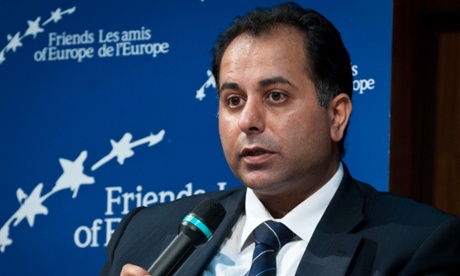
Sajjad Karim, a Conservative MEP, has just told the World at One that the Eric Pickles letter was badly phrased.
Conservative MEP @SHKMEP: Pickles letter is "holding that section of our community responsible for matters..well beyond their control" #wato
— The World at One (@BBCWorldatOne) January 19, 2015
I’ll post the full quote shortly.
Dr Bruce Philp, head of the Work and Employment Research Group at Nottingham Business School, has sent me a note saying that the Conservatives will have difficulty showing that they are the party of full employment. He says that if you look at the 40-year period from 1974 to 2014, the claimant count has averaged 3.45% under Labour governments, but 7.29% under Tory ones, and that you can’t explain this difference just by looking at the state of the global economy.
If we investigate the relative performance of Labour and Conservative administrations we can see a marked difference in outcomes with regard to unemployment in their respective periods of office.
Some of these differences may be attributed to the global economic environment in the respective periods, for example the oil crises of the 1970s and the global financial crisis from 2008. However, the marked differences in government policy outcomes under Labour and Conservative governments, in the period in question, cannot be dismissed entirely with reference to the relative international business environments.
Regional assemblies have been out of favour ever since voters in the north east rejected John Prescott’s plan to give them one by a margin of four to one.
But today the Lib Dems are reviving the idea. Lord Tyler, a Lib Dem constitutional affairs spokesman, and Sir Nick Harvey, the former defence minister, have published a pamphlet for the CentreForum thinktank saying that devolution should be offered to every region of England. They say that this could lead to the establishment of up to 20 “mini-parliaments” and that it would be best to devolve power within England before addressing the “English votes for English laws” issue in parliament.
Harvey said:
It is wearily depressing to see right wing Tories licking their lips at the thought of expelling 59 Scottish MPs from the debate over much of the domestic agenda, then reinforcing the status quo – of grotesque centralised rule from London – with the rightward lurch effected by axing the Scots.
Their sabre-rattling about English votes is a massive distraction from the real need to decentralise power within England.
Our proposals are for radical devolution from London, and not just to cities, but to rural areas too. It is the only way to bring about a renaissance of local accountability and to stop some small rural local authorities going bankrupt.
Number 10 has been in touch to say that David Cameron was not criticising Lord Sacks when he gave his answer at the Q&A. (I said he was “implicitly”, which I think is still true, because Sacks did say there was a “problem” with the Pickles letter. See 11.03am.) A source points out that Cameron was responding to a question about the Muslim Council of Britain, and that Sacks was not mentioned. And he says that Sacks himself said the Pickles letter was “incredibly well-intentioned”.
For the record, here are the employment figures for G7 countries. They are from 2013 and they’e from this OECD table.
Canada: 72.5%
France: 64.1%
Germany: 73.3%
Italy: 56.4%
Japan: 71.7%
UK: 71.3%
US: 67.4%
Cameron's speech and Q&A - Summary
Number 10 hasn’t even released a text of David Cameron’s full employment speech. A press notice was released overnight, but the speech itself was relatively perfunctory, and it sounded as if Cameron was speaking from notes. As often happens with these events, the best stuff came out of the Q&A.
Here are the key points.
- Cameron strongly defended the letter Eric Pickles has sent to Muslim leaders, saying they should show how faith in Islam can be British. The Muslim Council of Britain and others criticising it have “a problem”, he said. (See 11.03am.)
-
He reaffirmed the Conservative commitment to “full employment”, but refused to set a timetable for achieving this. And he offered two definitions of what it meant.
Our aim is very clear - our aim is for a Britain of full employment. What I mean by that is a higher rate of employment here in Britain than in any other advanced economy. Full employment means for me that anyone who wants a job is able to get a job in our country ...
The ambition for full employment is that anyone who wants a job should be able to get a job, and we want to see our employment rate, which is already one of the higher ones in the advanced world, we want it to be the highest of the G7 countries. I’m not putting a date on that, but the ambition is there. And we are well on the road to getting there.
-
He said that he was “relaxed” about publishing his tax return before the election, but refused to give a firm commitment to doing so.
Nothing has changed. I’m very relaxed about publishing these things. There’s no secrets about my status. I’m paid handsomely as your prime minister and that is my main source of income. And I have a house I used to live in before I moved into Downing Street and I rent that out and get the income from that. I don’t have other sources of income, so there will be no surprises in terms of my tax affairs.
-
He said he expected to see further above-inflation increases in the minimum wage.
I want to see it rise further. It has just, quite recently, gone up to £65.0. That’s the first increase there has been ahead of inflation for several years. And I look forward to the minimum wage getting to £7 and beyond. It is right that it is set by the Low Pay Commission, rather than by politicians ... But I think the circumstances are now right for further increases in the minimum wage.
- He described the Conservatives as “party of the roofers and the retailers”.
-
He said the Conservatives were committed to issuing another 50,000 start up loans in the next parliament. Some 25,000 have been issued already, he said.
A new Populus poll is out this morning.
Latest Populus VI: Lab 36 (+1), Con 35 (+3), LD 8 (-1), UKIP 13 (-1), Others 9 (-1). Tables here: http://t.co/Qz3a9EUgQO
— Populus (@PopulusPolls) January 19, 2015
There is also a poll in the Daily Record from Survation suggesting that, for Scottish vogters, a Labour/SNP coalition would be the more popular election outcome. This is from the Press Association.
A third of Scots want to see a Labour and SNP coalition at Westminster, according to a new poll.
The Survation poll for the Daily Record newspaper revealed that 35.1% of Scottish voters would prefer to see a deal between the two parties after the general election.
A Labour/SNP coalition was the most popular post-election outcome in the survey, which questioned 1,006 people between January 12 and 16.
Scotland’s First Minister Nicola Sturgeon has previously said she could not envisage the SNP entering a formal coalition with Labour, but could see the party negotiating a “confidence and supply” arrangement.
Labour leader Ed Miliband has suggested he would not seek a coalition with the SNP, but has failed to categorically rule out such an arrangement.
The poll showed that a majority Labour government was the second most popular result among Scottish voters, with 19.8% backing such an outcome, while 13.8% backed a Tory majority.
A total of 4.7% of people want to see another Tory/Lib Dem coalition, while 8% want to see Labour and the Lib Dems rule together, and 5.5% would like the Tories and Ukip in power.
A further 9.3% favour an SNP/Tory coalition, while 3.8% back a Labour/Ukip pairing.
When asked about voting intentions, 46% of those polled back the SNP, 26% support Labour and 14% back the Tories.
A further 7% intend to vote Lib Dem, while the remaining 7% support other parties.
Here’s Ed Miliband’s respond to David Cameron’s claim that the Conservatives are committed to full employment.
David Cameron’s empty promises of full employment will mean nothing to so many people struggling with empty wallets as a result of the low-wage economy. This is the first government since the 1920s where people are going to be worse off at end of the government than at the beginning.
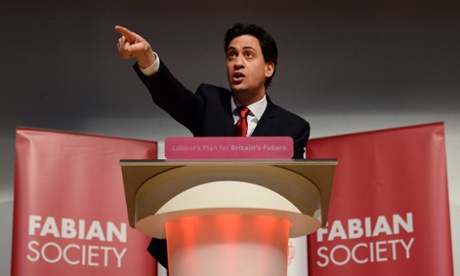
Cameron backs Pickles over controversial letter to Muslim leaders
David Cameron’s most interesting answer came when he was asked about Eric Pickles’ letter to Muslim leader. (See 9.32am.)
He strongly defended Pickles - and implicitly criticised the Muslim Council of Britain for questioning the tone of the letter. The MCB “has a problem”, he suggested.
But Cameron was also implicitly criticising Lord Sacks, the former chief rabbi, who also raised doubts about the letter this morning. (See 9.52am.) This is risky politics, because there are not many religious figures in the UK more measured, intelligent and respected than Lord Sacks. Cameron may find it easy to win a reasonableness contest with the MCB in the court of public opinion, but he will not see off Sacks so easily.
Cameron said:
I think it is absolutely right to write this letter, to say that we all have a responsibility to fight extremism. And anyone who reads this letter, and I’ve read the letter, will see that what he’s saying is that British Muslims make a great contribution to our country, that what is happening, in terms of extremist terror, has nothing to do with the true religion of Islam. It’s being perverted by a minority who have been radicalised. But everyone needs to help dealing with this problem of radicalisation. And anyone, frankly, reading this letter who has a problem with it, I think really has a problem. Because I think it’s the most reasonable, sensible, moderate letter that Eric could possibly have written. And, frankly, all of us have a responsibility to try and confront this radicalisation and make sure we stop young people being drawn into this poisonous, fanatical death cult that a very small minority of people have created.
Updated
Q: If you win the election, what will you do to improve the NHS?
Cameron says the most important thing he will do is ensure a strong economy, because that is needed to sustain the NHS.
The biggest challenge is to get health and social care to work together, he says.
And that’s it.
I’ll post a summary in a moment.
Q: Don’t people getting £26,000 on benefits get the money tax free?
Cameron says that is why the government introduced the benefits cap.
It was set at £26,000. The Tories would take it down in the next parliament to £23,000, and use the money to fund more apprenticeships.
Q: What will you do about increasing the minimum wage, and extending the living wage?
Cameron says he wants the minimum wage to go up. It is right that it is set by the Low Pay Commission. But the circumstances are right for it to go up.
On low pay, he says the best thing you can do is take the low paid out of tax. The Tories want to raise the tax threshold to £12,500, he says.
He says, again, that it is “just not true” to say all the new jobs that have been created are low paid ones.
Q: What is your timetable for full employment?
Cameron says he is not putting a date on this.
Q: Will you publish your tax return before the election?
Cameron says nothing has changed. He is very relaxed about this.
His only income comes from his generous salary, and rental income from the house he used to live in.
Q: Eric Pickles has told Muslims to do more to tackle extremism. Have you alientated Muslims?
Cameron says Pickles was right to write this letter, and to say we all have a duty to tackle extremism.
He says he has read the Pickles letter. It says Islam has nothing to do with extremism.
Anyone who has a problem with the letter has a problem. It is the most reasonable letter you could imagine, he says.
Q: Will you comment on the Telegraph investigation into abuse on St Helena?
Cameron commends the Telegraph for its investigation.
Cameron's Q&A
Cameron is now taking questions.
Q: You say most of the new jobs are well paid. But the fact that tax receipts are less than expected suggests they are not.
Cameron says one reason the government tax revenues has been low is that the government has actually cut taxes.
But the figures speak for themselves. Over the last year, nine out of 10 jobs have been full-time jobs.
Of course there are people in the media and politics who want to talk down success.
But do we want even more well-paid jobs? Of course.
Cameron says it is not true that most new jobs have gone to foreigners. Two-thirds of new private sector jobs have gone to British people, he says.
And he sets out the four planks of his approach to immigration. (He has done this several times before. For example, see here.)
Cameron says the government’s jobs strategy also involves promoting infrastructure. It is not true that all the money is going on HS2, he says.
Cameron says he wants to tackle some myths about the jobs being created.
They are not all part-time. Over the last year, 95% are full-time, he says.
Since he became prime minister two-thirds are in highly-skilled trades.
And he says only 2 to 4% of new jobs are on zero-hours contracts, he says.
Cameron says he is going to talk about five measures he is taking to promote full employment.
First, he wants to cut red tape.
The government has a start-up loan scheme. Some 25,000 of these loans have been issued to date. Cameron says the Conservatives want to get this figure up to 75,000.
Some £300m will be available for this in the next parliament, he says.
Cameron says he wants to offer security. Economic security will be a general theme of what he will be saying in the run up to the election, he says.
But today he is talking about full employment.
He says he wants Britain to have a higher rate of employment than any other advanced economy. And, by full employment, he means creating a situation where anyone who wants a job can get one.
David Cameron's full employment speech
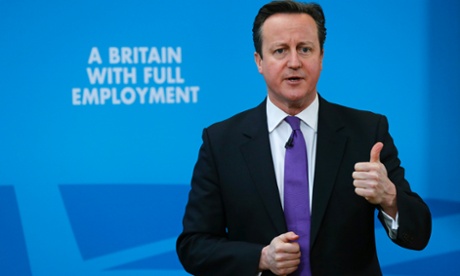
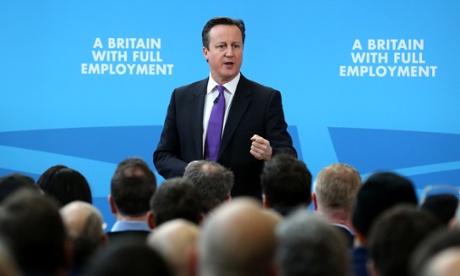
David Cameron is delivering his full employment speech.
He says he is in a lawnmower factory.
British Gas to cut household gas prices by 5%
The Press Association has just snapped this.
British Gas is to reduce household gas prices by 5%, cutting annual energy bills on average by £37.
This is a good illustration of how hard it can be for policy to survive a collision with reality, or the future. When Ed Miliband proposed his energy price freeze in September 2013, it was a hit that had the Conservatives on the back foot for weeks. Now, unfortunately, the proposal is starting to look redundant.
In his Guardian column today Matthew d’Ancona mentions a report out today from Bright Blue, a liberal Conservative thinktank, arguing that the Conservatives should be wary of adopting too hardline an approach to immigration.
Using poll findings looking at the views of Conservative and Ukip supporters, it says Conservative supporters are more interested in managing migration than in imposing an overall cap (unlike Ukip supporters), that 85% of Conservative supporters do not want to cut the number of international students coming to the UK, that most Conservatives have had a positive personal experience of immigration and that the voters who are going to be increasingly important to the party in the future are more likely to be pro-immigration.
The full report is available here.
Must read @WeAreBrightBlue's new Conservative voter immigration work use large samples & @LordAshcroft definitions: http://t.co/0tSXEzCLOK
— Damian Lyons Lowe (@DamianSurvation) January 19, 2015
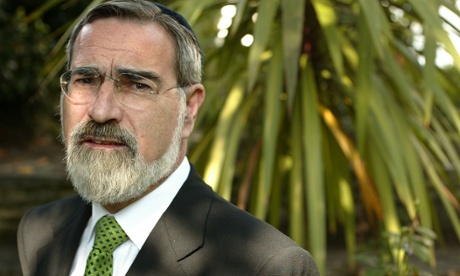
Lord Sacks, the former chief rabbi, told the Today programme earlier that he could understand why Muslim leaders were upset by the tone of Eric Pickles’ letter. (See 9.32am.) He said:
The problem is that letter suggested that the Muslim community within Britain can contain its own radicals. The truth is that Islamism, like all modern global political movements, is actually a global phenomenon - transmitted by the internet, transmitted by social media - and so I would not be surprised if the Muslim community didn’t say ‘You’re asking of us something that is not under our control’.
Also, be aware that a survey two years ago showed that Muslims in Britain have the highest percentage of loyalty to Britain.
I am absolutely sure that the government was incredibly well-intentioned - Lord Ahmad and Eric Pickles are terrific people - but I can kind of see that Muslim communities said ‘Why are you pointing the finger of blame at us?’.
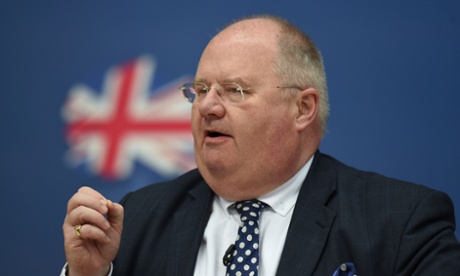
Eric Pickles, the communities secretary, is one of those politicians who could start a fight in an empty room. He seems to have done it today, with a letter to Muslim leaders that has gone down badly with the Muslim Council for Britain.
Pickles and Lord Ahmad, the communities minister, sent an open letter to more than 1,000 Islamic leader saying there was “more work to do” in the light of the Paris attacks.
We are proud of the reaction of British communities to (the French terror attacks). Muslims from across the country have spoken out to say: not in our name.
But there is more work to do. We must show our young people, who may be targeted, that extremists have nothing to offer them.
We must show them that there are other ways to express disagreement: that their right to do so is dependent on the very freedoms that extremists seek to destroy.
We must show them the multitude of statements of condemnation from British Muslims; show them these men of hate have no place in our mosques or any place of worship, and that they do not speak for Muslims in Britain or anywhere in the world.
Let us assure you that the Government will do all we can to defeat the voices of division, but ultimately the challenges of integration and radicalisation cannot be solved from Whitehall alone. Strong community-based leadership at a local level is needed.
You, as faith leaders, are in a unique position in our society. You have a precious opportunity, and an important responsibility: in explaining and demonstrating how faith in Islam can be part of British identity.
We believe together we have an opportunity to demonstrate the true nature of British Islam today. There is a need to lay out more clearly than ever before what being a British Muslim means today: proud of your faith and proud of your country. We know that acts of extremism are not representative of Islam; but we need to show what is.
But the Muslim Council of Britain has objected to the tone of the letter. Harun Khan, the MCB deputy secretary general, said he would be writing to Pickles asking for clarification.
We will be writing to Mr Eric Pickles to ask that he clarifies his request to Muslims to ‘explain and demonstrate how faith in Islam can be part of British identity’. Is Mr Pickles seriously suggesting, as do members of the far right, that Muslims and Islam are inherently apart from British society?
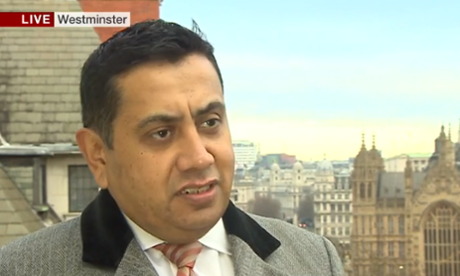
And this morning Ahmad has hit back, saying the MCB response is “disappointing”. He told the BBC:
I think his response is disappointing. Within the letter there’s an explicit paragraph which says British values are Muslim values. You can’t be more explicit than that. Look, all Muslims should be non-violent, Islam is a religion of peace. Islam says there is no compulsion in religion. As I said, his response was disappointing, perhaps he wasn’t clear in what the letter said, but if you have seen a copy of the letter it’s pretty explicit that we want to work together with the Muslim community. This is about reassurance, it was about recognising that as Theresa May said yesterday a Britain without Muslims, without Jews, Hindus, would not be the Britain we want.
Updated
#UKGENERALELECTION2015 108 DAYS TO GO
— General Election (@UKELECTIONS2015) January 19, 2015
David Cameron gave a speech on the deficit last week, identifying it as the first of six Conservative election priorities. The second is employment, and today Cameron is giving a speech on that, saying the Conservatives are committed to full employment.
Full employment may be an economic term, but this is what it means in human terms: it means more of our fellow men and women with the security of a regular wage; it means you, your family and your children having a job and getting on in life. We have had a tough few years as a country, but we are coming out the other side. We are the jobs factory of Europe; we’re creating more jobs here than the rest of Europe put together. That’s what our long-term plan means for you – and if you vote Conservative, we can stay on this road to recovery.
I’ll be covering the speech, and reaction to it, in detial.
Here’s the full agenda for the day.
9am: Ed Balls and Larry Summers, the former US treasury secretary, hold the UK launch of their Commission on Inclusive Prosperity report.
10.10am: Nick Clegg speaks at the Mental Health Conference. As James Meikle and Patrick Wintour report, he will urge NHS trusts to sign up to a “zero suicides” campaign.
Morning: Ed Miliband publishes a report from Labour’s independent Mental Health Taskforce. It calls for a radical improvement in mental health provision.
10.15am: David Cameron give a speech on jobs. He will say the Conservatives are committed to full employment.
11am: Number 10 lobby briefing.
1pm: John Bercow, the Commons Speaker, holds a briefing on events planned to mark the 750th anniversary of the Simon de Montfort parliament (1265) and 800th anniversary of the Magna Carta (1215).
2.30pm: Theresa Villiers, the Northern Ireland secretary, gives evidence to the Commons Northern Ireland committee on “on the runs” (OTRs).
As usual, I will be also covering all the breaking political news from Westminster, as well as bringing you the most interesting political comment and analysis from the web and from Twitter. I will post a summary at lunchtime and another in the afternoon.
If you want to follow me on Twitter, I’m on @AndrewSparrow.
Updated