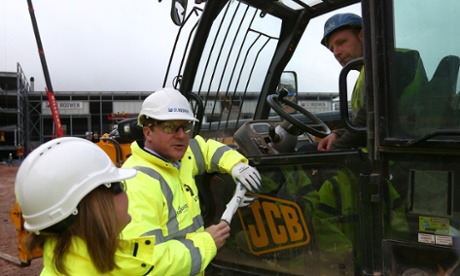
David Cameron’s latest pledge that a re-elected Tory government would legislate for a ban on tax rises in the next parliament is economically illiterate as well as politically dishonest.
For brazen incoherence it is up there with the kind of Daily Mail front page splash (“Miliband eats babies”) we have been reading these past few weeks. From an incumbent prime minister, even one addicted to tactical solutions, it is quite startling; a “gimmick”, as Ed Balls kept protesting on Wednesday.
Are the plans of the two Eds – Balls and Miliband – for tax and spending much better? Not really, as Larry Elliott’s brisk summary of the Institute for Fiscal Studies (IFS) analysis explains. Nick Clegg’s are probably slightly more plausible (I cannot remember their thrust except that they are in between the others), but the Lib Dem leader’s likely leverage on events after 7 May makes it rather less important. The Greens and the SNP? Don’t even ask.
In varying ways they all subscribe to the tree-grown theory of money which suggests something will turn up, probably for the best, that will allow them to make good the spurious promises they make to voters – on housing, the NHS, education, childcare, budget surpluses – despite the fragility of our credit-driven economy. In 2015, their rival strategies are well below the level of challenging events, as engaged voters instinctively know.
So it must be the airhead tendency in key marginals whose votes they are courting. That would help explain the estuary English – dropped consonants and the rest – with which the campaign chiefs choose to address us in radio and TV interviews, posh boys Cameron and George Osborne almost as much as Miliband and Balls. Accents are no indicator of intelligence or civil commitment, but patronising people think they are.
The simple reason why no political party should, or can, promise not to raise the key engines of tax revenues – income tax, VAT and national insurance – is that it cannot see into the future. Not even that truism is quite true because, as the IFS rightly points out, we can all see enough to know that, one way or another, most of us expect to be worse off in terms of tax and benefits in the years ahead.
How can it be otherwise when the sums don’t add up, but the nation’s accumulated debts do?
This week’s first-quarter growth figures for January to March 2015, of 0.3% compared with 0.6% in Q4 of 2014, remind attentive voters that the government’s claim to have rescued the economic mess it inherited from Labour is as spurious as Labour’s cry that it has failed – or indeed as silly as the Tory insistence that it was Blair and Brown, not the bankers, who caused the 2008-9 crash and recession. Infantile really.
It is worse than that. Though you might not realise from the campaign rhetoric, the world has not stopped spinning because Britain is holding a general election. Bad things keep happening out there which may blow skipper Cameron’s vessel off course and on to the rocks of spiralling debt – and they cannot be ignored.
Thus Alexis Tsipras, Greece’s prime minister – widely admired here by tree-grown money theorists – has just sidelined his over-educated and combative finance minister, Essex-trained Yanis Varoufakis, despite his own claims to the contrary. Ian Traynor, the Guardian’s man in Brussels, was among the first to spot that the self-declared game theory specialist might not have the right skill set to handle the EU’s money men. The only way is not Essex after all.
Greece still totters on the brink between more austerity and Grexit. The eurozone’s crisis of confidence is far from over and anyway, Greece is not Europe’s most serious challenge. That problem is the twin disaster looming in Ukraine, not just militarily, where Russian-backed troops are eroding the last ceasefire, but also economic. Ukrainian GDP has fallen 15% this past year, industrial output is down 21% and inflation is predicted to be 35%.
Ukraine is even more strategically important to Europe than Greece, so the EU will have to decide how best it can help and how best to deter Russian adventurism. Whatever it does will cost, and the cost will be shared by Britain – as it would if Nigel Farage, as prime minister, took the UK out of the EU and towed it into the mid-Atlantic.
You get my drift. Things happen beyond our control and there are consequences which have to be dealt with if they are not to generate even worse ones. More destablising oil price shocks? Islamist terrorism? A refugee crisis sparked by worse turmoil in the Middle East? An ever-deeper Chinese recession? There is a long list of possible “events, dear boy” – as Harold Macmillan, the last Etonian PM to win an election outright, once put it – which might make Cameron’s pledge look silly.
Global uncertainty hurts national economies, pushes up costs (including borrowing) and reduces revenue. Lower public spending and higher taxes become unavoidable imperatives, not manifesto options. Not even lofty assurances from the Nobel prize-winning economist Paul Krugman that borrowing is the best way to restore growth – he reproaches both Tories and Labour for their deficit reduction policies – may be enough to assure lenders that they will get their money back. Some of Krugman’s own predictions have been wrong too.
Cameron and Osborne should know all this, yet persist in bad tactical moves; not just on the economy, as Rafael Behr magisterially points out, but in using Scotland as a wedge issue. After all (Balls keeps reminding them), they won office in 2010 promising not to raise VAT or reduce tax credits, but under pressure of events – the fear that Britain might become the next Greece – they did both. That is what happens in real life and legislating against tax rises (or to have a balanced budget, another current fad) does not make it any less so.
What happens is that governments massage the figures to make them look right, as Labour (Balls and Miliband included) did when it rewrote Gordon Brown’s “golden rule” in office or the German government did when (long before Greece or Ireland) it broke the eurozone’s borrowing limits. Osborne has done it too, to explain away his own borrowing excesses, welcome though the chancellor’s conversion to plan B was at the time.
The result is not good for public trust in government; any government, not just Dave’s or Ed’s. All these extravagant pledges rarely make much of a difference to most voters; they have much more effect on the rich (Labour’s election scapegoat) and the poorest (the Tory scapegoat) while making the tax system ever more complicated instead of simpler, which should be every party’s goal.
What’s more, those “no tax rises” promises usually contain a few escape clauses. Just listen to Balls on the airwaves on Wednesday wriggling on tax thresholds – the point at which earnings become liable for a higher tax rate. Ditto benefit thresholds and inflation-linking. Lower them or freeze them, it can save or yield serious money to the Treasury. And remember, Osborne’s promise to raise thresholds benefits the honest millionaire, the ones who pay up without complaint, more than it does Mr and Mrs Squeezed Middle.
It’s never too late to start treating us like adults. Even with just eight days to go.