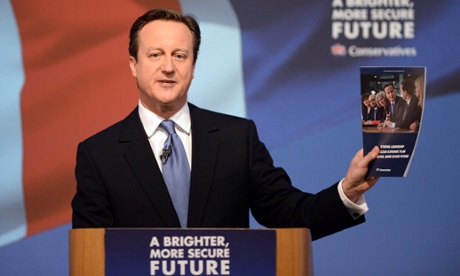
David Cameron has offered voters a fresh wave of election promises including 30 hours a week of free childcare for working families and scrapping tax on the minimum wage as he launched the Conservative party manifesto for “buccaneering Britain”.
The prime minister’s new pledges, which also include the right to buy housing association properties, appear designed to appeal to lower-income swing voters in the key seats that the Conservatives need to hold at the election.
Cameron also surprisingly repeated the Conservative party “ambition” to bring down immigration to the tens of thousands rather than the hundreds of thousands, despite the clear failure of the party to meet this target over the last five years.
Speaking at a technical college in Swindon alongside cabinet colleagues, Cameron began his address by repeating his claim that the Conservatives are now “the party of working people”.
His manifesto was presented as a “plan for every stage of your life”, with promises aimed at voters of all ages.
During the speech, Cameron also made an attempt to address criticism that he has failed to show vision or articulate what he believes in over the last five years.
The prime minister said he did not go into politics to be an accountant who balances the books but to create a country “where children can make the most of their God-given talents whatever their background... That is why I am here”.
He described Britain as “buccaneering”, promising “a good life” for families, before adding: “I am above all a patriot ... I love my country with all my heart. That’s why five years ago, almost to the day, I stood on a stage like this asking you to give me and this party, five years to save our country from ruin.
“And it’s why I stand on this stage and ask you for five more years to finish the job.”
Cameron said he was doubling the amount of free childcare for three- and four-year-olds, saving parents up to £5,000 a year.
“For families with young children, this is not one issue among many, but the issue they rightly care about,” he said.
Cameron said the policy would be introduced from 2017, would cost £350m and be funded from the reduction in pension tax relief on higher earners.
Turning to personal finances, he said there would be a new law making sure no one on the minimum wage ever pays income tax.
On homes, Cameron said the right to buy social housing would further his dream of the UK being a property-owning democracy. He pledged that the housing stock would be replaced, although experts have raised concerns that the number of social homes could be severely depleted. The policy would be funded by councils selling off expensive stock.
Cameron said these three pledges exemplified “down-to-earth values” and “the expression of what is in the hearts of the majority of people in this country”.
However, there was no mention of how some of the promises would be funded, such as the party’s plans for an extra £8bn a year for the NHS and its pledge to raise the 40p tax threshold.
The prime minister brushed this off, saying: “All our commitments are fully funded as part of our balanced fiscal plan.”
Other pledges included giving English MPs a veto on English laws, ending new subsidies for onshore wind turbines and bringing down the benefit cap to £23,000 a year.
The speech did not refer directly to Ed Miliband and only briefly to Labour but set out how the Conservatives would create a “brighter, more secure future”, perhaps in response to criticism that Cameron’s campaign has been too negative. However, he did attack Miliband during a question and answer session, emphasising the risk of a coalition with the SNP.
Asked whether it was too late for the Conservatives to start claiming they are the party of workers when they are seen as the party of the rich, Cameron denied he hadn’t “suddenly” started becoming interested in low earners and pointed out the new jobs created in the last five years.