
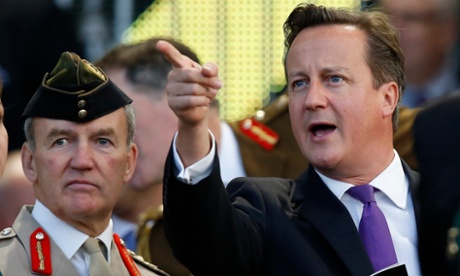
“I tell you what”, David Cameron told Britain’s top military commanders during the Nato air strikes on Libya three years ago. “You do the fighting and I’ll do the talking”.
He was responding to complaints by defence chiefs about pressures on the armed forces, the lack of kit, and poor morale.
Cameron is gagging them again. His office prevented General Sir Nicholas Houghton, chief of the defence staff, from speaking on Monday at a Chatham House thinktank conference on the theme, Rising Powers and the Future of Defence Cooperation.
The gagging order came after Downing Street saw an early draft of Houghton’s speech. Cameron had already let it be known he was annoyed by remarks by Michael Fallon when the UK defence secretary said Nato must be ready for Russian aggression in “whatever form it takes” and tensions between the alliance and Moscow were “warming up”.
There was a “real and present danger”, added Fallon, that Russia could use irregular troops, cyber attacks, and inflame tensions with ethnic Russian minorities in nations seen as part of the country’s “near abroad” - ie Baltic countries.
The following day, last Friday, General Sir Adrian Bradshaw, Nato’s deputy supreme commander, talked about “an era of constant competition with Russia”, that the alliance was pressing ahead with plans for a very high readiness joint taskforce, “in order to convince Russia, or any other state adversary, that any attack on one Nato member will inevitably lead them into a conflict with the whole alliance”.
Bradshaw added in his speech to the London-based Royal United Services Institute: “While the threat from Russia, together with the risk it brings of a miscalculation resulting in a slide into strategic conflict, however unlikely we see that as being right now, represents an obvious existential threat to our whole being, we of course face threats from Isis and other instabilities to our way of life and the security of our loved ones.”
Bradshaw’s predecessor, General Sir Richard Shireff, earlier this month angered Cameron by claiming that his failure to be at the forefront of talks over Ukraine had turned the British prime minister into a “bit player”.
Cameron is angry with Britain’s military top brass for a very simple reason: they are warning against more cuts in the defence budget, drawing unwelcome attention to something the British government is desperate to avoid. The less they say in public, the better.
Houghton raised eyebrows in Downing Street more than a year ago when in his first major speech as Britain’s most senior military figure he warned of the need to fund the military adequately in face of the danger of what he called “hollowed-out” armed forces, with expensive warships and warplanes but not enough people to operate them.
Unlike health, and even foreign aid, the defence budget has not been ring-fenced, not protected against further cuts, an omission of which anxious military chiefs are well aware.
Both Cameron and George Osborne have steered cleared of making any promises about the next spending round and Strategic Defence and Security Review due by the end of the year.
The heads of the armed forces are even more worried now that their combat role in Afghanistan is ended and there is little public appetite for any significant British role in military operations overseas.
Furthermore, Downing Street does not want to get embroiled in any debate about the future size of the army, Trident, or the number of increasingly expensive planes to put on the two large aircraft carriers being built in Scotland.
They do not want to be reminded, either, about a most pertinent gap in Britain’s national defences - given Russia’s provocative decision to send warplanes and submarines around Britain - namely, the absence of British maritime patrol and reconnaissance aircraft.













