There’s sometimes a virtue in being rather dull. The liaison committee is not recommended for the decaffeinated; the joys of a committee made up of the chairs of the 32 select committees whose principal task is to consider the work of the 32 select committees can quickly wear thin. But every so often it does get the chance to do one thing that no one else gets to do: it asks the prime minister straight questions and gets straight – well, straightish – answers.
No gags, little abuse. It could catch on. Not least because David Cameron comes out of it quite well. He may not have the Rolls-Royce brain that exists in his own imagination, but there is something more going on in there than the second-hand Corsa that is generally on show during prime minister’s questions.
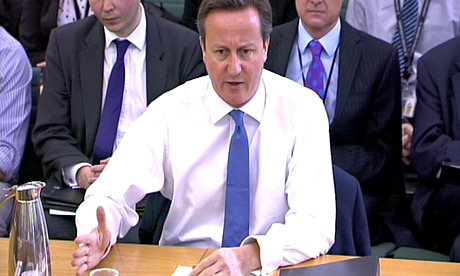
Cameron took off his jacket and put on his most serious face in anticipation of a 90-minute ordeal on devolution. As the government isn’t sure what it plans to do about devolving more powers to all parts of the UK – it rather depends on how tricky some Tory backbenchers decide to be – the prime minister could have found himself ad-libbing policy if he wasn’t too careful.
As a result, he prefaced every answer with “I will try not to give too long an answer on this” before adding more and more qualifying parentheses, so that by the time he had stopped talking it was hard to remember where he had started or if he had somehow managed to deliberately contradict himself.
“Let me get this straight,” said Labour’s Ian Davidson. “When you were asked if Scottish devolution was not dependent on a solution to the English problem, you replied: ‘Effectively yes.’ Is that ‘effectively yes’ or ‘yes’?” “Yes,” said Cameron, still effectively not quite answering the question. Davidson didn’t get much further when he asked if the government would seek to amend any draft clauses. “I hope this isn’t the case.”
Having endorsed the Barnett formula with a creased brow, an admission of “Barnett consequentials” and a quick “hang on, when I said the economy was doing well, I didn’t mean it was doing so well that the English would have to give the Scots any more money,” Cameron turned to face his nemesis, Clive Betts. There are few things the Labour MP enjoys more than winding up the prime minister and he chose to mention the mayor of London three times while calling for every English village to be given tax-raising powers. “Now you are just being churlish,” Cameron snapped.
Tory Andrew Tyrie was quite put out by this. He likes to be seen as the awkward customer asking the smart-arse questions, so when Cameron gave his clearest answer of the day on English votes for English laws, Tyrie went out of his way to make clear he had a better grasp of the situation than anyone else in the room and managed to split one of the few remaining hairs he has left.
The PM smiled and agreed that Tyrie was indeed a constitutional genius. This was a bad move, as Labour’s Graham Allen likes to think he has the monopoly on constitutional affairs. He is also a man who will use everything in his power to get his point across. Boredom usually. “I will send you my report on constitutional codification,” he said. “Goody,” Cameron replied wanly.
The Allen effect was not lost on Betts, whose eyes had been shut for several minutes. “These things can go on a bit,” the PM said as he left. Indeed they can. But sometimes they are worth it.






.jpg?w=600)