

Afternoon summary
-
Nick Clegg has urged northern cities like Manchester and Liverpool to emulate Berlin by throwing open empty buildings and unused land to artists and entrepreneurs. Speaking in Berlin, he said pop-up shops, start-up businesses and charities would be able to takeover vacant buildings temporarily under a project to revitalise areas. As the Press Association reports, disused cinemas, post offices, old schools and market halls will be matched up with users by councils and land-owners to help stop areas becoming blighted, Clegg said. He visited the Betahaus project in Berlin that offers derelict land and property in the city centre as work space and said he wants to see how the Britain can mirror its success in the north.
Leaving useful land in the north to languish is not only bad for business, it can hamper the success of an area in so many ways. Which is why I want to see empty buildings brought back to life and back in business.
We need to understand what stands in the way of some of the most incredible space in the country being used, and make things more flexible so that we can fill these buildings with artists, start-ups, and other entrepreneurs to restore the buildings’ purpose and appeal.
-
Liz Truss, the environment secretary, has signalled that she wants a better relationship with environmental groups than her predecessor had. Owen Paterson described the green lobby as the “green blob” after he left office. Giving evidence to a Commons committee, she said it was “difficult” to comment on what Paterson said. But she went on:
I think there are a lot of opportunities and I’m keen to work with [environmental groups]. Of course, in any debate there are different sides of the argument. But I fundamentally don’t think we have to choose between economic progress and environmental progress. I think we can do both. I think this government is showing that we can do both.
That’s all from me for today.
Thanks for the comments.
Here’s an afternoon reading list.
Is it possible that the press barons and their hired hands fear that their power to control the flow of opinion and information is, daily, slipping away from their hands?
The Tories think that media is their not so secret weapon; that the right wing press will go all out to swing the election for the Tories and UKIP.
But the truth is that the newspapers, although still influential, are declining, their readership is falling and their reach is diminishing.
Also the old vertical world where the rich and powerful could control so much is now receding. And a horizontal era of mass communication is opening up where each of us can make our own voice heard and each of us can choose who we listen to.
And this is what Sky’s Faisal Islam says about this.
clearest exposition from Team Ed that they think that they can win despite or even because of newspaper hostility: http://t.co/63vKVzQqCH
— Faisal Islam (@faisalislam) November 26, 2014
It is impossible to compare what I saw at the Hydro arena with any sort of political rally seen recently in the United Kingdom. Rather, the image that sprang to mind is the evangelical megachurch. The similarities are striking: new members were approached directly and welcomed into the group and invited to raise their hands, there was constant affirmation of the shared beliefs of the group (“Scotland will become an independent country.”), there was music familiar to the groups follower’s (Caledonia by Dougie Maclean - “everyone sing along!” - and Son I Voted Yes by Stanley Odd) inspiring sermons were given by various prominent party figures (Stewart Hosie, Alex Salmond...) and an offertory (‘Please - donate to SNP now!’)
The denouement of the event was the appearance of the charismatic leader. The new prophet of the nationalist movement, Nicola Sturgeon. I wonder how aware she is of the beast that has awoken – the task of retaining the new members’ loyalties while still steering a politically viable ship will be a difficult one.
Herman Van Rompuy, the outgoing president of the European Union, has said that the European Union could survive without Britain. But it could not survive without France, he said. Bloomberg has the full story. And here’s the quote.
Europe would be wounded, even amputated, without the UK - and we have to do everything to prevent that - but would survive. Without France, Europe - the European idea - would be dead.
Ipsos MORI has released polling showing that a majority of people think the government’s record on immigration is no better than the Labour government’s.
Here’s an extract from the news release.
Similarly, the majority think there is no difference between the job that is currently being done and the job done by Labour on immigration (56%), although the proportion of people saying it is better (25%) is higher than the proportion saying it is worse (12%).
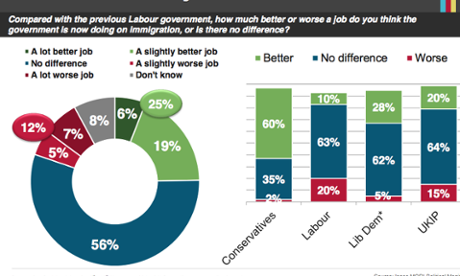
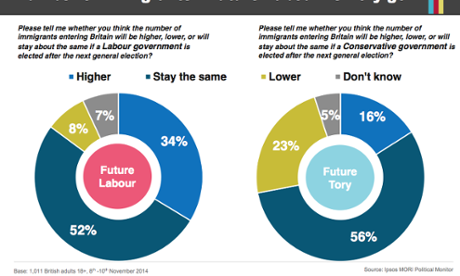
And a majority of people also think immigration will stay at the same level whether the Conservative or Labour win the election.
The polling also asked people to consider how the number of immigrants coming to Britain would change if a Conservative or a Labour government is elected in May next year. In both scenarios, the majority of the public foresee an unchanging picture: 56% feel the number of immigrants will stay the same if a Conservative government is elected, 52% if a Labour government is elected. However, more people think the number of immigrants allowed in will be higher if Labour is elected: 34% compared to 16% if the Conservatives are elected.
Updated
Ian Murray, a shadow business minister, says the Royal Mail’s warnings about the threat to the universal postal service (see 2.25pm) show that Labour was right to raise concerns about its privatisation.
This stark warning from the chief executive of Royal Mail will be deeply worrying for the millions of consumers and small businesses who rely on Royal Mail’s six-day delivery and essential services.
Labour warned that David Cameron’s Royal Mail fire sale would put vital services at risk, and Moya Greene’s evidence today has confirmed our worst fears. IT comes after taxpayers were short changed by hundreds of millions of pounds by the botched sale.
Ministers urgently need to clarify what action they will take to secure the future of postal services following the mess created by their botched fire sale.
Lunchtime summary
-
David Cameron has admitted the NHS is “under pressure”. He was speaking at PMQs, where Ed Miliband accused him of running down the health service. Miliband said:
The truth is the crisis in A&E is a symptom of the crisis in elderly care and in relation to getting to see a GP. One of the biggest problems is one in four people are unable to get to see a GP within a week ... What does it say about the NHS when the health secretary says he goes to A&E because he can’t get a GP appointment?
Cameron said that the NHS was “under pressure”, but that it was dealing with more patients than under Labour and that it would only be strong if there were a strong economy.
What the figures show is yes, the NHS is under pressure. Last week 429,000 presented at accident and emergency units across England - that’s 3,000 more patients every day than under the last government. The key thing is what we are going to do to respond to these problems - what we are doing is putting £700m into the NHS this year. We are only able to do that because we have a strong and growing economy.
-
Cameron has reaffirmed his commitment to move people with learning difficulties out of institutional care and into the community. But, when asked at PMQs about today’s report commissioned in the wake of the Winterbourne View scandal, which found that individuals were still being place in “inappropriate institutional in-patient facilities”, Cameron refused to set a timetable for this.
We have got to do more to get people out of hospitals and into loving and caring homes in the community ... I don’t want to set out a timetable that is impossible to meet.
-
MPs have been told that a British-funded hospital to treat Ebola victims in Sierra Leone is only treating five patients. At PMQs Sir Edward Garnier, the former solicitor general, said:
A few weeks ago a 92-bed hospital in Kerry Town in Sierra Leone was completed at a cost of 2 million to the British taxpayer. That’s a good thing. As of last night, it was looking after five patients. It’s run by Save The Children. Would you have a word with [international development secretary Justine Greening] and others in government to make sure that hospital is made proper use of?
Cameron conceded there was a problem. He replied:
You are absolutely right. It’s good that it has been built and built roughly on time but there is an issue about its operation and the work we’re doing with Save The Children and we’re working with them intensively to make sure that the hospital reaches its full capacity and its full.
-
Cameron has said that Israel should continue to respect the rights of its people. He was speaking in response to Sir Gerald Kaufman, who said a new Israeli bill “removes what are defined as national rights from all Israeli citizens who are not Jews, makes Hebrew the only national language, and has been denounced by the Israeli attorney general as causing a deterioration in the democratic character of the state”. Cameron replied:
One of the reasons I’m such a strong supporter of Israel is that it is a country that has given rights and democracy to its people and it’s very important that that continues. When you look across the region and you look at those indexes of freedom you see that Israel is one of the few countries that ticks the boxes in terms of freedom and it’s very important it continues to do so.
-
Cameron has accused Labour of sneering at people who work hard and love their country. At PMQs Nadhim Zahawi, the Conservative MP, taunted Labour in the light of the Emily Thornberry affair. (See 1.13pm.) Cameron said he agreed with Zahawi.
I agree with every word you have said. In fact I was wondering why the Labour benches were so quiet. Now I realise of course the shadow attorney general [Thornberry] who normally makes so much noise presumably isn’t here. Probably out taking pictures of people’s houses I expect. But we know what that meant about the modern Labour party. Sneering at people who work hard and love their country.
- The Treasury has refused to deny reports that George Osborne will use the autumn statement to announce a vote on a plan to get rid of the budget deficit by 2017/18. Such a vote would be seen as a trap for Labour, which would either have to back the government or run the risk of being seen as soft on the deficit.
- Detectives are examining allegations of misuse of expenses by Stormont Assembly members. As the Press Association reports, the Police Service of Northern Ireland (PSNI) said officers from its serious crime branch were assessing the claims of “potential criminality”. The series of allegations against a number of Assembly members were outlined in two recent documentaries by BBC Northern Ireland Spotlight, the second aired last night. The programmes shone particular focus on how representatives of the Assembly’s two largest parties - the Democratic Unionists and Sinn Fein - claimed money over the last decade. They included an allegation that Sinn Fein MLAs drew down nearly 700,000 in expenses for research apparently conducted by a company run by the party’s finance managers. The reports also raised questions about the use of public money at a number of DUP and Sinn Fein constituency offices. Both parties have defended their actions and criticised the BBC coverage.
-
Rachel Reeves, the shadow work and pensions secretary, has accused the government of wasting money by failing to control the welfare budget. In a speech she said:
Last week Ed Balls and I released new analysis, commissioned from the House of Commons Library, which shows that the failure of this government to help people boost their earnings, or tackle the lack of affordable housing, has resulted in £25bn extra welfare spending, including £1.4bn more than they budgeted for on housing benefit for people in work over the life of this parliament.
An overspend that is set to continue as the number of working people reliant on housing benefit to pay their rent is now set to double by 2018-19, as rents rise faster than wages, and as wages rise more slowly than prices.
Today I am releasing further new analysis showing that the government has also spent £5bn more than they planned on tax credits over the course of this parliament.
Indeed, total spend on in-work benefits is now set to rise in real terms into the next parliament too.
These figures are all the more astonishing when you remember that George Osborne and Iain Duncan Smith have spent the entire parliament trying to cut spending on benefits and tax credits by reducing their value and making them harder to claim – for millions of people in work as well as those out of work.
-
Moya Greene, the Royal Mail chief executive, has told MPs that “cherry picking” from competitors threatens the future of the universal service, under which letters are posted anywhere in the country for the same price. As the Press Association reports, she said the universal service obligation (USO) cost £7.2bn a year because of the high cost of delivering post to rural and remote areas of the UK. She told the business committee that the USO was “essential” for most people, but it had a high fixed cost and needed internal subsidies to make the economics work.
Low cost, high density areas are needed to cross subsidise suburbs and rural areas which are much higher cost. If you allow cherry picking you undermine the economics.
PMQs - Verdict from the Twitter commentariat
Here’s a round-up of what political journalists are saying about PMQs on Twitter, and on the internet.
Those who are calling it are making it a draw.
COMMENT Sterile #PMQs there should be more to politics than complaining or boasting about NHS performance.
— Adam Boulton (@adamboultonSKY) November 26, 2014
#PMQs this week's score. Not great stuff. NHS as football. 2-2 ?
— MichaelWhite (@MichaelWhite) November 26, 2014
Another week, another #pmqs bore draw: http://t.co/WoQ7kHOt4d pic.twitter.com/YJFJPsGhr1
— Sun Politics (@Sun_Politics) November 26, 2014
Here are some more general comments.
No sign of Clegg at #pmqs for second week running. @dannyalexander is on the frontbench
— Tony Grew (@ayestotheright) November 26, 2014
Miliband goes on NHS again: Labour keen to keep its best issue at the top of the agenda. #PMQs
— George Eaton (@georgeeaton) November 26, 2014
#PMQs Mil says NHS under A and E pressure. Yes, says Cam, but we treat 3k more a day. Both right
— MichaelWhite (@MichaelWhite) November 26, 2014
EdM admits his weakness by going on the NHS again and again. #PMQs
— John Rentoul (@JohnRentoul) November 26, 2014
This parliament done. Leaders going through motions, MPs bored, public not paying attention. Bring on craziest general election ever. #PMQs
— Iain Martin (@iainmartin1) November 26, 2014
Con MP Nadhim Zahawi who claimed a spare groom tax, charging taxpayers to heat his stables, feels pride in white vans. Apparently #pmqs
— Kevin Maguire (@Kevin_Maguire) November 26, 2014
Shouldnt zahawi be quoting "a horse, à horse, my expenses for a horse?" #pmqs
— JamesLyons (@_James_Lyons_) November 26, 2014
It is now more than six months since either Dave or Ed said anything at PMQs that might surprise voters or convince the undecided to decide.
— Tim Shipman (@ShippersUnbound) November 26, 2014
Mark Reckless begins his battle to hold Rochester and Strood at PMQs http://t.co/KKlOGNjboq
— Isabel Hardman (@IsabelHardman) November 26, 2014
PMQs report coming up on #wato. No pussy footing about. Good day for John of Gaunt (Lancaster). Clear win for Plantagenets
— Ross Hawkins (@rosschawkins) November 26, 2014
PMQs Verdict: Half an hour of learning very little, says @markfergusonuk http://t.co/r37KO1KC0D
— LabourList (@LabourList) November 26, 2014
Ed bangs on about the NHS. Dave bangs on about the economy. 23 more weeks until voters choose neither of them and ends up with one of them
— Tim Shipman (@ShippersUnbound) November 26, 2014
PMQs report coming up on #wato. No pussy footing about. Good day for John of Gaunt (Lancaster). Clear win for Plantagenets
— Ross Hawkins (@rosschawkins) November 26, 2014
And here is an extract from George Eaton’s New Statesman blog about PMQs.
Labour aides regard Cameron having to talk about the NHS at all as a victory for them. The party’s focus groups have found that the coalition’s top-down reorganisation of the service means voters blame him for the deteriorating state of the service. When Cameron later responded to Ukip defector Mark Reckless by accusing the party of wanting to “break up” the NHS, the Labour frontbench pointed accusingly at him. The problem for the Tories is that many voters are doing the same. But some in Labour regard Miliband’s reliance on the NHS as a mark of his weakness and his failure to conquer new political territory.
On the World at One Sadiq Khan, the shadow justice secretary, also rolled out his white van credentials. When he saw a white van, he thought it could be his nephew, or one of his brothers, he said. He challenged Ed Vaizey, the Conservative culture minister, to see if he could say the same. Vaizey said his children were too young to drive? What about anyone else in your family, Khan asked. Do they drive a white van? Vaizey said, when he saw a white van, he thought of his neighbours.
Updated
PMQs - My verdict
PMQs - Verdict: Today it felt like a tug of war. After two questions about Winterbourne View, where the party political differences are relatively slight, Ed Miliband moved on to the NHS, and stuck with it for his final four questions. There is no great mystery why. Just look at the YouGov tracker figures for which party is ahead on this (Labour, by 11 points). But every time Miliband asked about the NHS, after addressing the point, David Cameron tried to yank the argument back into the economy territory, with the argument that only a strong economy will deliver a strong NHS. There’s no mystery about that either; the Tories are 15 points ahead on the economy.
Overall, it sounded as if Miliband and Cameron were hardly listening to each other, and it certainly did not make for a conclusive contest. But it served well as a preview of what the election campaign will be like.
For the Tories, the highlight was probably Nadhim Zahawi’s rapsody to white van man.
When I see a white van, Mr Speaker, I think of the small-business owner who works long hours to put food on the family table. When I see the cross of St George I think of the words of my constituent William Shakespeare, this blessed plot, this earth, this realm, this England. Does my Rt Hon Friend agree with me that we shouldn’t sneer at people who work hard, who are patriotic and who love their country?
Zahawi was, of course, poking fun at Miliband’s answer to the question posed by an interviewer last week about what he felt when he saw a white van. The Labour MP Jamie Reed later provided his own answer.
The first thing I think of when I see a white van is whether or not it’s my father or my brother driving it.
I think Reed was trying to be helpful, because he was pointing out to Cameron that there are MPs on the Labour side with white van working life experience. But, inadvertently (or not?), it was a double-edged intervention, which also had the effect of illustrating how gauche and inept Miliband was when he was asked to explain what effect white vans have on him.
Jason McCartney, a Conservative, asks Cameron to praise those men who have taken part in Movember.
Cameron agrees. He praises McCartney for his Movember effort. And he says the MP next to McCartney, also growing a moustache, is like someone from Cheech and Chong. His protection team are growing moustaches, he says. But he says he cannot join them himself. (He is very smooth-skinned.)
Updated
Andrew Turner, a Conservative, asks if Tony Blair should have got a leadership award from Save the Children.
Cameron says he got it from someone who used to work for Gordon Brown. So that person [Justin Forsyth, the head of Save the Children, who actually wasn’t responsible for Blair getting the award] knows something about peace-keeeping.
But Cameron says he won’t comment on the award.
Labour’s Pamela Nash says 76% of children with HIV in the world do not receive medication. What will Cameron do to encourage investment in this area?
Cameron says we need to have a look at the World Health Organisation. It should be able to respond. But it is “badly in need of reform”. Its regional aspects are “not fit for purpose”.
Mark Reckless, the new Ukip MP, rises.
Other MPs heckle him so loudly he can barely be heard. John Bercow has to intervene, and insist on Reckless being heard.
Reckless ays he is grateful for Cameron for spending so much time in Rochester. Does Cameron agree with the chief executive of Medway hospital, who says it needs patience to get better.
Cameron says the hospital is in special measures. It needs special help. What he does not understand is why Reckless joined a party that wants to break up the NHS.
Labour’s Phil Wilson asks if there are any circumstances in which he would back a no vote in an EU referendum.
Cameron says, unlike Labour, he has set out what he wants to achieve. (He does not directly answer the question.)
Simon Kirby, a Conservative, asks Cameron to back the government’s free HIV tests initiative. Cameron does.
Updated
Labour’s Andrew Slaughter asks Cameron to abandon any further A&E cuts in north London.
Cameron says investment in A&E in west London is going up. Slaughter should not be trying to frighten his constituents.
Sarah Newton, a Conservative, asks Cameron to join her in thanking the servicemen and women from the Royal Navy for their contribution to the Sierra Leone mission.
Labour’s Jamie Reed says, when he sees a white van, his first thought is whether it is his father or his brother driving it.
The NAO says 40% of cuts in England have been made at the expense of adult social care. What is the cost of failure, he says.
Cameron says if Reed values people who work hard and want to get on, he should cross the floor.
On social care, the government has introduced the better care fund, he says.
Karl Turner, the Labour MP, asks if it is right to give Serco another contract before there has been an inquiry into Yarl’s Wood.
Cameron says when things go wrong, they should be looked into. But one or two bad contracts should not lead to the government to fulfil the trade unions’ dreams and end these contracts for good.
Cameron says the Care Act has made important breakthroughs in terms of providing care to people.
Nadhim Zahawi, a Conservative, says when he sees a white van, he thinks of a small business owners working long hours. When he sees an England flag, he thinks of the words of his constituent, Shakespeare, “this blessed plot, this earth, this realm, this England”. Does Cameron agree we should not sneer at people like that?
Cameron says he agrees with every word. It is quiet today, he says. That’s because Emily Thornberry, who normally makes so much noise, is away, “probably taking pictures of other people’s houses”. Labour sneers at people who work hard and love their country, he says.
Norman Baker, the Lib Dem MP, asks Cameron to condemn Ukip opposition to green energy. The sector creates jobs, he says.
Cameron says renewable energy is important for the country.
Labour’s Sir Gerald Kaufman asks Cameron to denounce a new Israeli law that removes citizenship rights from Israelis who are not Jews. This could turn Israel into an apartheid country, he says.
Cameron says Israel has given rights to its people. It is one of the few countries in the region that does. It is very important that this continues, he says.
Annette Brooke, the Lib Dem MP, asks if Cameron will back more money for the NHS in the autumn statement.
Cameron says she will have to wait for the autumn statement.
The SNP’s Pete Wishart says pandering to Ukip has been a disaster for Cameron. Scotland could be dragged out of the UK because of that. How could that be right?
Cameron says the SNP and Ukip have something in common. They seek to divide people.
Sir Edward Garnier, a Conservative, says the Ebola hospital in Sierra Leone is not being fully used.
Cameron says it is important to ensure that it does operate at full capacity.
Cameron says the government will go on cutting taxes. It has lifted people out of poverty by raising the tax threshold, he says.
Cameron praises Lewis Hamilton for his Formula One victory. But he says the whole motor industry is a British success.
Snap PMQs verdict: An impressive display of message discipline by both leaders, but it sounded like a dialogue of the deaf, and, overall, it was fairly inconclusive.
Miliband says the Kings Fund says the NHS will face financial meltdown without more funding. It is the same Tory pattern. Isn’t that a damning indictment of the government?
Cameron says the government is putting £12bn more into the NHS. Cameron forget to mention the deficit. Look what happened to countries, like Portugal, that cannot control their deficits. They cut NHS spending.
Miliband says this is a crisis of Cameron’s making. Only a Labour government can save the NHS.
Cameron says when the government put £12bn into the NHS, his shadow health secretary said it was irresponsible. Miliband has forgotten the deficit, Andy Burnham has forgotten Mid Staffs, and they have both forgotten you only have a strong NHS with a strong economy.
Miliband says a report this week showed a patient waiting far too long at A&E. Is the NHS approaching breaking point?
Cameron says it is under pressure. There are 3,000 more patients every day than under Labour. Hospitals are supposed to see 95% within four hours. The figure is 94.7%. The NHS needs investment. But it can only get that with a strong economy.
Miliband says one in four people cannot see a GP within a week. And yesterday the health secretary said he went to A&E because he could not get a GP appointment. What does that say about the NHS?
Cameron says Miliband is raising a problem Labour created, through the GP contract. The government is putting in place seven-day opening. If you cannot run the economy, you cannot run the NHS.
Ed Miliband says people were appalled by the abuse of people with learning disabilities at Winterbourne View. Today’s report shows people have not been moved into the community. Should we reaffirm that aim?
Yes, says Cameron. Anyone who watched the Winterbourne documentary will have been shocked. Today’s report was commissioned because the commitment to get people out of these homes has not been met.
Miliband same more people with learning disabilities are moving into institutional care than out of it. Will the government set out a timetable?
Cameron says he will not set out a timetable without knowing it can be met. He is keen to move on. He will respond to that report in due course.
Anne Main, a Conservative, says her mother died under the Welsh NHS. Does Cameron share her concerns about it?
Camerons says Labour is holding a debate on Wales today. But it does not cover the NHS. The NHS in Wales “is in trouble”, he says.
Cameron at PMQs
Labour’s Albert Owen says VAT is a regressive tax. Will David Cameron rule out increasing it to pay for income tax cuts?
Cameron says his plans do not include putting up tax.
A new statistic has come out today. Since 2010 there are 760,000 new businesses in Britain, he says.
Nigel Farage highlights 'problem' caused foreigners having children - like his wife?
This is surreal. Nigel Farage has started posting tweets that implicitly critcise himself for having children.
84 per cent of population growth between 2001 and 2012 - or 3.8 million - was due to migration: http://t.co/qPwn7erstg
— Nigel Farage (@Nigel_Farage) November 26, 2014
Sir Andrew Green notes: even if net migration brought down to 165,000 a year, we'd have to build 10 cities of Birmingham size within 25 yrs.
— Nigel Farage (@Nigel_Farage) November 26, 2014
Farage is referring to some figures produced by MigrationWatch, feature by the Daily Express and the Daily Telegraph among other papers, saying that 84% of population growth between 2001 and 2012 - equivalent to 3.8m people - was due to migration, once births to foreign mothers are included.
That is higher than the official Office for National Statistics figure saying migration is responsible for 57% of the population increase over the period.
The Telegraph quotes Sir Andrew Green, the MigrationWatch chairman, saying:
Those born in the UK to settled immigrant parents are British citizens, irrespective of their parents’ country of birth. That said, it is now undeniable that the massive scale of net migration has been the main cause of our population growth and that, in the future, our population growth is likely to be almost entirely due to migration.
MigrationWatch have bumped up the figures by including people born in the UK to foreign mothers.
And what makes Farage’s decision to promote this figure so peculiar. The fact that he’s responsible for at least one of these 3.8m himself. His wife, Kirsten, is German and they have two children. One was born in 2000, outside the MigrationWatch timeframe, according to Wikipedia, but the other was born in 2005.
Updated
Terror law watchdog calls for courts to have a role in imposing exclusion orders
David Anderson, the independent reviewer of terrorist legislation, has now finished giving evidence to the human rights committee.
Here are the key points.
-
Anderson said the government’s actual plans to stop extremists returning to the UK were “nothing like as dramatic” as what David Cameron originally proposed.
I sense that this power was an announcement waiting for a policy. And although it was announced on 1 September in terms that emphasised the need to exclude British nationals from their own country, I suspect it pretty soon became evident that neither legally nor practically was that actually going to work.
So what we now have that, although titled ‘temporary exclusion orders’, I think in reality is much closer to managed return or controlled return, which are two phrases the home secretary used recently.
My understanding is that somebody who’s seeking to fly home may be presented at the border at the check-in desk and told, in order to come home, you’ll have to comply with certain obligations. Those are the obligations in the order.
In terms of restricting the right of abode, it is nothing like as dramatic as what appeared to be originally proposed.
-
He said the courts should have a role in imposing temporary exclusion orders.
The central concern is where are the courts in all of this? ... One will want to look very carefully to see if this is a power which requires the intervention of the court at any stage, or if it is just something the home secretary imposes.
-
He said he favoured allowing Tpims (terrorism prevention and investigation measures) to include the power to relocate suspects away from a particular part of Britain. Control orders allowed this, and when they were abolished, the cost of keeping suspects under surveillance rose by tens of millions of pounds, he said. He said he had done a secret report on this for Cameron and Nick Clegg.
@terrorwatchdog reveals he did a secret report for PM and DPM into re introducing relocation into Tpims, says it remains 'extremely useful'
— Robin Brant (@robindbrant) November 26, 2014
Scrapping re-location element of control orders cost tens of millions of pounds - David Anderson
— norman smith (@BBCNormanS) November 26, 2014
-
He said the Tpim regime needed to be tightened (which is what the government is not proposing).
@terrorwatchdog says 'there isnt the confidence any more' in Tpim regime, adds he was told if people wanted to abscond they would.
— Robin Brant (@robindbrant) November 26, 2014
-
He said the requiring internet service providers to retain internet protocol (IP) addresses would be “very useful”.
@terrorwatchdog says he's 'no doubt' new power to require ISP's to retain details about device use will be 'very useful' to law enforcement
— Robin Brant (@robindbrant) November 26, 2014
-
He called for a review of the Prevent programme.
@terrorwatchdog says 'somebody ought to review the prevent programme' (the govts counter radicalisation programme)
— Robin Brant (@robindbrant) November 26, 2014
@terrorwatchdog calls for a wide ranging review of prevent, incl. breadth of expertise beyond a single person (like him)
— Robin Brant (@robindbrant) November 26, 2014
Updated
You can read all today’s Guardian politics stories here. And all the politics stories filed yesterday, including some in today’s paper, are here.
As for the rest of the papers, here’s the PoliticsHome list of top 10 political must-reads, and here is the ConservativeHome round-up of all today’s political stories.
And here are three articles I found particularly interesting.
Former minister Damian Green and other prominent pro-Europeans say they are mobilising to dispel the popular view that the “vast majority of the Tory party are gagging to get out of Europe.”
Mr Green said there was 60 MPs in the European Mainstream Group but declined to release a list of the members. Chaired by Mr Green, the group is being relaunched to act as a “rebuttal mechanism” to colleagues such as Owen Paterson. The former environment secretary this week told a business audience the prime minister should begin the process of leaving the EU.
“The battle lines are increasingly clear,” Mr Green said. “We have been too polite over the years. We have obeyed instructions to not bang on about Europe and the result is people don’t think we exist. There is a referendum coming and we have to make our case.”
Dr Hunt’s proposals are deeply depressing – and not just because of the questionable legality of a government in effect removing charitable status for political reasons. (Did he nothing learn from Michael Gove’s abortive attempt to make Ofsted inspect independent schools?) His position is that, if they are unwilling to do more to help the state sector, independent schools will be treated as purely commercial enterprises. Why, then, should they not behave as such? Treat private schools as pariahs and you remove any pretence of encouraging them to play their part in society. Instead, they could simply charge whatever fees they wished – no need to worry about social balance or pupil diversity, no need to waste money on bursaries, no need to share their facilities with the local community.
The good news is that there is not a single independent head who would want this. They know as well as anyone that the only result would be to reduce social mobility massively. But we as heads already have more than sufficient red tape to wade through without being compelled to expend further time and energy on yet more. But how else would Dr Hunt’s plan work, save with an added bureaucracy to invigilate and oversee?
Modernisers who consider Mr Cameron finished unless he can pull off the unlikely coup of an overall majority next May, are quietly promoting the Culture Secretary, Sajid Javid, as the leader-in-waiting. Raised in poverty as the son of a Pakistani immigrant, Mr Javid had a glittering ascent first at Chase Manhattan Bank and then in politics. His backers believe that the flamboyant Mr Javid would appeal both to “white van Conservatives” and, with luck, to the growing ranks of ethnic minority voters without whose support the Tories have no future. Assuming that George Osborne’s brutal cuts have ended his chance of becoming prime minister, Javidites believe that the Chancellor would back his protégé. In this dream scenario, Michael Gove would counter-balance Mr Javid’s inexperience and become his future Chancellor. “Gove is the kingmaker,” says one insider.
Business for New Europe, a pro-European business group, has put out a statement backing Nick Clegg’s proposals to change the rules affecting migrants and benefits. (See 9am.) This is from Alisdair McIntosh, its director.
Clegg ... recognises that we need to address concerns about migration, while also maintaining a sense of proportion. He rightly points out that immigrants ‘overwhelmingly’ come here to work and pay taxes, but also that the rules must be seen to be fair. We welcome his proposals that only migrants who have worked and contributed in the UK should receive the new universal credit, and that the earnings threshold to receive in-work benefits should be raised.
Such proposals recognise that the British government can address immigration concerns using domestic policy. This is a much better and more practical approach than trying to renegotiate treaties in Brussels, which would probably fail, would further damage our relations with other EU countries, and be very time consuming.
David Anderson, the independent reviewer of terrorist legislation, has told the parliamentary human rights committee that the courts should have a role in imposing temporary exclusion orders - the measures announced by Theresa May on Monday that would allow the government to stop extremists who have fought abroad with Islamic State from returning to the UK on a temporary basis.
My colleague Alan Travis has been following the hearing.
Counter-terror watchdog, David Anderson - relocation or 'internal exile' powers cld restore faith in Tpims regime which has withered on vine
— Alan Travis (@alantravis40) November 26, 2014
Terror watchdog, David Anderson, says the new terror law proposals outlined by Cameron in Sept contains some workable, some not so workable
— Alan Travis (@alantravis40) November 26, 2014
Counter-terror law watchdog says details of temporary exclusion orders nowhere near as dramatic as originally proposed by David Cameron 1/2
— Alan Travis (@alantravis40) November 26, 2014
Terror law watchdog criticises absence of the courts from proposed temporary exclusion orders - no effective judicial oversight of home sec
— Alan Travis (@alantravis40) November 26, 2014
"My central concern is where are the courts in all of this?" terror law watchdog, David Anderson tells MPs
— Alan Travis (@alantravis40) November 26, 2014
Counter-terror law watchdog- plan for compulsory deradicalisation programme needs safeguards against individuals incriminating themselveds
— Alan Travis (@alantravis40) November 26, 2014
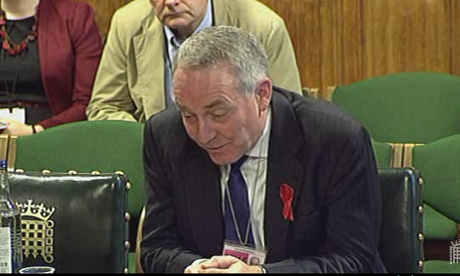
Boris Johnson, the mayor of London, is going global. He’s on a tour of the far east. This is from the Press Association.
Johnson is leading a trade visit to Singapore, Jakarta, and Kuala Lumpur today and will meet Indonesia’s new president Joko Widodo, Malaysian prime minister Najib Razak and Singapore prime minister Lee Hsien Loong.
The high profile international visit, which follows trips to China and India earlier in Johnson’s mayoralty, is tasked with “banging the drum” for London in rapidly growing markets.
Johnson will work alongside a UK Trade and Investment (UKTI) mission taking delegations of British small and medium sized businesses to meet potential customers in each country.
The mayor said: “It is vital to continue to bang the drum loudly for the capital’s status as a world class destination for business, jobs and innovation.
“The truly dynamic cities of Singapore, Jakarta and Kuala Lumpur are delivering exciting infrastructure and regeneration at a fast pace and are the perfect partners for London to share knowledge and expertise across many important sectors.
“By strengthening ties we secure long standing relationships that will form the basis of an abundance of opportunities for Londoners and people for the Far East to work together on future possibilities.”
During the six day visit, Mr Johnson will highlight London’s financial technology (FinTech) industry which has produced projects such as contactless payments on the London Underground.
The industry, which employs 44,000 people, generates £20bn in annual revenue for the UK economy.
Other events include a meeting at Singapore’s Botanic Gardens with executives and scientists from London’s Kew Gardens, including chairman Marcis Agius. A fellowship will be awarded by the Botanic Garden to Kew as the two organisations embark on scientific exchange projects.
And Johnson will deliver the annual Khazanah Global Lecture in a major speech to 200 of Malaysia’s top business and political leaders. Previous lectures have been given by Kofi Annan, the former UN Secretary General, and Manmohan Singh, the former Prime Minister of India.

Nick Clegg has been holding a press conference this morning in Berlin with the German deputy prime minister and vice chancellor, Sigmar Gabriel.
#Clegg in Berlin for talks with vice chancellor Gabriel pic.twitter.com/Ur3SuOFTgp
— David Charter (@DavidCharter) November 26, 2014
'The vast majority of British people want to continue to enjoy freedom of movement but don't want their generosity abused' #Clegg in Berlin
— David Charter (@DavidCharter) November 26, 2014
For the record, here are today’s YouGov GB polling figures.
Labour: 33% (down 1 point from YouGov yesterday)
Conservatives: 32% (up 2)
Ukip: 16% (down 2)
Lib Dems: 7% (up 1)
Greens: 6% (no change)
Labour lead: 1 point (down 3)
Government approval: -22 (up 8)
According to Electoral Calculus, this would give Labour a majority of 6.
David Cameron is due to give a major speech on immigration soon, possibly later this week. The Labour party launched a pre-emptive strike last week, announcing its own plan to curb benefits for migrants, including possibly cutting tax credits for migrants who are working. And today Nick Clegg has also put his proposals on the table, in an article in the Financial Times. The Lib Dems also want to limit benefits for migrants.
Here’s an extract from the FT’s news story (subscription), summarising Clegg’s position.
Mr Clegg accepts that British voters need to be reassured “the rules are fair” for migrant workers. He has already proposed that EU migrants should not be able to claim child benefit for children not living in the UK.
Now the deputy prime minister wants to stop migrants from claiming the new universal credit until they have worked in Britain for six months: the benefit would then only be payable for a maximum of six months.
Mr Clegg also wants to restrict the access of migrants to in-work benefits like tax credits, saying they should only be paid to people working the equivalent of a 35-hour week on the minimum wage: a threshold of £227 instead of the current £153.
And here is some more detail from Clegg’s article.
- Clegg says that if Cameron proposes putting limits on the number of EU migrants who can come to the UK, he will be making a big mistake.
David Cameron will soon give his much built-up immigration speech. If the prime minister asserts that a Tory government will introduce caps or overall quotas on the number of EU migrants coming here, we will find ourselves in the worst of all worlds. Ukip will say it is not enough. Europe will say it is not possible. Once again the British people will be plunged into a cycle of wild overpromising and inevitable disappointment, their scepticism confirmed. And the risks to the openness of the British economy will be considerable.
- Clegg says that other EU countries are restricting migrants’ access to benefits and that a recent European Court of Justice ruling had made this easier.
- He says that, as a first step towards stopping migrants getting child benefit for children abroad, it should be paid at the rate in the home country.
As a first step, we should pay the same rate as the country in which those children reside. In the UK it is about £80 a month, whereas in Poland it is less than half that. And there are other proposals we must now explore.
- He says Britain should consider re-entry bans.
There are examples from which we can learn. Germany is pursuing five year re-entry bans for migrants involved in identity or benefit fraud. We must see if we can strengthen our laws as well.
If there is any reaction to this, I will cover it later.
Here’s the agenda for the day.
Morning: Nick Clegg is visiting Berlin.
9.30am: The Commons business committee takes evidence from the Royal Mail, other postal companies and the CWU union about postal sector competition.
9.45am: David Anderson QC, the independent reviewer of terrorist legislation, gives evidence to the human rights committee.
10.30am: Rachel Reeves, the shadow work and pensions secretary, gives a speech on waste in the welfare budget.
12pm: David Cameron faces Ed Miliband at PMQs.
2.30pm: Nicky Morgan, the women’s minister and education secretary, gives evidence to the human rights committee about violence against women and girls.
3pm: Liz Truss, the environment secretary, gives evidence to the Commons environment committee.
As usual, I will be also covering all the breaking political news from Westminster, as well as bringing you the most interesting political comment and analysis from the web and from Twitter. I will post a summary at lunchtime and another in the afternoon.
If you want to follow me on Twitter, I’m on @AndrewSparrow.








._Patrick_s_Day_Parade_94380.jpg?w=600)



