Afternoon summary
-
Downing Street has signalled that it may reject a key recommendation in a wide-ranging report into the future of surveillance legislation published by David Anderson, the independent reviewer of terrorism legislation. The prime minister’s spokeswoman suggested that stripping ministers of their power to issue interception warrants, and giving it to judges, could be problematic. (See 1.13pm.) Theresa May, the home secretary, praised the report for its thoroughness, but she would not immediately commit the government to accepting its recommendations. Instead the government’s plans will be set out in a wide-ranging draft bill published in the autumn. Anderson said the current legislation was “incomprehensible” and “undemocratic” and called for a new, comprehensive, comprehensible bill covering surveillance. Summing up his plans, he said:
My aim has been to build on the best features of the current regime and to learn from the practice of other countries. The resulting framework aims not only to satisfy the majority who broadly accept current levels of investigatory activity and supervision, but to help build trust among sceptics both in the UK and abroad.
The opportunity now exists to take a system characterised by confusion, suspicion and incessant legal challenge, and transform it into a world-class framework for the regulation of strong and vital powers. I hope that opportunity will be taken.
Civil liberty campaigners have welcomed many aspects of the proposals (see 1.35pm), especially Anderson’s rejection of some aspects of the 2012 draft communications data bill (see 1.27pm), dubbed the snoopers’ charter by the Lib Dems. But, as Alan Travis writes in his Guardian analysis, ministers will be glad Anderson has endorsed the continued bulk collection of personal communications data.
-
Labour has mocked George Osborne’s claim that the taxpayer will make money from the sale of its majority stake in Royal Bank of Scotland. Speaking in the Commons, Chris Leslie, the shadow chancellor, said the Treasury could not pretend it was not making a loss on RBS because it was making a gain on completely separate assets. He said:
Taxpayers who bailed out RBS during the global financial crisis want their money and will rightly be suspicious of any rush to sell. We come to this extremely dodgy claim that if you roll everything together, you stand on one leg, you squint a little bit and then you look at RBS losses, they are not really that bad. Isn’t that a bit like saying I have sold my house and lost a fortune but don’t worry I have got a great deal on the car? Come off it - you can’t pretend that you are not making a loss on RBS just because you are making a gain on completely separate assets elsewhere.
Harriet Baldwin, a Treasury minister, said the government was getting the best deal for the taxpayer.
That’s all from me for today.
Thanks for the comments.
Updated
Andy Burnham, favourite in the Labour leadership contest, has been visiting Scotland.
Visiting Holyrood, Andy Burnham says relationship between SLab and UK party has "never been right since devolution" pic.twitter.com/Wcbim7M4yk
— Tom Gordon (@HTScotPol) June 11, 2015
Andy Burnham says he won't be taking sides in SLab leader contest but adds Kez is one of the brightest lights in the party
— Tom Gordon (@HTScotPol) June 11, 2015
He has also said he would be willing to give a “helping hand” to help another candidate get enough nominations to get onto the ballot paper. He told the Evening Standard:
I wouldn’t be against it as long as it didn’t create something artificial. It would have to be something that was used judiciously. But if it was to get someone over the line I wouldn’t be against it.
Sara Thornton, chair of the National Police Chiefs Council (a new body that replaced ACPO, the Association of Chief Police Officers), has welcomed the Anderson report. In a statement she said:
We support David Anderson QC’s finding that there should be “no no go areas” for those charged with law enforcement because without access to communications data we are less able to keep people safe. Proposed legislative changes to strengthen our access to communications data will help us to keep up with rapid changes in technology and emerging threats. We simply do not have the coverage which we had five years ago.
Labour’s plight must be truly dire if it is causing Alastair Campbell and John Prescott to fall out. Normally - unlike so many in the Labour party - they don’t have a bad word to say about each other.
But here’s Campbell’s reaction to Prescott’s interview. (See 3.10pm.)
@johnprescott it will not take three years to find out if they are up to it. Sad to see you lapsing into comfort zone. Unity around what?
— Alastair Campbell (@campbellclaret) June 11, 2015
And here’s Prescott’s reply.
.@campbellclaret So you'll be a Roman emperor giving the thumbs up or down on a democratically-elected leader? I want debate & a wide field
— John Prescott (@johnprescott) June 11, 2015
Here’s a Guardian video of Theresa May that draft surveillance legislation will be published in the autumn.
Lord Prescott, the Labour former deputy prime minister, was on the Daily Politics earlier, and he didn’t hold back. As well as repeating the point he made in a New Statesman article yesterday about Labour’s leadership rules making it too hard for candidates to get on the ballot paper, he hit out at - well, more or less everyone.
Here are the key points.
-
Prescott said that David Miliband’s intervention yesterday was “terrible” and that Miliband should “shut up”. Asked about what Miliband said, he replied:
Terrible. He should shut up. Look, we’ve gone through that period, the Miliband period is now gone. We’re not looking to a period where he emerges as another Miliband interpretation. I don’t think that’s possible. Get on with your international job. Don’t come over here telling us we do.
-
Prescott criticised Ed Miliband’s leadership.
They fought an election blaming the last Labour government as if it hadn’t achieved anything. We started off almost zero year. Many of the things that were to our benefit were not put to the fore. Too much control was in the hands of one person. It became almost presidential. With a load of advisers I’d never even heard of. We got the wrong policy. They didn’t trust us and we mustn’t make the mistake again. The problem with Ed is he’d almost done an agreement that you win this election on being anti-Blair. And David Miliband didn’t want to be identified with Blair. Seems to have changed his position since.
-
And he also criticised Ed Miliband for not still being leader - ie, for resigning too soon.
He should not have resigned right at the beginning. It’s the job of the leader to carry through the period of transition. Now we’re left at running the election, but leaders must be required. If you lose it you take the hammering but you don’t run away. But that’s what he did. That was wrong.
-
He criticised Alastair Campbell for saying the party should ditch the new leader after three years or so if he or she is under-performing. (See 10.19am.)
Alastair should know better. What does he mean? He’s going to tell us whether it’s alright in three years? It’s going to take us more than three years to get this party back into shape, win the election and the trust. Does he then come in on these arguments and say ‘you’ve not satisfied my task and I’m now going to attack you?’ Come on. Stay at home Alastair.
-
Prescott criticised Chuka Umunna and Liz Kendall for being too ambitious too young.
They want to run for leader before they’ve got any experience and it’s showing. For Chuka to say he was amazed the way the press - for God’s sake. What was he doing the last few years? One of the other candidates [Kendall] has rushed into the papers to say ‘I support these surplus years.’ Have you thought through what it is what you’re actually saying? Then she made another point about ‘why hadn’t we taken on the powerhouse of the north’? I developed the Northern Way ten years’ before which the government actually scrapped. She didn’t know that because she didn’t have the experience to know it. I don’t think researchers [should be] running for leader in four years.

Updated
Anderson report - A reading list
Here are two blogs from legal experts on the Anderson report.
Not surprisingly, David Anderson seems to approve.
@JoshuaRozenberg has read 373 pages so you don't have to ... http://t.co/zJ6jR35oZN
— David Anderson (@terrorwatchdog) June 11, 2015
-
Cian Murphy, a counter-terrorism legal expert at King’s College, London, says that the report is “most commendable”. Here’s an excerpt:
Perhaps the key contribution of A Question of Trust is Anderson’s development of five principles to guide law and practice of investigatory powers.
The Anderson Principles are:
- Minimization of no-go areas;
- Limits on powers;
- Rights compliance;
- Clarity and transparency; and
- A unified approach.
These principles might seem uncontroversial at first. However, their elucidation in 124 recommendations is likely to give rise to passionate debate given the strength of opinion on the subject already in evidence in the UK and in the wider world. For example, privacy campaigners may be unhappy with Anderson’s endorsement of the contention that the law should seek to minimize the (virtual) areas where individuals’ actions are beyond the reach of investigation. However, this principle goes hand-in-hand with the second, and Anderson also notes that at times the principle of limits on powers necessarily means that some crime may go unpunished. There is strong reliance throughout the Report on the principles of necessity and proportionality – imports into the UK legal system from the EU and the Council of Europe – and Anderson makes it clear that new powers should be given only if the case for them has been made out.
On the World at One David Davis, the Conservative MP and libertarian, said that David Anderson’s call for judges, not ministers, to have to sign off interception warrants was one of the key recommendations in the report. He said ministers would be reluctant to accept it.
Yes, they hate it; the simple truth is this involves a significant reduction in the power of the relevant secretaries of state, principally the home secretary and the foreign secretary. But as David Anderson told you, he signs off seven or eight a day. Well, you know I would take quite a long time signing off one warrant to intercept somebody’s phone. I would really want to know why it was necessary, I would want to know why, [and] I would want to check the data. Seven or eight a day - how good a protection for the public is that? Not very, really.
At the moment there was no accountability, he said.
Every time I ask a minister in this area they say they never comment on security matters. So, the result of that is there is no accountability, they’re the ministers but nobody knows what they are doing ... I’m not being rude about the relevant secretary of state, Theresa May, William Hague or others, but when they come to this job they are amateurs, they really have no more knowledge than that that is handed to them by civil servants and the operatives of the agencies. As such, I would rather trust a judge who has had a long history of dealing with security matters who knows what to ask, knows who to trust and so on.
Davis also said that, even if the government did not include judicial authorisation in its forthcoming investigatory powers bill, MPs and peers would insist on it being included while the legislation was going through parliament.
I’ve taken the quote from PoliticsHome.

What Liberty likes and doesn't like about the Anderson report
Liberty, the human rights pressure group, has released a detailed response to the Anderson report. It is unhappy with some of Anderson’s conclusions, but it is pleased with many others and on balance it is positive.
What Liberty likes
- Anderson’s call for all interception warrants and and some communications data requests to have to be approved by judges.
- His rejection of some elements in the draft communications data bill. (See 1.27pm.)
- His call for a new law to comply with international human rights safeguards.
- His call for investigatory powers tribunal rulings to be subject to appeal on matters of law.
- His call for hacking, or computer network exploitation, to be brought within the law.
-
His call for information about general spying capabilities to be made public.
What Liberty does not like
- His support for the bulk collection of communications to continue, subject to safeguards.
- His call for the data retention laws in the Data Retention and Investigatory Powers Act 2014 to remain.
-
The vagueness of the information provided in the case studies in the report (see 11.31am) to justify mass surveillance.
And here is a comment on the report from Shami Chakrabarti, Liberty’s director
This thoughtful report is in sharp contrast with the defensive whitewash from the discredited intelligence and security committee of the last Parliament. Liberty has been campaigning for judicial warrants and against the Snoopers’ Charter for many years.
Whilst we don’t agree with all his conclusions, Mr Anderson’s intervention could be the beginning of re-building public trust in surveillance conducted with respect for privacy, democracy and the law. It is further vindication of Edward Snowden’s courage.

Updated
This is what what David Anderson’s report says about three of the key proposals in the 2012 draft communications data bill (the one the Lib Dems dubbed the snoopers’ charter). He has rejected, or part-rejected, two of the three key elements.
In relation to the subject-matter of the 2012 communications data bill:
a) The provisions for IP resolution in the Counter Terrorism and Security Act 2015 are useful and should be kept in force.
b) The compulsory retention of records of user interaction with the internet (web logs or similar) would be useful for attributing communications to individual devices, identifying use of communications sites and gathering intelligence or evidence on web browsing activity. But if any proposal is to be brought forward, a detailed operational case needs to be made out, and a rigorous assessment conducted of the lawfulness, likely effectiveness, intrusiveness and cost of requiring such data to be retained.
c) There should be no question of progressing proposals for the compulsory retention of third party data before a compelling operational case for it has been made out (as it has not been to date) and the legal and technical issues have been fully bottomed out.
The “third party data” provision refers to a suggestion that British communications service providers should be obliged to collect data from overseas firms using their networks. For example, a broadband provider could be obliged to collect data on emails sent from abroad.
No 10 suggests government will reject call for ministers to lose interception warrant power
Downing Street indicated that David Cameron is unlikely to agree to a proposal by David Anderson that ministers should be stripped of their powers to authorise surveillance warrants.
The prime minister’s spokeswoman said that the authorities need to be able to “respond quickly and effectively to threats of national security or serious crime”. This suggests that Downing Street will be wary of handing the power to authorise warrants to judges.
The spokeswoman said:
The starting point on the issue of authorisation of warrants is that we need a system with proper oversight that allows us to respond quickly and effectively to threats of national security or serious crime. As part of our work now on the upcoming bill we will need to consider the recommendations that Anderson has set out today.
But Downing Street welcomed the Anderson report in general. The spokeswoman said:
The prime minister welcomes the report from David Anderson today. It is a comprehensive independent look at an extremely complex area. It will provide a basis for the forthcoming investigatory powers bill that we set out in the Queen’s speech. In terms of specific recommendations there are 100 or more in David Anderson’s report and it is right that we consider those carefully
Updated
Natalie Bennett, the Green party leader, says the Greens welcome David’s Anderson’s call for Ripa to be replaced, but disagree with him about mass data retention. In a statement she says:
The Green party is completely opposed to unaccountable mass surveillance, and is deeply disappointed that this report recommends that the intelligence agencies keep their powers to spy on the public.
Under mass surveillance there is a presumption that everyone is guilty until proven innocent, which goes against one of the fundamental principles of our justice system.
This approach is also counterproductive. The security services should focus on targeted surveillance of those they have reason to suspect. Intercepting everyone’s communications only creates a bigger haystack in which the security services must search for the real criminals.
However, we are pleased that David Anderson QC has called for the Regulation of Investigatory Powers Act, which has failed on so many levels, to be scrapped. With this gone, we can re-examine our whole approach to surveillance, remembering that safeguarding freedom of expression must be a priority.

Amnesty International has welcomed David Anderson’s call for an overhaul of surveillance legislation. This is from its UK legal programme director, Rachel Logan.
We’re pleased that David Anderson agrees with our longstanding call for the whole messy system of surveillance laws in this country to be given a radical overhaul ...
It’s only right that surveillance laws are fully scrutinised before they go into the statute book. We’ll need to see the fine detail here and we’ll be arguing strongly for proper limits on the powers of the snoops and the spooks.
Theresa May’s statement is now over.
She praised David Anderson for the “thoroughness” of his work, but did not sound over-enthusiastic about his recommendations. Beyond committing herself to new legislation (which was coming anyway), she is not backing any of his key recommendations at this point.
This is from the BBC’s Danny Shaw.
Theresa May: "I'd hope we'd be able to establish a law that can stand for some time" - bit non-committal on @terrorwatchdog exact proposals
— Danny Shaw (@DannyShawBBC) June 11, 2015
And this is from the Daily Mirror’s Jack Blanchard.
Sounds suspiciously like Theresa May is kicking the @terrorwatchdog report into the long grass. No meaningful Govt response until the autumn
— Jack Blanchard (@Jack_Blanchard_) June 11, 2015
Updated
Matt Warman, a Conservative, asks if it is right to the state to have the same powers in the age of Snapchat as in the age of the phone.
May says that is why the powers need to be updated.
Nicola Blackwood, a Conservative, welcomes the efforts to strengthen judicial oversight. But she urges May to combat the “narrative” that feeds Islamist extremism.
Alex Chalk, a Conservative, asks May to give due weight to the views of Lord Carlile, Anderson’s predecessor, who said the draft communications data bill was necessary and proportionate.
May says she agrees with that view.
Chris Davies, a Conservative, asks May if she agrees with David Cameron that there should be no safe spaces on the internet for terrorists and paedophiles to operate.
May says the agencies need powers to ensure that this is the case.
Crispin Blunt, a Conservative, says if the new bill is drafter from scratch, May will not have “a cat in hell’s chance” of getting it ready by the autumn.
May says parliament set a deadline of December 2016 for new legislation when it passed legislation last year.
She says some aspects of the new bill are ones that have been considered already.
Caroline Lucas, the Green MP, says the Anderson report vindicates the work of human rights campaigners. Will May accept that the blanket retention of data is unlawful?
May says Anderson says the powers the agencies have are the powers they need.
May says she is sorry Keir Starmer, the Labour MP and former director of public prosecutions, is not in the chamber today. Starmer knows how important communications data is, not just for investigating criminals, but for prosecuting them too, she says.
Tom Brake, the Lib Dem MP, says the Lib Dems were right to oppose the snoopers’ charter. Only Russia, among liberal democracies, tracks website searches, he says.
May says she disagrees with Brake. As technology has changed, the ability of the agencies to track people has been reduced.
She says the draft communications data bill was not about tracking the website searches of 40m people. The Lib Dems should stop presenting it in these terms, she says.
Labour’s Fiona Mactaggart asks if the conclusions of the secret report into this written by Sir Nigel Sheinwald will be made available to the joint committee looking at the new draft bill.
May says she will consider this. She says David Cameron mentions Sheinwald’s report in his written statement on this today (pdf).
Mark Pritchard, a Conservative, says the snoopers’ charter would be better called the security charter. May agrees.
Labour’s David Winnick says the snoopers’ charter is the biggest affront to civil liberties proposed by government for years.
May says the draft bill was no such thing. It was just about ensuring the intelligence agencies continue to get access to the communications information they can get now.
May says the Anderson report includes polling figures showing that the public trust the intelligence agencies, and want them to have the powers to keep people safe.
The public have a more “sanguine” approach to these matters than some people elsewhere, she says.
Labour’s George Howarth says the time allowed for the draft bill to be considered may be too tight. Could the current legislation be extended beyond December 2016, to allow more time for the bill to be considered properly.
May says she wants to meet the December 2016 deadline. It was put there for a reason, she says.
Sir Eric Pickles, the Conservative former communities secretary, says councils have abused their powers under Ripa.
May agrees. The last government introduced safeguards, she says. The government will not want to go backwards. Councils should not be using these powers to investigate whether a child is entitled to a place at a particular school.
Keith Vaz, the Labour MP, says the report is excellent.
Dominic Grieve, the Conservative former attorney general, says he agrees with Anderson about how incomprehensible the current legislation is.
The agencies need powers to protect us, he says. And, in his experience, they behave “ethically”, he says.
May says she agrees they behave ethically.
She says she agrees on the need for clear legislation. But she says that does not always happen one parliamentary lawyers get hold of legislation.
Joanna Cherry, the SNP justice and home affairs spokesperson, says the SNP was opposed to the ideas in the snoopers’ charter. Today’s report proposes more oversight, and the SNP welcomes that, she says.
She says the SNP also welcomes the call for judicial authorisation of warrants.
She says she has four questions.
Will the new legislation be more than just a name change from the draft communications data bill?
Will the new law be comprehensive, and will it include proper safeguards?
Will May fully engage with the Scottish government on this?
Will SNP members sit on the joint committee looking at the draft bill?
May says Cherry is wrong to refer to the snoopers’ charter. There was never any proposal for a snoopers’ charter, she says.
This is about updating the law, she says.
The new bill will not just be a rebranding of existing law, she says.
Discussions about the joint committee are taking place, she says.
David Davis, the Conservative MP, says the most important recommendation was the one for judicial authorisation for warrants. He says, with the exception of Zimbabwe, Britain has about the worst record in allowing politicians to authorise interception.
May says she will look at this carefully. But she will not commit herself today to agreeing to this.
Updated
May is responding to Cooper.
She thanks her for her constructive tone.
May says Anderson recommended judicial authorisation for warrants. But the intelligence and security committee took a different view, she says.
She says any solution should not disrupt the balance between the executive and the judiciary.
She will have to look at this idea, she says.
Yvette Cooper, the shadow home secretary, is responding.
She says Labour called for this report. Quoting David Anderson (see 11.25am), she says the current legislation is flawed.
She says surveillance is needed to protect the public. But existing safeguards are not strong enough.
She welcomes the proposal for judicial authorisation of warrants, and urges May to accept this proposal.
Cooper says Anderson says the powers in the draft communications data bill were too sweeping. She says she agrees.
She calls for a debate in the Commons on the Anderson report.
In other countries there has been a wider public debate on these issues than there has been here, she says.
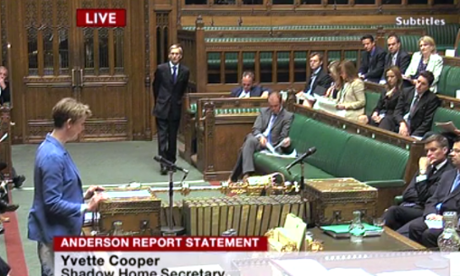
May says the use of sensitive powers should be overseen by parliament.
A draft bill will be published in the autumn for pre-legislative scrutiny by a joint committee, she says, with the intention of a proper bill being produced early in the new year.
-
May says she will publish draft surveillance bill in the autumn, and legislate before the end of 2016.
May says the Anderson report complements the report published by the intelligence and security committee earlier this year.
And later this year a report into this issue by RUSI will be published, she says.
Collectively, these reports will provide a firm basis for legislation, she says.
Updated
May says no redactions were made to the report prior to publication.
Theresa May's statement on the Anderson report
Theresa May, the home secretary, is making her statement on the Anderson report now.
She says the government intends to pass new legislation before the end of next year.
In his report David Anderson says that claims that Britain faces “exceptional” or “unprecedented” threats “should be approached with scepticism”. This is from page 39 of the report (pdf).
No one doubts the gravity of the threats that are faced by the UK and its inhabitants, or the capacity of those threats both to take life and to diminish its quality. But it is generally a mistake (though a surprisingly common one) to describe threat levels as “unprecedented”. Two points need to be kept in mind:
(a) Events capable of taking life on a massive scale are a feature of every age and every stage of development
(b) Whilst some of the threats faced at any given time will be realised, others will not.
The last point was well made by Jonathan Evans (now Lord Evans of Weardale) in a public speech as Director of MI5: “Those of us who are paid to think about the future from a security perspective tend to conclude that future threats are getting more complex, unpredictable and alarming. After a long career in [MI5], I have concluded that this is rarely in fact the case. The truth is that the future always looks unpredictable and complex because it hasn’t happened yet. We don’t feel the force of the uncertainties felt by our predecessors. ... At least some of the areas of concern that I have highlighted tonight may turn out to be dogs that don’t bark. ... On the other hand, the dog you haven’t seen may turn out to be the one that bites you.”
The moral is not that threats ought to be ignored: on the contrary, any credible threat should be guarded against. The point is, rather, that claims of exceptional or unprecedented threat levels – particularly if relied upon for the purposes of curbing well-established liberties – should be approached with scepticism.
The report (pdf), on pages 337 and 338, contains six short case studies intended to show the value of the bulk collection of data.
Here are two of them.
In 2010 GCHQ analysts identified an airline worker in the UK with links to al-Qaida. Working with the police, agencies investigated the man, who it transpired had offered to use his access to the airport to launch a terrorist attack from the UK, and pieced together the evidence needed to successfully convict him. This individual had taken great care to ensure that his extremist views and plans were totally concealed in his offline behaviour, meaning that this investigation and conviction would have been highly unlikely without access to bulk data.
Sometimes, because of the international nature of al-Qaida inspired terrorism, bulk data is the first and last line of defence. In 2010, an intelligence operation identified a plot which came right from the top of al-Qaida: to send out waves of operatives to Europe to act as sleeper cells and prepare waves of attacks. The intelligence specified unique and distinctive communications methods that would be used by these operatives. GCHQ, in partnership with many other countries, was able to identify operatives by querying bulk data collection for these distinctive patterns. This international effort led, over a period of months, to the arrest of operatives in several European countries at various stages of attack preparation – including one group literally en route to conducting a murderous attack.
Anderson says Ripa is 'incomprehensible' and 'undemocratic'
The Anderson report is pretty damning about Ripa (the Regulation of Investigatory Powers Act). It says:
RIPA, obscure since its inception, has been patched up so many times as to make it incomprehensible to all but a tiny band of initiates. A multitude of alternative powers, some of them without statutory safeguards, confuse the picture further. This state of affairs is undemocratic, unnecessary and – in the long run – intolerable.
Anderson's report - Summary of the key recommendations
Here is a summary of the key recommendations in David Anderson’s report.
- Existing internet surveillance laws should be replaced with a new law, “both comprehensive in its scope and comprehensible to people across the world”.
- The bulk collection of communications data should continue, subject to safeguards
- Judicial authorisation should be required for all interception warrants, with the role of ministers limited to saying some warrants are required in the interests of national security.
- Judicial authorisation should be required if the police want to obtain communications data relating to people like lawyers and journalists who receive information in confidence.
- The power in the draft communications data bill for the retention of website search information (one of the most controversial elements in the “snoopers’ charter) should only apply where “a detailed operational case can be made out and a rigorous assessment has been conducted of the lawfulness, likely effectiveness, intrusiveness and cost”.
-
A new independent surveillance and intelligence commission to be established, replacing the three existing commissioners dealing with surveillance.
Anderson says state should have to request encryption keys
Before the election there was a great deal of debate about whether the state should have the power to over-ride internet encryption services. In his report, David Anderson suggests some of the reporting has been misleading.
The agencies do not look to legislation to give themselves a permanent trump card: neither they nor anyone else has made a case to me for encryption to be placed under effective government control, as in practice it was before the advent of public key encryption in the 1990s. There has been no attempt to revive the argument that led to the Clipper Chip proposal from the NSA in the 1990s, when public key cryptography first became widely available. But the agencies do look for cooperation, enforced by law if needed, from companies abroad as well as in the UK, which are able to provide readable interception product.
And Anderson recommends that the presence “no-go areas” in the digital world should be minimised.
Few now contend for a master key to all communications held by the state, for a requirement to hold data locally in unencrypted form, or for a guaranteed facility to insert back doors into any telecommunications system. Such tools threaten the integrity of our communications and of the internet itself. Far preferable, on any view, is a law-based system in which encryption keys are handed over (by service providers or by the users themselves) only after properly authorised requests.
Updated
David Anderson publishes his report on surveillance powers
The David Anderson report is now out. The key links are on his website.
Here is Anderson’s news release about it (pdf).
Here is the report itself (pdf).
Here is a statement from Anderson about what he is recommending.
Modern communications networks can be used by the unscrupulous for purposes ranging from cyber-attack, terrorism and espionage to fraud, kidnap and child sexual exploitation. A successful response to these threats depends on entrusting public bodies with the powers they need to identify and follow suspects in a borderless online world.
But trust requires verification. Each intrusive power must be shown to be necessary, clearly spelled out in law, limited in accordance with international human rights standards and subject to demanding and visible safeguards.
The current law is fragmented, obscure, under constant challenge and variable in the protections that it affords the innocent. It is time for a clean slate. This Report aims to help Parliament achieve a world-class framework for the regulation of these strong and vital powers.
And here is Ewen MacAskill’s Guardian story about the report. And here is how it starts.
UK intelligence agencies should be allowed to retain controversial intrusive powers to gather bulk communications data but ministers should be stripped of their powers to authorise individual interception warrants.
That is the conclusion of a major report on British data laws published on Thursday that proposes changes to the oversight of GCHQ and other intelligence agencies.
The 373-page report, A Question of Trust, by David Anderson QC, also comes in response to revelations by the US whistleblower Edward Snowden about the scale of government surveillance disclosed two years ago.
GCHQ will be happy to have retained its bulk collection powers while privacy campaigners will be dismayed. The privacy lobby will take comfort though in the shift on warrants to judicial control.
Updated
In December 2012 the joint committee on the draft communications data bill published its report (pdf) on the surveillance powers proposed by Theresa May. (See 8.57am.) This was its key recommendation.
We accept that there is a case for legislation which will provide the law enforcement agencies with some further access to communications data, but we believe that the draft Bill pays insufficient attention to the duty to respect the right to privacy, and goes much further than it need or should for the purpose of providing necessary and justifiable official access to communications data. Clause 1 would give the Secretary of State sweeping powers to issue secret notices to communications service providers (CSPs) requiring them to retain and disclose potentially limitless categories of data. We have been told that she has no intention of using the powers in this way. Our main recommendation is therefore that her powers should be limited to those categories of data for which a case can now be made. If in future a case can be made for the power to be increased, this should not be done without effective Parliamentary scrutiny. We recommend the procedure for this.
The Labour leadership candidates are under renewed pressure to agree to a “break clause” that would allow the party to get rid of them easily in, say, 2018 if they were under-performing. Under the current rules, getting rid of a sitting leader is nigh on impossible. Lady Royall, the former Labour leader of the Lords, first floated the idea, but Alastair Campbell, Tony Blair’s communications chief, has raised it again, in comments in a Times frontpage story (paywall) which he has elaborated on in a lengthy and very interesting blog on Labour’s plight.
Here’s how Campbell explains his thinking in his blog.
There will be some who think the idea of someone like me publicly saying before we even have the new leader that we should try to oust them if they are failing is daft or disloyal. But it is not. Politicians are fond of everyone else in top public sector jobs being subject to regular assessment and review. So why not the leader of the opposition ? In my view the next leader should embrace this approach and embrace the idea of a confirmation process in the run up to a general election. It could be a massive opportunity. If the next leader turns out to be good and look like they can win, then great, they get confirmed in a big moment of renewal and energy before the run in to the election. And if the debate shows the party thinks the leader is not up to it, perhaps because we have had had three years of the public telling us so – and they are the boss by the way – then off they go. Sorry but there is it. Football managers have to deal with it. CEOs have to deal with it. If leaders fail, they go. It’s the real world and it is time we got back into it.
None of the candidates have embraced this idea yet (although Liz Kendall sounded vaguely supportive at one point when she spoke to the press gallery) but this is exactly the kind of pledge you might expect a candidate who is trailing to make later in the contest.
Do read the Campbell blog in full. He posted it at 5am and lack of sleep has clearly affected Campbell’s thinking because it starts with an elaborate and entertaining fantasy about how to create a lefty paradise by getting Scotland and Wales to hive off from the UK and link up with Norway and Denmark. But then he makes a telling point about Norway.
What I loved about Norway was the answer of Labour leader Jonas Lahr Store when I asked him how he intended to win the next election. Often at times like this, a private chat over breakfast, the politician comes back to a question like that with smart tactical ideas, a good slogan and news of the hiring of a hotshot foreign advisor.
He said this. ‘There are five big issues and give big themes for me and we need to build a campaign and an argument around them.’
– population growth. Oslo alone will grow from 600,000 to 800,000 and that will bring new opportunities for new business investment but it will also mean new schools and hospitals and a new way of dealing with and winning a progressive argument on immigration.
– ageing. How do we see this as an opportunity as well as a threat to traditional welfare models? How do we develop the concept of the family amid demographic change ...
When he had finished I just put down my knife and fork and said thank you. Thank you for being a political leader who sees election campaigns as being about big themes requiring big ideas and big solutions.
Campbell says he won’t be backing any of the Labour leadership candidates publicly and his endorsement of the “break clause” idea suggests he’s not very keen on any of them. In the Campbell household others feel the same way. This is what his partner Fiona Millar tweeted yesterday.
Getting fed up of Labour shadow ministers disowning any responsibility for the election defeat. Can't face voting for any of them.
— Fiona Millar (@schooltruth) June 9, 2015

Updated
The Anderson report will be out at 11am, Sky News reports.
On the Today programme David Omand, a former head of GCHQ and former security and intelligence coordinator at the Cabinet Office, was interviewed about the Anderson report. Omand has read it and, although he would not reveal its contents, he signalled what some of the key themes would be.
He was also very critical of Edward Snowden, the American NSA whistleblower.
Here are the key points.
- Omand said the current legislation governing surveillance was “very, very complicated” and “not easy to follow”.
- He indicated that he expected Anderson to conclude that the bulk collection of data was justified, but that it needed to be controlled by a framework making allowance for rights to privacy and free speech.
-
He said there was an issue to be resolved as to whether politicians or judges approved surveillance operations.
It would be, I think, unconscionable for a judge to authorise a very sensitive intelligence operation where the political risk, if it went wrong, fell on the home secretary, or overseas the foreign secretary, who would know nothing about it and wouldn’t have approved it. So you’ve got to have a system where sensitive national security operations are actually approved by ministers who will in the end have to bear the risk.
On the other hand, in terms of European precedents, most countries would have judges approving law enforcement. Somehow that has got to be worked through.
-
He said Edward Snowden knew “virtually nothing” about how the intelligence agencies operate in the UK and that his revelations did “an enormous amount of damage”.
The way [Snowden] did it, he has caused an enormous amount of damage to our security. Quite unnecessarily, because he stole information about support to British military forces overseas, he stole information about how law enforcement goes about pursuing particularly difficult crimes like paedophilia and narcotics. He did not need to do any of that. So, in my book he’s certainly not a hero.

Theresa May, the home secretary, will be making a statement to MPs on the Anderson report.
Despite govt saying no statements we now have 2: Bus Q's followed by circa 11.15/30 Home Sec on Anderson report. 12.15/12.30 Ch Ex on RBS.
— Labour Whips (@labourwhips) June 11, 2015
One of the most important laws being passed over the next 12 months or so will be the investigatory powers bill, described as a “turbo-charged” version of the snoopers’ charter when it was flagged up in the Queen’s Speech last month.
Today David Anderson, the independent reviewer of terrorism legislation - or the terror watchdog, as he calls himself on Twitter - is publishing a lengthy report that will have a huge influence on the debate about the legislation, and may have a considerable effect on how it is drafted. Anderson has described the background to this on his website.
I was required by DRIPA 2014, which passed through Parliament in only four days back in July 2014, to conduct an independent review of the operation and regulation of investigatory powers, with specific reference to the interception of communications and communications data, including under RIPA. That review was distinct from my normal function of reviewing the operation of the terrorism laws.
Parliament asked me, in particular, to consider:
“(a) current and future threats to the United Kingdom,
(b) the capabilities needed to combat those threats,
(c) safeguards to protect privacy,
(d) the challenges of changing technologies,
(e) issues relating to transparency and oversight,
(f) the effectiveness of existing legislation (including its proportionality) and the case for new or amending legislation.”
As I tweeted at the time, my report was completed and submitted to the Prime Minister on 6 May 2015 – the day before the General Election. A process of security-checking and preparation for publication has followed.
Given the size of the canvas that the Review was asked to cover, it will come as no surprise that it turned out to be a substantial piece of work. I am grateful to all who provided written submissions and who met with me in various parts of the UK, Berlin, California, Washington DC, Ottawa and Brussels, as well as to the small team of self-employed persons that assisted with the Review.
The report is out after 9.30am.
My Investigatory Powers Report, "A Question of Trust", will be released on Thursday (tomorrow), after 9.30 am. Text will be on my website.
— David Anderson (@terrorwatchdog) June 10, 2015
In a preview story, Alan Travis, the Guardian’s home affairs editor, says that Anderson is expected to argue that the proposed “snooper’s charter” - a reference to the draft communications bill, published in 2012 but then effectively shelved because the Lib Dems refused to agree to the coalition taking it any further - should be implemented, but with stronger oversight. Here is an extract from his story.
It is thought that the Anderson report is likely to clear the way for May to push ahead with the “snooper’s charter” powers but will insist it is done within a stronger oversight system and human rights framework.
The Anderson report comes after parliament’s intelligence and security committee recommended a new intelligence services act in the wake of the disclosures by the whistleblower, Edward Snowden. The MPs and peers said the new legislation should set out “clearly the intrusive powers available to the security agencies, the purposes for which they may use them, and the authorisation required before they may do so”.
A second secret report by Sir Nigel Sheinwald, the former British ambassador to the United States , commissioned at the same time as the Anderson report, is believed to have recommended that a new international treaty be negotiated to secure the co-operation of the giant American internet companies in providing their customers’ data in response to requests from British police and security services.
A report by the journalist Duncan Campbell in September of a Ditchley Foundation conference attended by senior intelligence figures suggested that post-Snowden a consensus had emerged in the intelligence community that a change towards transparency was both overdue and necessary.
I will be covering the report when it comes out, and bringing you reaction and analysis.
Otherwise it looks relatively quiet today. But, as usual I will be covering the breaking political news as it happens, as well as bringing you the best reaction, comment and analysis from the web. I will post a summary at lunchtime and another in the afternoon.
If you want to follow me on Twitter, I’m on @AndrewSparrow
Updated