Dave Mackay, who has died aged 80, flourished both as a fiercely competitive left-half with an enormous throw-in, and a manager capable of winning the League Championship with Derby County. He made his name with Heart of Midlothian, and also played internationally for Scotland, before moving to Tottenham Hotspur, where he was a member of the team that won the double in 1961.
Born in Edinburgh, he began his playing career with the Heart of Midlothian club, making his League debut in 1953. He made just four appearances that first season, but 1954-55 saw him as a regular player. Though a notably robust and even an abrasive player, he was anything but a big man, standing not much over 5ft 7in and weighing little over 11 stone, but he was utterly fearless and a forceful tackler. He was renowned for his shouting and gesturing, demanding from his team-mates the same commitment he himself gave.
With Hearts, he gained a Scottish championship medal in 1958 (when he captained the side), a Cup winners’ medal in 1956, and League cup medals in 1955 and 1958. His first cap for Scotland arrived in May 1957, when he appeared in a 1958 World Cup qualifying match against Spain. He was capped in the tournament itself in Sweden, when Scotland lost 2-1 to the brilliant French team of Raymond Kopa and Just Fontaine. All in all, he made 22 international appearances for his country, half a dozen of which took place in the 1959-60 season, after Mackay had moved south to play for Tottenham Hotspur.
He had been signed by Spurs in March 1959 for £32,000. He did not settle there quickly, but once he had done so became a dynamic force in their midfield, perfectly complementing the other – more elegant and academic – wing-half, the Northern Ireland international Danny Blanchflower, though Mackay’s virile approach was complemented by his skill on the ball.
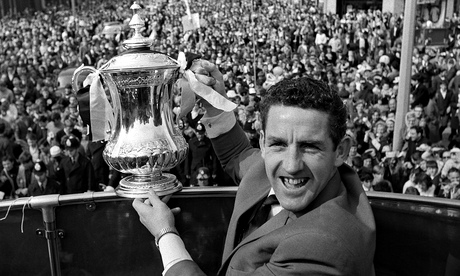
In the 1960-61 season, he was a major figure in Tottenham’s historic achievement in taking both the League and the FA Cup, the first club to win the double in the 20th century; Mackay made 37 out of the 42 League appearances, and figured prominently in the Cup final at Wembley, won against a Leicester City side largely reduced to 10 men. The following season Mackay added another Cup winners’ medal when Spurs defeated Burnley in the final.
He should also have participated in the final of the European Cup Winners’ Cup in Rotterdam in May 1963, but an injury to his stomach muscles kept him out of the game, which Spurs won in a five-goal canter against Atlético Madrid. There was more bad luck later that year for Mackay, when in a Cup Winners’ match at Old Trafford against Manchester United he broke his leg. With great determination, he found his way back, only to break the leg a second time; and return courageously, once more.
There was one more successful Cup final to come with Spurs, in May 1967, when he captained the team that beat Chelsea at Wembley. A year later, the club allowed him to move on advantageous terms to Derby County, where his career continued to flourish. In these latter years, he had to temper his rumbustious style, becoming essentially a second, left-sided centre-back but where, in his own way, he was just as effective. Derby was in the Second Division when Mackay joined at the start of the 1968-69 season, but under his influence and tutelage, the club won the division by seven points and returned to the First Division. Mackay was named joint Footballer of the Year.
In 1971 he went into club management, first at Swindon Town, and then, for the 1972-73 season, at Nottingham Forest. But in 1973 he went back to Derby County, to succeed Brian Clough as manager, and stayed for three years, taking the club to the League title in 1974-75. It was a low-points-scoring season, in which Derby’s 53 were two more than Liverpool’s 51. In later years he managed Walsall, Doncaster and Birmingham City, and clubs in the Middle East, before retiring from football in 1997.
He is survived by his wife Isabel, whom he married in 1954, and their four children, David, Derek, Valerie and Julie.
Brian Glanville
Julie Welch writes: Stocky, barrel-chested and gimlet-eyed, Dave Mackay combined delicacy of touch and sublime attacking play with an air of barely restrained violence. Danny Blanchflower might have been the inspirational captain of Spurs in their greatest era but Mackay was the one whose approval was sought by the players. He was the leader who had to win at everything, a man of huge energy and almost terrifying commitment. “You’d have to go into the gym with body armour,” his team-mate Bobby Smith once commented. “He’d smash you against the wall.” Even so, nothing he did on the pitch was ever mean or unbecoming. “I was a hard player,” Mackay maintained, “but I was never dirty.”
He was also brave. “If he had served in a war, he would have been the first man into action,” his manager at Spurs, Bill Nicholson, once said. “He would have won the Victoria Cross.” In 1964, when his leg was broken by a Noel Cantwell tackle at Old Trafford, and the bone visible for all to see, Mackay sat up on the stretcher that carried him away, as if signalling to his team-mates that he would get patched up and be back on the pitch with them in another 10 minutes. That summed up the essence of the man. No way was he going to go off as a fallen hero.
• David Craig Mackay, footballer and manager, born 13 November 1934; died 2 March 2015