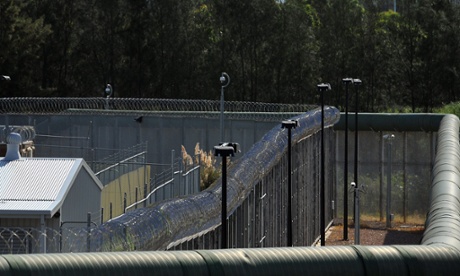
Australian governments invest more than $3bn in prisons every year, but it is impossible to know if this funding is directed appropriately because the number of people passing through the system is unknown, a new report says.
Current reporting of prisoner numbers “substantially” underestimates the number of people released from prison each year, the paper, published on Thursday in the Australian and New Zealand Journal of Public Health, says.
This is because the Australian Bureau of Statistics (ABS) records only the number and characteristics of people in custody on a single day – 30 June – each year.
By calculating ratios for NSW prisoners and applying them Australia-wide, the researchers from the University of Melbourne’s school of population and global health estimated that 38,576 people were released from prison in 2013.
This was 25.3% higher than the 30,775 people estimated to be in prison that year.
An author of the paper, Associate Professor Stuart Kinner, said it meant basing demand for support services on prisoner numbers alone was misguided.
“We know now the transition from prison to the community is a risky and complex time, where people face an increased risk of death, while two out of five will end up back in prison within five years,” he said.
“But no one can tell us how many people come out of prison each year, and we really need that information to scale for services like mental health, drug and homelessness services for that population.”
In other large, state-based systems such as public hospitals and schools, accurate data on the number of people moving through the system each day was readily available to the general public, Kinner said.
“Yet, despite a recurring public investment of more than $3bn a year, equivalent data are not available for Australia’s correctional systems,” he said.
The researchers also found for every young Indigenous woman in prison on 30 June, 2013, 3.7 young, Indigenous women were released.
“So if we used the ABS data to ask how many Indigenous women we need to worry about supporting in their transition to the community, we would be grossly underestimating the support needed,” Kinner said.
The foundation director of the Melbourne Poche Centre for Indigenous Health, Professor Shaun Ewen, said the most recent Closing the Gap progress report recommended developing a target for reducing imprisonment of Indigenous Australians.
But that would be difficult to achieve with no data on how many were being released, he said.
“Indigenous Australians are 15 times more likely than non-Indigenous Australians to be incarcerated, and we know that every time someone is released from prison, their risk of preventable death increases,” Ewen said.
“If we’re going to get serious about closing the gap and setting a target for reducing Indigenous Australians in prison, we need to get the basics right first. And that includes routine, accurate and public reporting of the number of Indigenous people who cycle through Australian prisons each year.”
Michelle McDonnell, a spokesperson for the Smart Justice project of the Federation of Community Legal Centres, said the paper raised other important issues around prison statistics.
“If we’re going to have evidence-based justice policy rather than a law-and-order evidence-free zone, there is a range of levels on which we need to know more and more frequently,” she said.
“That includes the composition of the prison population by all sentenced offences, which would let advocates better identify scope for prison alternatives that do not impact community safety such as low-level drug offences and imprisonment for fines. Better data might also allow comparisons between public and private prisons – for example, reoffending rates.”
It was not in the public interest for this information to be shrouded in secrecy, she said.