

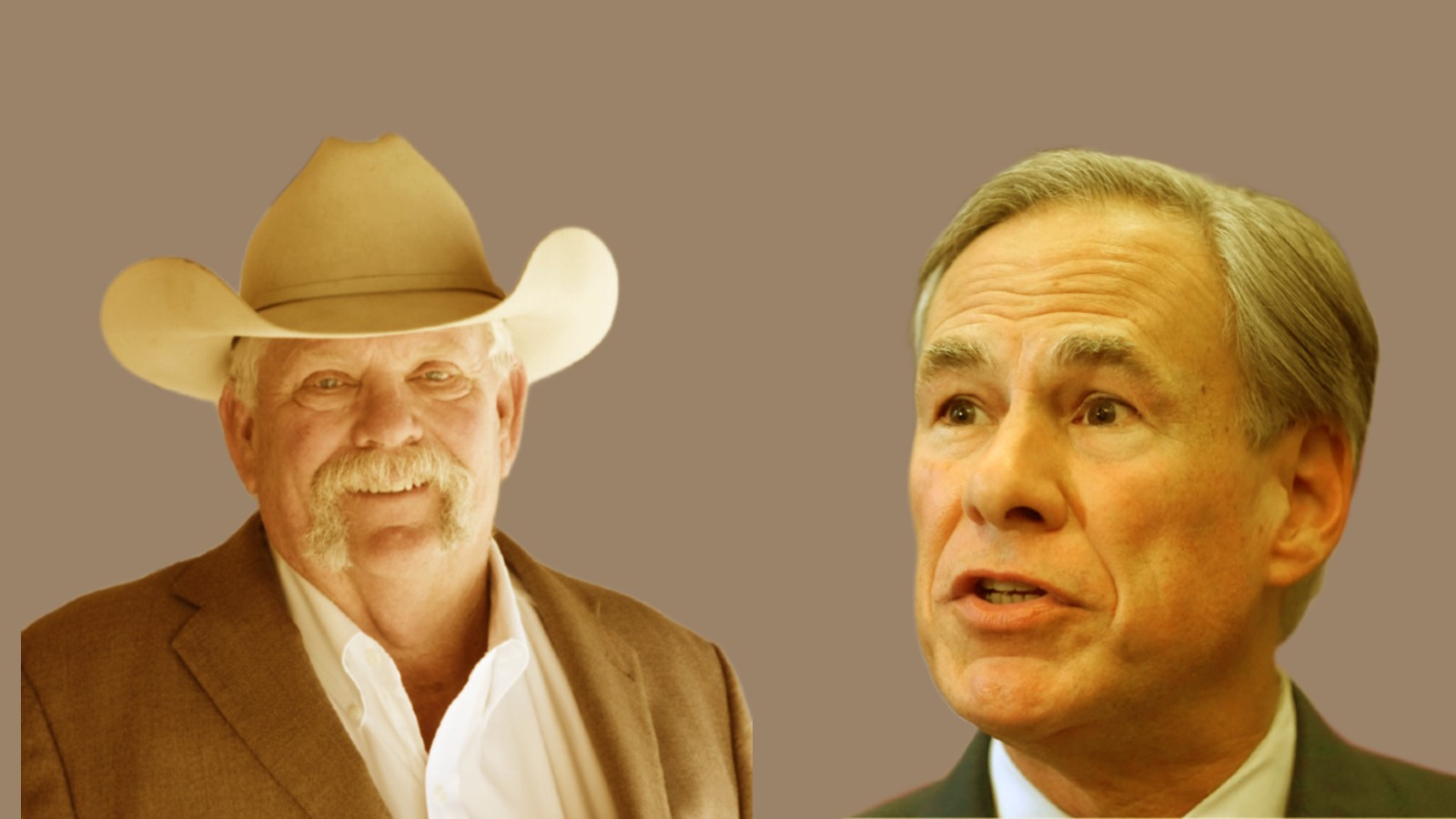
Caldwell County Judge Hoppy Haden, a stout 63-year-old who sports a cowboy hat and a white handlebar mustache, is hoppin’ mad about the artificial intelligence-fueled data center boom in his backyard.
Like so many other rural Republican county officials across the state, Haden is staring down several energy- and water-sucking data center projects that he and other county officials have very few powers to constrain. “By the time I hear about it, [developers have] already bought their land, so it’s not like they’re asking our permission to show up,” Haden told the Texas Observer. “So that’s frustrating, right? But I can’t do anything about that, so I’m trying to do something about things that I can do.”
The open pastures of rural Caldwell County, situated between Austin and San Antonio, are poised for at least four new data center developments. One of the largest developments is a 3,000-acre tech compound from the Denver-based data center developer Tract, which chose its site in Caldwell specifically for its access to the Permian Highway gas pipeline and to nearby transmission lines, according to the Caldwell/Hays Examiner. A New York-based data firm called Edged is planning another major data center on 330 acres near the county’s fracked gas plant.
The developments are among the more than 400 proposed data centers that are rapidly proliferating around Texas, and which collectively could, per the state’s power grid provider, quadruple electricity demand by 2032 and could consume as much as 161 billion gallons of water this year, according to the Houston Advanced Research Center. That’s in addition to the projects’ other well-publicized scourges, like light and noise pollution, heat, habitat loss, higher utility rates, greenhouse gas emissions, and potential health effects.
All this has Haden walking a tight rope between current state law, which grants counties next-to-no zoning authority, and angry citizens who have banded together under the banner of the nonpartisan Caldwell Data Center Action Team (DCAT) to demand the county do whatever it can to stop or delay the developments for as long as possible. In some ways, Haden exemplifies the ruling Republican Party’s divide over Texas’ data center boom, caught between unabashed champions like Governor Greg Abbott and grassroots conservatives pushing for an approach that seeks maximal local control, such as a countywide moratorium on data center development along the lines of what Hill County commissioners originally passed in May.
The policy debate thus far has exposed deeper tensions within the party as GOP state leaders have for years engaged in an expanding war on local control—aimed at big blue cities—in favor of state supremacy. But that ideological shift now has local Republicans finding that they, too, have fallen prey to that crusade.
So far, Haden and other county officials are choosing a middle lane between these political poles. Two days after the Hill County commissioners passed their data center moratorium, Caldwell County commissioners took a more moderate action by unanimously passing a resolution calling on the state to grant counties greater land-use authorities to rein in data centers. The resolution additionally calls for independent environmental assessments and for developers to disclose their energy, water, and infrastructure impacts before they can proceed.
Haden is also working with his county’s state legislators, Republican state Representative Stan Gerdes and Democratic state Senator Judith Zaffirini, to draft legislation that would do just that. Haden says his draft bill would grant counties the ability to impose certain land-use requirements on data centers within county subdivision ordinances. This would allow county officials to impose a range of limits on data center projects, including clear limits on potable water use, stormwater use, and wastewater discharge, forcing the data centers to use more efficient closed-loop water cooling systems with non-potable water and “dark sky” lighting, among other stipulations.
“This is not a property rights bill. I’m not asking for [developers] to be able to come or not to come. What I am asking is to be able to regulate our national natural resources if they arrive here,” Haden told the Observer.
Right now, Haden says, counties can only impose such requirements as part of a development agreement that would grant developers lucrative tax abatements or reinvestment zones. For now, per Haden, the county is granting tax abatements as a means of leverage in order to ensure data centers follow basic rules—sparking ire among many of his constituents in the process.
Haden said Gerdes, who did not respond to the Observer’s request for comment, agreed to help carry the bill during an annual meeting with local county judges in his district. Data centers dominated the discussion.
Later that week, on May 22, Judge Haden joined Zaffirini, her staff, and local activists from Caldwell DCAT and the San Marcos-based Data Center Action Coalition in a community center in Luling to discuss potential state legislation. Zaffirini told the Observer she was open to supporting Haden’s bill. “I’m very interested in [the county’s] proposals, and we’ll pursue them and we’ll vet them in the process,” she said.
The Laredo-based senator told the local constituents that she’s a strong proponent of local control and counseled those in attendance to engage the regulatory powers at the Texas Commission on Environmental Quality and Public Utilities Commission and testify at the Legislature’s upcoming committee hearings.
In turn, local activists urged Zaffirini and Haden to back a moratorium similar to Hill County’s, arguing that the data center projects are being rushed into construction while they wait for legislative and regulatory process to play out.
Haden’s draft bill is one of several pieces of possible legislation focused on data centers, a topic that will be a central issue for the GOP-controlled legislature when it returns to session in January. Earlier this year, Texas Lieutenant Governor Dan Patrick directed state senators to focus on the issue in several interim committee hearings scheduled this summer that will weigh data centers’ economic benefits against the projects’ vast resource costs to local communities. One issue he’s zeroed in on is the possibility of eliminating state sales tax exemptions for data centers, which are reportedly costing the state at least $1 billion a year.
According to the Texas Tribune, state Representative Cody Vasut, who represents a rural-ish district in coastal Brazoria County, has vowed to bring a bill that would return regulatory control over data centers to counties next session. He filed the bill last session, but it languished in committee. State Representative Helen Kerwin, a rural Republican from Glen Rose, also called on the governor to support a statewide moratorium until the necessary environmental studies can be completed, while soon-to-be state Senator David Cook has said he plans to bring a bill that would also give counties new powers to regulate data centers.
The outgoing Republican Texas Agriculture Commissioner Sid Miller, too, has called for a statewide moratorium, questioning the benefits of continued tax incentives and subsidies for data center developers. “We must not surrender our resources to global corporations without asking hard questions about the costs to Texas families, farmers, ranchers, and property owners,” Miller wrote.
Haden is running out of patience and has called on Abbott to call a special legislative session specifically to address data center regulation. “Governor Abbott could call [a special session] tomorrow. He has chosen not to. I mean … we have special sessions over who can use which restroom, but we don’t have a special session for this,” Haden said just before voting to pass the county’s resolution supporting data center regulation.
Meanwhile, Abbott, who has received more than $2 million from the AI industry, fully embraces the data center boom—exemplified by his high-profile photo op last November with Google CEO Sundar Pichai welcoming three new data centers in West Texas and selling the state as a new AI hub. “This is a Texas-sized investment in the future of our great state,” Abbott said. “Texas is the epicenter of AI development, where companies can pair innovation with expanding energy.”
Other influential Republican legislators, including state Senator Paul Bettencourt, are applying a now-familiar GOP line at the Capitol—statewide uniformity over local control—to the data center debate. “These should be statewide, top-down guidelines. You can’t have 254 different counties and 1,000 cities all coming up with different answers. Stuff would never get built,” he told the Tribune.
When Hood County considered enacting its own data center moratorium earlier this year, Bettencourt wrote a letter to state Attorney General Ken Paxton warning that counties had no constitutional or statutory power to enact such a development pause and encouraging the AG to explore legal responses. The county commissioners court then voted to kill the pause on several proposed projects.
Hill County, which proceeded with its pause, voted on June 4 to renege on its moratorium after being slammed with a $100 million lawsuit from the industry. The county could potentially face another suit from the state for exceeding its authority in passing the original moratorium.
Susie Carter, a Caldwell DCAT member and former Hays County commissioner, who owns 120 acres adjacent to Virginia-based Powerhouse’s 500-acre data center development in Caldwell County, is among the conservative Republicans calling on GOP leaders to back state or local moratoriums. Carter told the Observer she hopes that calls for a statewide pause from state leaders like Sid Miller might influence Haden and Caldwell commissioners to pursue a similar measure to Hill County’s—but so far, Haden told the Observer, that’s something he isn’t willing to do.
Carter said: “We need to quit approving [data centers], and we need to call a moratorium, or a pause, statewide to let people come to understand what really is involved with them.”