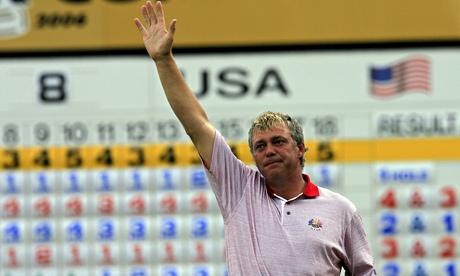
Judging by first impressions, Darren Clarke will resist what can only be a natural temptation to make his own firm mark on the Ryder Cup captaincy. That stance, in itself, is a wholly wise one.
Europe’s recent success, so serious that the USA have taken to appointing a task force, owes everything to the progression of a template rather than radical approaches. Upon confirmation that he is the successor to Paul McGinley, Clarke made clear that he will look to continue with more of the same by the time Hazeltine comes around in September next year.
“We all know how good a job Paul did at Gleneagles and how successful that whole event was,” Clarke explained. “I think it would be very silly to move away from that. It was so successful. The team bonding was unbelievable and Paul’s role in things would figure in all that. It would be stupid of me to move away from that.
“I will obviously consult with other past captains, as well, and try and get as much information as I can to what was successful. But I think the way Paul did things the last time at Gleneagles, it will be tough to get it any better than that.”
Clarke, therefore, has no aspirations of altering qualification processes, captain’s picks or vice-captaincy numbers. “I wouldn’t foresee any reason why we would want to change,” he said. “The system we have in place is obviously a very successful one, so I think it would be foolish of me to ask for any changes.”
Clarke was the sensible appointment to lead Europe in Minnesota, a matter it did not take the five-man selection panel of George O’Grady, David Howell, José María Olazábal, Colin Montgomerie and McGinley long to conclude. Clarke is a golfing traditionalist, popular in the United States and has been immersed in the Ryder Cup since his first of five consecutive appearances in 1997.
Clarke’s Ryder Cup story will thereby come full circle, exactly 10 years after he cut an emotional figure by playing a part in European victory at the K Club just six weeks after the death of his first wife, Heather.
“I think what I went through there was perfect preparation for anything I would ever face in the game of golf afterwards,” he said. “Obviously, that’s been one of my most emotional experiences in the game, and just with it being the Ryder Cup, as well, everything that goes along with it, it was a very special week for me.
“Emotion is part and parcel of the Ryder Cup, we’ve seen that before; we’ve seen that from Seve Ballesteros and José María when they were partners. You’ve seen it so many times. It’s a massive part of it. I think the European team has been obviously very successful in capturing that emotion and using it for their benefit.”
With 19 months to go before a competitive ball is struck, there appear to be two obvious dangers to Clarke. The first has a basis in the expectation, with Europe in such fine form against the USA team, that more glory could somehow be taken for granted. “I would be foolish not to realise that,” Clarke responded. “With the run that Europe have been on, it’s an exceptional one. We are going for our fourth straight win. That hasn’t been done before. With the players that we have at our disposal, I think it’s definitely an achievable feat.
“But it will be difficult going to America, there’s no doubt about that. The home crowd always makes the difference. Medinah was very special, the way the guys performed on Sunday, doing what they did, coming back from where they did. But yes, I would expect a very, very stern test from America, as it always is.”
The second danger, albeit not unique to this Ryder Cup, is the likely strength of the USA. Patrick Reed and Jordan Spieth have emerged as young, potent forces. Dustin Johnson will be too, provided his attitude is correct. In short, the USA may actually benefit from the potential progression from the high-profile Tiger Woods and Phil Mickelson axis, which can no longer be taken for granted.
“We have a lot of players at the top of the world rankings,” Clarke said. “Very, very strong players. The team gelling and stuff from the European point of view seems to be a little stronger than it is for the Americans. Can you point your finger on why so successful? Not really. It’s just the way it goes. Europe are on a good run and I hope that run continues.”
Clarke has started by saying all the right things. Which, throughout history, has proved a key part of the Ryder Cup captaincy remit.