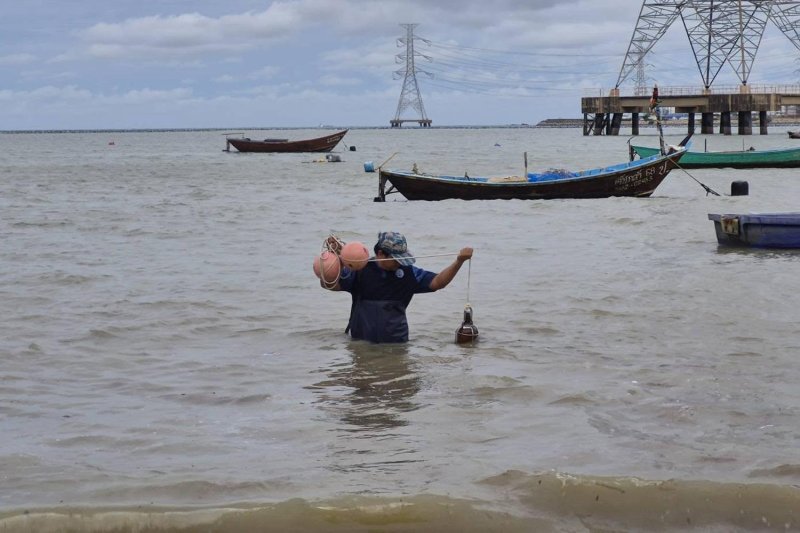
The Ministry of Industry has ordered the strictest level of environmental monitoring following reports of unusually dark seawater and foul odours in Pradu Bay in Rayong province.
The issue gained public attention after social media users reported black-coloured seawater and a sulphur-like odour near the mouth of Chak Mak Canal and Pradu Bay.
In response, officials from the Department of Marine and Coastal Resources (DMCR) inspected the area on Sunday. Initial water-quality tests found dissolved oxygen levels within normal standards and detected no signs of a critical threat to marine life.
According to the department, the affected area is a semi-enclosed bay with limited water circulation, and fine sediment and organic matter carried by canals flowing into the bay have accumulated on the seabed over a long time.
During periods of strong monsoon winds and rough seas, sediment can be stirred up and brought to the bay's surface, causing the seawater to appear dark and murky. The decomposition of organic material trapped in low-oxygen sediment may also release hydrogen sulfide gas, which produces an odour similar to rotten eggs.
Despite no serious harm to local marine animals reported, the DMCR noted that short-term impacts are expected on seabed-dwelling and coastal species, including shellfish, crabs and other seabed invertebrates, as sediment and organic matter may smother their habitats and reduce oxygen levels.
Officials are also closely monitoring nearby coral reefs and seagrass beds to minimise potential ecological damage and protect local communities.
Industry Minister Varawut Silpa-archa said the Industrial Estate Authority of Thailand's (IEAT) Map Ta Phut Industrial Port and Environmental Monitoring and Control Center (EMCC) had been instructed to conduct a thorough investigation using scientific equipment.
He stressed his ministry had directed the IEAT to maintain 24-hour monitoring of high-risk areas and impose maximum legal penalties on any factory found illegally discharging wastewater.
Laboratory results from the EMCC showed that seawater quality remained within normal and safe levels. Tests indicated neutral pH conditions and high oxygen levels suitable for marine life.
Additional investigations found no evidence that nearby factories had released wastewater beyond legal limits.