Sometimes the intention is more striking than the achievement. I applaud the National’s attempt to broaden its cultural base by offering us a play about Muslim culture written by Shahid Nadeem for Pakistan’s adventurous Ajoka Theatre. But, in Tanya Ronder’s free adaptation, it feels like a slightly earnest history lesson.
The subject itself is fascinating: the war of succession in the 17th-century Mughal empire between the sons of Shah Jahan: the man who built the Taj Mahal in honour of his wife. One son, Dara, is a Sufi poet and scholar and a model of religious enlightenment. His rival, Aurangzeb, is power-hungry, puritanical and a strict adherent of Islam. Starting in 1659, the year of Dara’s humiliating defeat and trial and Aurangzeb’s ascent to the Peacock Throne, the play ranges back and forth in time to capture the source of the sibling rivalry and to touch on its consequences.
It is clear that Shaheed Nadim’s motive in writing the play was to correct the historic imbalance by which Aurangzeb is seen as an Islamic role model and Dara as an unworldly heretic. But what in Pakistan is a brave, moral choice becomes, in Ronder’s version, a one-sided deification of Dara. You see this most clearly in the prolonged trial scene which, one gathers, is Ronder’s own work.
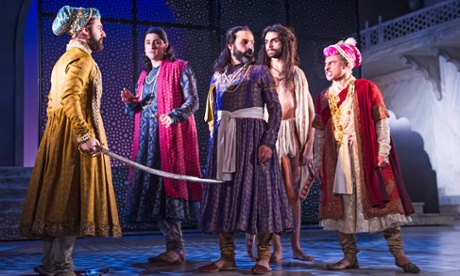
On one level it is stirring to hear Dara rebutting the charges of apostasy by declaring, “I am a Muslim who recognises that other religions have value” and arguing that the Qur’an is both the word of God and the product of a specific time and place. But, dramatically, the dice are so heavily loaded in favour of Dara that one longs to hear the counter-arguments better put than they are by a heavy-handed prosecutor.
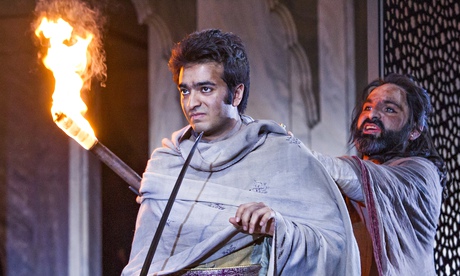
The play works best in smaller moments: in the fables told by a Sufi saint to Dara or in an imperial eunuch’s savage rejection of the parents who sold him into slavery. It also looks consistently beautiful in Nadia Fall’s production with the sliding lattice screens of Katrina Lindsay’s design and the soft hues of Neil Austin’s lighting proving richly atmospheric. Zubin Varla captures perfectly the anguished idealism of Dara, who has the instincts of a fakir but finds himself embroiled in fraternal power battles, and there is fine work from Sargon Yelda as the Machiavellian Aurangzeb, Anjana Vasan as his Hindu lover and Chook Sibtain as the vengeful eunuch.
But, however well the play is done, it seems a partial history that suffers from its hero worship of Dara and consequent vilification of his brother.
• Until 4 April. Box office: 020-7452 3000. Venue: National Theatre. Buy tickets from theguardianboxoffice.com or call 0330 333 6906.