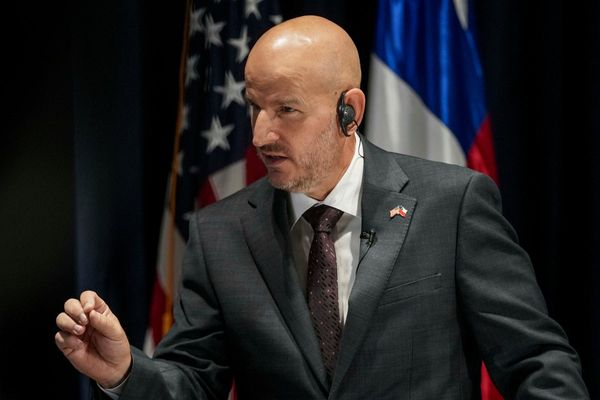
Danish Justice Minister Soeren Pape Poulsen said Wednesday he would prefer for militants from his country to die fighting in Syria rather than return home, drawing criticism from the opposition.
With the collapse of ISIS’ last bastion in Syria over the weekend, several governments have been grappling with the problem of what to do with captured militants from their country.
Denmark's official policy to take back foreign fighters has generated public debate.
"It's better that they are jailed here (rather than) traveling freely," Pape Poulsen told a parliamentary committee on Wednesday, local papers reported.
But, he added, it would have been preferable "if they had fallen in combat over there".
According to Agence France Presse, the opposition Social Democrats criticized the minister's remarks.
"These are not words that I would have used," Trine Bramsen, a spokeswoman for the party said.
Pape Poulsen, who is also the leader of the Conservative Party, explained that there were around 40 militants with links to Denmark in what used to be the ISIS territory in Syria, 10 of whom had been captured.
Since 2016, it has been a criminal offense in Danish law to have fought in conflict zones for a terrorist group.
The courts have already convicted 13 people for having joined or tried to join a terrorist organization, Pape Poulsen told the committee.
Nine of those convicted were stripped of their Danish nationality and expelled from the country. The others could not be stripped of their citizenship as they did not hold dual nationality.
Syria's Kurds warned Sunday that the thousands of foreign militants they have detained are a time-bomb the international community urgently needs to defuse, AFP said.
The US-backed forces in Syria called Monday for the establishment of an international court in the country to try suspected ISIS militants.
"The call... is really a call for help by the authorities in northeast Syria," said Nadim Houry, from the New York-based watchdog Human Rights Watch.
"They have been abandoned by the international community to deal with the aftermath of ISIS."
An international tribunal run by specialized judges would help answer the pressing questions of who, why and how to move towards some form of closure, jurists said.
Joel Hubrecht, from the Paris-based Institute of Advanced Legal Studies, argued that only such a court could match the impact of crimes "that scarred the entire world in its humanity,” AFP said.
The gradual military reconquest of ISIS territory has so far unearthed mass graves estimated to contain at least 12,000 bodies in Iraq and 5,000 in Syria, according to a UN inquiry.
The group is also accused of mass rape, of perpetrating deadly attacks on several continents and of genocide against the Yazidi minority in northern Iraq.
The global nature of ISIS's crimes justifies large-scale trials for its bosses, comparable to those organized in Nuremberg for Nazi leaders, Hubrecht said.
"Such a collective endeavor would bring a much more potent justice response than when it is delivered locally," he said.
Harvard academic Andras Riedlmayer also noted that "all of humankind has been deprived of its memory by these wanton attacks on its patrimony".
Riedlmayer agreed that an international tribunal would provide a good alternative to justice systems in Iraq and Syria that lack resources and independence.
The trials that have already taken place for ISIS crimes in Iraq have been condemned by rights groups as failing to meet international standards.
"In a 15-minute hearing, there is no time for hearing what happened. Victims are not heard," Nadim Houry said.
"They cannot ask questions to ISIS suspects, they cannot ask 'What happened to our loved ones?'"
But Houry raised the critical issue of "selective justice", arguing that a court would lack in credibility if it was perceived as tackling only certain perpetrators and not others.