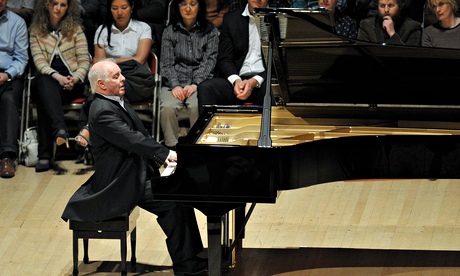
The programme for the second instalment of Daniel Barenboim’s Schubert series consisted of the sonatas in B major, G major and C minor – D575, D894 and D958, respectively. These are the first public concerts for which Barenboim is using the newly designed piano to which he has given his name. In addition to the sense of occasion that invariably accompanies his appearances, we’re conscious of a process of discovery, of testing the instrument’s potential and range.
The clarity and lightness of touch of the new piano have already received considerable comment. But those at the first concert who found Barenboim’s performance of the early A minor sonata, D537 overpowered, might have been surprised to discover that D575 was almost studiedly reined in, except for some sudden moments of imperious assertion that gave the impression Barenboim wanted to let the work off the leash but couldn’t quite bring himself to do so. D894, meanwhile, is sometimes described in terms of quiet serenity. There’s more to it than that, of course, and here we were conscious of a fierce intellect at work, carefully probing the surface to examine the emotions and colours stirring beneath.
D598, however, gave us both Barenboim’s finest Schubert and the greatest insight into the new piano’s capabilities. This is Schubert at his most intense in a work that is at once dramatic, lyrical and spectral. There was a fieriness in Barenboim’s articulation, an instinctive shaping of long-breathed phrases and a powerful combination of authority and delicacy throughout. The adagio’s big central melody revealed wonderfully warm depths in his piano’s central registers, and the final tarantella’s swirl from grace to menace, gathering pressure as it went, was superbly done. Breathtaking.