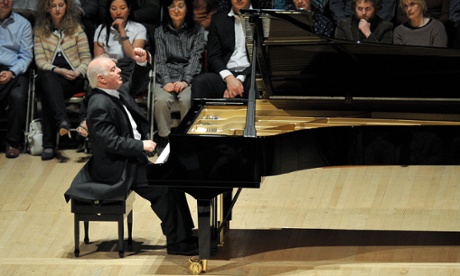
The final two legs of Daniel Barenboim’s four concert, 11-sonata Schubert series culminated, as it must, in the last sonata of them all: the B flat, D960. But the journey towards this inevitable summation began far away with the E flat sonata, D568, grand and exploratory in Barenboim’s occasionally undisciplined hands, and the darker dramas of the A minor, D784, in whose clashes and contrasts Barenboim’s Beethovenian instincts clearly revelled. It was, though, the D major sonata, D850, that revealed the characteristic essence of Schubert’s piano writing, with Barenboim’s mastery of tone, weight and touch turning the spotlight on details of this expansive work, which is playful, wistful and soaring by turns, almost as if Schubert was extemporising as he wrote his score.
It would be too crude to say that these occasionally uneven concerts have presented Barenboim’s Schubert, rather than the composer’s own, though some Schubertians will certainly feel this. Yet in everything Barenboim played there was a sense of a spontaneous encounter, in which the details were never subsumed into a predetermined whole. Sometimes, as in the first movement of the A minor sonata, D845, with which the final concert opened, the fingerwork threatened to get away from him, although the colour and balance of the playing was mostly of the highest order. The scherzo and trio were particularly successful, the trio seeming to transcend the written notes into something immensely mysterious and still.
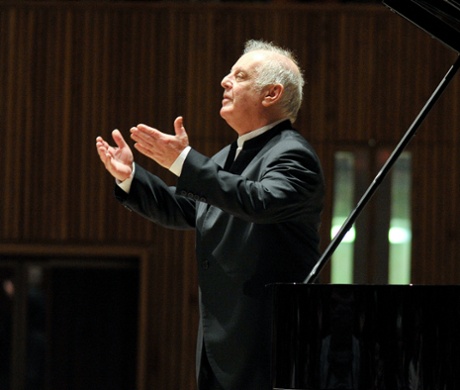
And so to D960. Occasionally, Barenboim can skate over the inner qualities of works he has been playing for 60 years. That was never true for a moment of this intensely concentrated and probing reading, stirring memories of Rudolf Serkin in this hall long ago, with the arc of the first movement unerring yet everything given space to breathe. The later movements were models of buoyant fingering and rhythmic control. But the finest musicianship of the night, worth all the rest, came in the second-movement andante, where the softness, slowness and simplicity of Barenboim’s playing in the final bars seemed to unlock the most private and profound reflections of the composer.