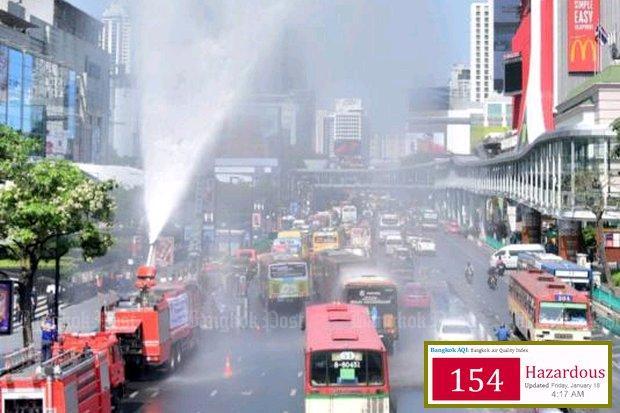
The haze is expected to worsen again over the weekend in Bangkok after the cold front over Thailand dissipates, according to the Meteorological Department.
Phuwiang Prakhammin, director-general of the department, said that on Saturday, Bangkok and its vicinity could face stagnant air circulation with minimal wind, he said, noting the smog could become worse on Sunday with a build up of fine particulate matter known as PM2.5.
Pollution will not be worse than the past several weeks, supposedly, because rainfall on Tuesday and Wednesday helped to significantly diminish the haze, Mr Phuwiang said.
Disaster Prevention and Mitigation Department director-general Chayapol Thitisak said his agency is continuing to spray water into the air to reduce dust in Bangkok and three provinces in the Central Plains. Officials were looking to ensure there would be no outdoor burning, particularly along the sides of highways, he said.
Meanwhile, PM2.5 levels were still dropping in the capital as of 6pm Thursday. They fell to a range of between 37 and 56 microgrammes per cubic metre (µg/m³), according to readings taken by 10 air quality stations in Bangkok. The so-called safety limit is 50 µg/m³.
Transport authorities were also checking city buses to control emissions of black exhaust fumes.
Transport Minister Arkhom Termpittayapaisith said at least two buses that officials inspected were producing more black exhaust than the law allowed Thursday morning. They were taken off the road.
In the afternoon, Mr Arkhom and land transport officers also inspected 111 buses at the Bangkok Mass Transit Authority's (BMTA) depot in Chatuchak district. According to the minister, most buses' emissions were acceptable.
He said 815 city buses had B7 diesel in their tanks which was replaced with the more environmentally-friendly B20 biodiesel on Tuesday.
Another 1,260 vehicles would have their fuel changed from the beginning of next month. "The change of fuel could help reduce black exhaust smoke by 3.7%," Mr Arkhom said.
In the long run, 2,188 buses powered by clean energy, including natural gas and electricity, would be procured, said Prime Minister Prayut Chan-o-cha.