Both Larry Elliott (Prolonged deflation remains a slim risk, 14 January) and your editorial (14 January) are alarmingly complacent about the slide in inflation towards deflation, as already grips the eurozone. The idea that a deflationary environment boosts living standards is delusion: as industry’s input prices decline, businesses respond to competitive pressure by cutting their prices, which in turn leads to cuts in wages or layoffs to maintain profit margins or avoid losses. Any business fortunate enough to enjoy an oligopoly will simply boost its profit margins and shareholder distributions. As the UK has the highest ratio of household debt to GDP in Europe, wage cuts lead to catastrophic loan defaults devastating bank balance sheets. As returns on traditional fixed-income securities turn negative, financial markets turn increasingly to leverage and speculative propositions to “juice up” returns, which is unsustainable and eventually turns to crash. None of this is a nightmarish fantasy: this is exactly what happened in Britain and across Europe from 1925 after Churchill, as chancellor of the exchequer, took the catastrophic decision to restore sterling to the prewar gold standard. It was not even clever politics in the short-term: the Tories’ landslide majority of 1924 collapsed in the 1929 election which made Labour the largest party for the first time. What followed, with the Wall Street crash and rise of fascism, may be history, but we should try by all means possible to avoid repeating it.
Tom Brown
Labour in the City
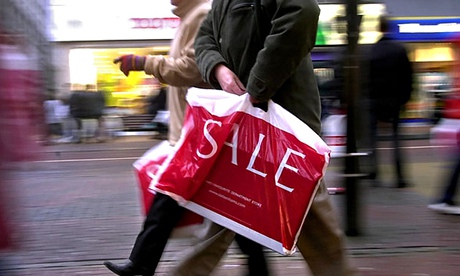
• Economists need to “look through” their theory a bit, and see what goes on in the real world. The idea that deflation will make us all stop spending now in the expectation of falling prices is about as plausible as the contractionary fiscal expansion that underpins austerity. If it were so, then shops wouldn’t do any business between sales and would all go bust. Anyway, our whole success story is based on buying stuff now, on credit, that we can’t really afford.
And while we’re at it, how can “core inflation” exclude things like food and fuel, which happen to be driving the present story? What is more “core” to people’s lives than driving to the supermarket? Perhaps there is no such thing as inflation, just prices that rise and fall in ways that can be added up and averaged.
Tim Grollman
London