Hull was the most heavily bombed city outside London during the second world war, though the fact was heavily suppressed at the time, with reports citing only damage to “a north-east coast town” in the interests of national security. The embargo lasted until the 1970s, though the extent of the city’s devastation still escapes attention. Hull was not chosen for inclusion in the BBC’s recent Blitz Cities series for example.
Still, the city is quite capable of standing up and telling its own stories; and Richard Vergette’s play, inspired by the 1,000 hours the population spent under alert throughout the war, is the first of a trilogy of historical plays dedicated to Hull’s oft-tested resilience in anticipation of its year as UK City of Culture in 2017.
The play focuses on two families from either side of Hessle Road (such distinctions matter in Hull) and the sorely tested but enduring love affair sparked by a dancehall encounter between Grace, a fish-filleting girl, and Tom, her prize catch. Vergette’s pleasingly unpretentious writing is stylishly enhanced by Mark Babych’s production, in which big-band euphoria becomes eerily replicated as a danse macabre among the city’s ruins.
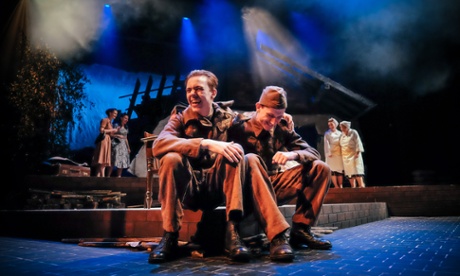
Both Laura Aramayo and Marc Graham impress as the sweethearts, while Christine Mackie, as Tom’s mother, shows particular sensitivity to where the lines of snobbery are drawn: “Hessle Road – it’s only a thoroughfare but what a difference it makes.” John Elkington slightly compromises the distinction by doubling up as the dads on either side: but his depiction of a breakdown caused by the distressing experience of an air-raid warden is moving nonetheless.
If the successive parts of the trilogy show a similar degree of confidence, it should go some way to putting the anonymous, north-east coastal town back on the map.
• At Hull Truck theatre until 24 October. Box office: 01482 323638.