On an unlit stage, a man sits staring intently at petals, candles and spiralling smoke, murmuring incantations under his breath in a blessing to the gods.
Over the next 80 minutes, Sri Lanka’s longest running dance company, Chitrasena, show off an ancient national tradition – the worship and celebration of demons and gods through the language of dance and the beating of drums.
When the company first toured the country in 1963, Australians had an opportunity to see the performance of this classical Asian dance for the first time. Some 52 years later, Chitrasena still opens a window bewitchingly to another time and place.
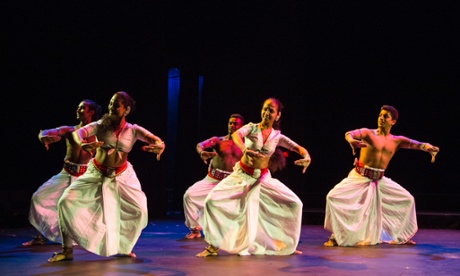
The seven dancers in the company appear in different combinations in each of the six performances within the show, displaying the distinctive posture of the Kandyan and Ruhunu styles, which have similarities with Bharata Natyam and other forms of Indian classical dance.
The body is held squarely upright in a vertical axis, holding a tight bend in the lifted elbows and knees, the foundation for intricate footwork patterns and expressive, flowering hand gestures. Repetition and sharpness of movement is a central feature of this ritualistic style, most obviously on show in the performance of Moksha, a reflection on the development of the Kandyan dance form.
According to Chitrasena, who founded the dance company in 1943, repetition is a key part of dance meditation and worship: “Why do you repeat? To emphasise, to bring a point home.” A point that Thaji Dias, Chitrasena’s granddaughter and the company’s star performer, heeds in her second linear and majestic solo piece, tirelessly returning to the same postures again and again.
There are more human moments, too. In the storytelling of Pantheru Matha, three female dancers have greater individuality. The women gape in awe, transfixed as an invisible god is resurrected. A dancer who curls up, hugging her knees, overcome with emotion, asks for our sympathy. And we also see the purposeful and graceful Dias collecting up three pantherus – a special tambourine-like instrument used in the dance – as an offering to a deity.
The choreography is both enchanting and mystifying in other places within Dancing for the Gods. Does an arm delicately waving during Ganapathi Vannama invoke the trunk of Ganesha? Is the wildly bent, rotating torso of a man a reaction to the demon god, Gara Yaka?
The poise that shapes the company and the way they dance reveals an impressive discipline – as engaging to watch as these narratives are to work out. And with a new president elected in Sri Lanka for the first time in 10 years, watching these old forms – these blessings and ceremonies – is a delight. Even as the country’s political cogs are shifting, its oldest creative traditions survive.
• Dancing for the Gods is at Seymour Centre, Sydney, until 11 January
Sydney festival 2015 runs from 8 to 26 January at venues citywide. Find all Guardian Australia’s coverage here