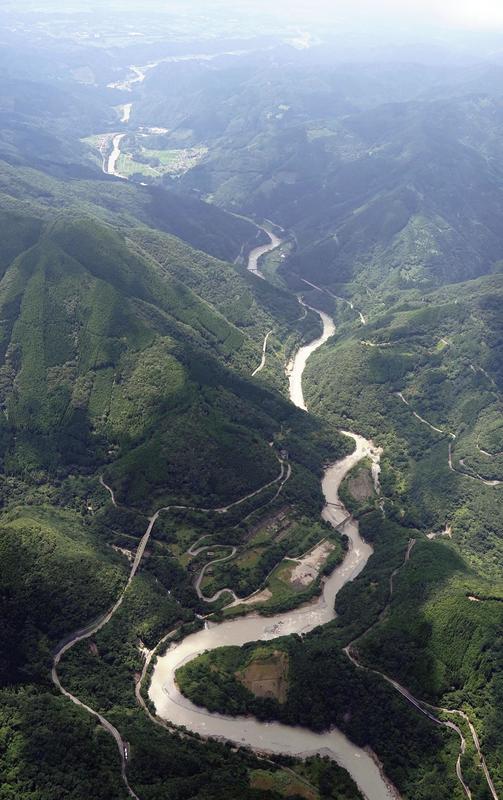
The volume of flood water that hit central Hitoyoshi, Kumamoto Prefecture, when the Kuma River overflowed last month could have been reduced by more than 90% if a dam had been built along one of its tributaries upstream, according to estimates by a Kyoto University team.
A project to build a dam on the Kawabe River was halted about 10 years ago. If constructed, the dam would have been one of the largest of its kind in the Kyushu region, holding back 133 million tons of water.
During heavy rains, the peaks for water flowing into the Kuma and Kawabe rivers came almost at the same time, causing severe flooding on July 4 in the center of Hitoyoshi, located just downstream from where the two rivers meet. More than 3,700 buildings were flooded in the city, leaving 20 people dead.
Tetsuya Sumi, a professor of hydraulic engineering who leads the team, used rainfall analysis by the Japan Meteorological Agency as well as topographical and geological data for the area to assess the impacts of those heavy rains, based on the assumption that the dam had been built as planned.
The team estimated that up to 2,500 tons of water would flow into the planned dam per second. Even if the dam's maximum discharge capacity was set at 200 tons per second, with water stored to its full capacity at 84 million tons, the team concluded that the dam would not have been able to prevent the flooding.
However, the team concluded that in this case, the amount of water flowing into the center of Hitoyoshi would have stood at about 1.7 million tons, less than 10% of the actual amount of water that inundated the city center at about 23 million tons. Moreover, the dam could have delayed the flooding by about two hours, according to the estimates.
A construction project for a dam on the Kawabe River was first announced by the central government in 1966. In 2008, Kumamoto Gov. Ikuo Kabashima expressed his intention to withdraw the plan, mainly in response to local opposition. The following year, the government led by the Democratic Party of Japan, which held to a stance of not relying on dams, finally decided to suspend its construction.
Tadashi Yamada, a professor of civil engineering at Chuo University, described the findings by the Kyoto University team as "scientifically reasonable."
"Based on benefits that dams can bring, we should have calm discussions on what measures are necessary for flood control and how local communities should develop by looking at the entire area along a river," he said.
Read more from The Japan News at https://japannews.yomiuri.co.jp/