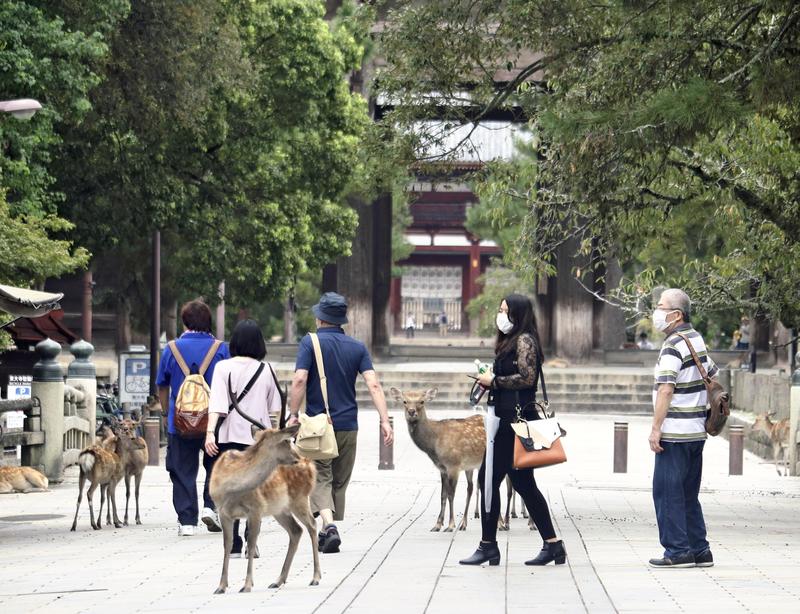
NARA -- The novel coronavirus has changed not only people's way of life, but also that of animals including the famous deer of Nara Park. With the pandemic leading to a massive drop in tourism, the deer are now foraging for food instead of awaiting handouts from visitors to Japan's ancient capital.
In mid-September the deer were grazing in the park, looking more at ease since the summer heat had abated and the area was not overrun with tourists. Before the coronavirus outbreak, the deer regularly gathered around visitors, seeking crackers from them. Such a sight is rarely seen nowadays.
Wild deer typically move from forests to grasslands around sunrise in search of food and then return to the woods after sunset. They spend most of the day eating staples such as grass, chewing the cud and resting.
-- Behavioral changes
A deer's natural behavior is to eat and rest at night. In January before the outbreak, less than 50% of deer in the area were doing so, according to research conducted by the Nara Deer Preservation Foundation and Shiro Tatsuzawa, an assistant professor at Hokkaido University. Many deer had been seen trailing people in attempts to be fed or, conversely, being followed by tourists who tried to touch the animals.
However, in their study conducted in June, the percentage of deer that ate and rested at night reached 90%. It is believed that the animals now spend more time relaxing and chewing cud at night due to the decrease of human interference.
The deer population in Nara Park is also declining. One possible explanation is that because fewer tourists are giving them food, the deer have moved to the nearby foothills in search of sustenance, experts said.
Tatsuzawa suggested it may be better for the deer to live in their natural environment and not rely on humans for nourishment. He said it could reduce their stress and improve the animals' health.
"Deer are not pets," Tatsuzawa said. "It's important to raise awareness of etiquette so humans and deer can coexist."
-- Shifting relationship
Nara's deer have been treasured since ancient times because they are believed to be divine messengers.
Legend has it that the deities of Kasuga Taisha shrine arrived on white deer from Kashima Jingu shrine in Hitachi Province, present-day Ibaraki Prefecture. This is why the deer are called shinroku, or deity deer, and the animals have enjoyed generous protection. Centuries ago, killing or injuring a deer was punishable by death.
During the Edo period (1603-1867), the relationship between the deer and humans shifted. A tourist guidebook to Yamato Province -- the old name for Nara -- published in 1791 contains a drawing of people at a teahouse feeding crackers to deer, suggesting such interactions between humans and deer were common by that time.
Since the Meiji era (1868-1912), the deer have been in danger of extinction on several occasions. They were designated as a nuisance in the Meiji era and were also aggressively poached in the social turmoil during and immediately after World War II.
Nara's deer have been protected as a national natural treasure since 1957. According to a survey conducted by the Nara Deer Preservation Foundation in July, there are 1,286 deer in the park.
This year marks the 140th anniversary of Nara Park's opening. Deer have coexisted with humans in the greenery that surrounds the Buddhist buildings in the ancient capital. Perhaps the time has come to reevaluate the relationship between Nara's divine messengers and humans.
Read more from The Japan News at https://japannews.yomiuri.co.jp/