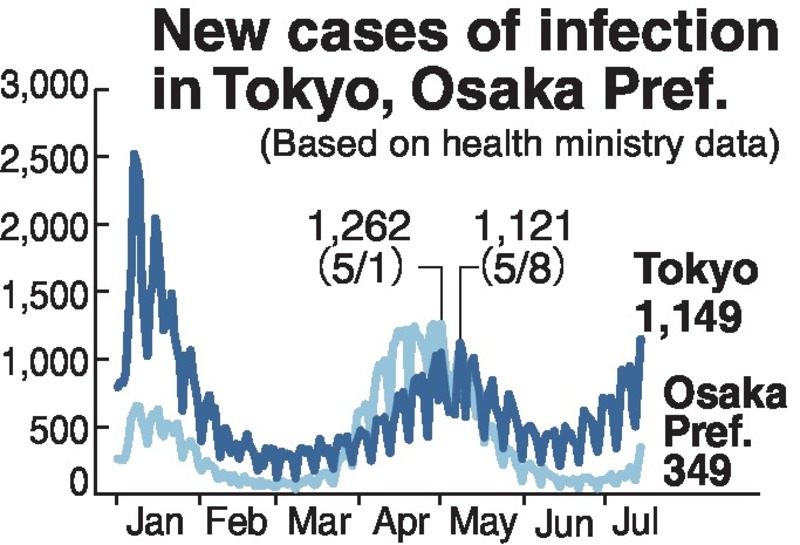
With 1,149 new cases confirmed on Wednesday, the daily number of novel coronavirus infections has exceeded the highest figure logged during the fourth wave in Tokyo.
The largest number seen during the fourth wave was 1,121, a level confirmed in May. Wednesday also marked the first time in about two months that daily cases exceeded 1,000 -- there had previously been 1,010 cases confirmed on May 13.
A total of 349 new cases were confirmed in Osaka Prefecture on Wednesday, going over 300 for the first time since May 27.
An advisory body to the Health, Labor and Welfare Ministry said the spread of infections has been notable in the Tokyo metropolitan area, and other areas also have seen their numbers rising again.
According to the Tokyo metropolitan government, the daily tally in the capital increased by 229 on Wednesday from a week earlier. This marked the 25th straight day that the daily number has topped the figure from the same day in the previous week.
In contrast, the number of seriously ill COVID-19 patients dropped by four from the previous day to 54, and there were four deaths related to the disease. These figures have not been increasing.
According to data from the advisory body, which held a meeting Wednesday, the number of new infections in Tokyo during the week through Tuesday was 39.75 per 100,000 people, up 30% from the previous week. The capital has continued to be at Stage 4, the most serious alert level with a weekly figure of at least 25 people infected per 100,000.
Most of the people infected are in their 20s to 40s. The percentage of those 65 or older has dropped to about 4% of the total as vaccinations have progressed for the elderly.
In Chiba, Kanagawa and Saitama prefectures, foot traffic increased both during the day and night. The advisory body expressed strong concern that the spread of infections would continue for a while in areas centered on Tokyo.
A surge in infections has also become evident in the Kansai region since the beginning of July. There are fears the virus will spread further in that area, as more people are going out at night.
In random testing conducted over the week through July 4 to check for Indian variants such as the delta variant, which are considered to be highly infectious, the percentage of such variants came to 11% nationwide, up four percentage points from the previous week.
The figures were 18% in Tokyo and 25% in Kyoto Prefecture. The National Institute of Infectious Diseases estimates that the Indian variants have accounted for more than 40% of infections in the Kanto region and over 20% in the Kansai region.
Read more from The Japan News at https://japannews.yomiuri.co.jp/