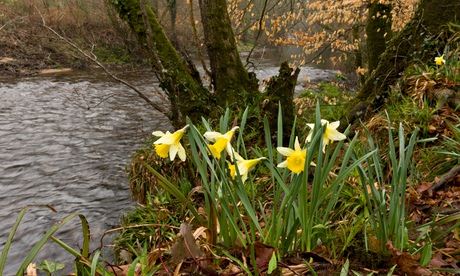
As the snowdrops fade, early daffodils, once cultivated for sale, flower in the regenerating woodland and around the orchard trees we planted some 30 years ago on the steep slopes of this old market garden.
Henry Irvings, with dainty trumpets on tall stems, remain upright and bright yellow. Beneath ash and oak in the copse called Sullens wood heavy blooms of a First variety have flopped among withered harts tongue fern, green moss and the startling scarlet of elf cup fungi.
On this morning the bleating of sheep and lambs, recently moved from their nursery shed, echo across the valley and sound louder than the bird song. In the drizzle, the daffodils, including Sir Watkin, the pale-petalled Princeps and the sun-like Helios, show open flowers, and buds of a Victoria variety push from sturdy leaves growing in their original rows.
If picked today the patch of Carlton might produce 50 perfect bunches, but only if the rain holds off. Developed by P D Williams, of Cornwall, Carlton dates from 1927 and is still grown commercially as the flowers last well, including when picked in tight bud, in the modern way. It is also a plant source of galanthamine, which is used in the treatment of Alzheimer’s disease.
Even older varieties have survived clearance on this historic plot and in other gardens in the parish. They are less showy than the types now grown for the cut-flower trade, but hardiness has allowed naturalisation in the woodland that has overtaken the neglected steeper ground, as well as on the hedge banks where they were thrown out, replaced by new varieties.
Snowdrops too used to be planted on the banks, to be picked and bunched as an extra source of income. In this cool spring they have been particularly long lasting beside farmsteads and former garden plots such as the narrow Brake lane that skirts the once productive Cleave valley.
Here, among rabbit burrows, beneath flailed top growth and bracken, drifts of these wintry flowers exist with discarded Fortune narcissi, pennywort, dog’s mercury and clumps of mud spattered primroses. But the celandines will remain closed until the sun appears.
Twitter: @GdnCountryDiary