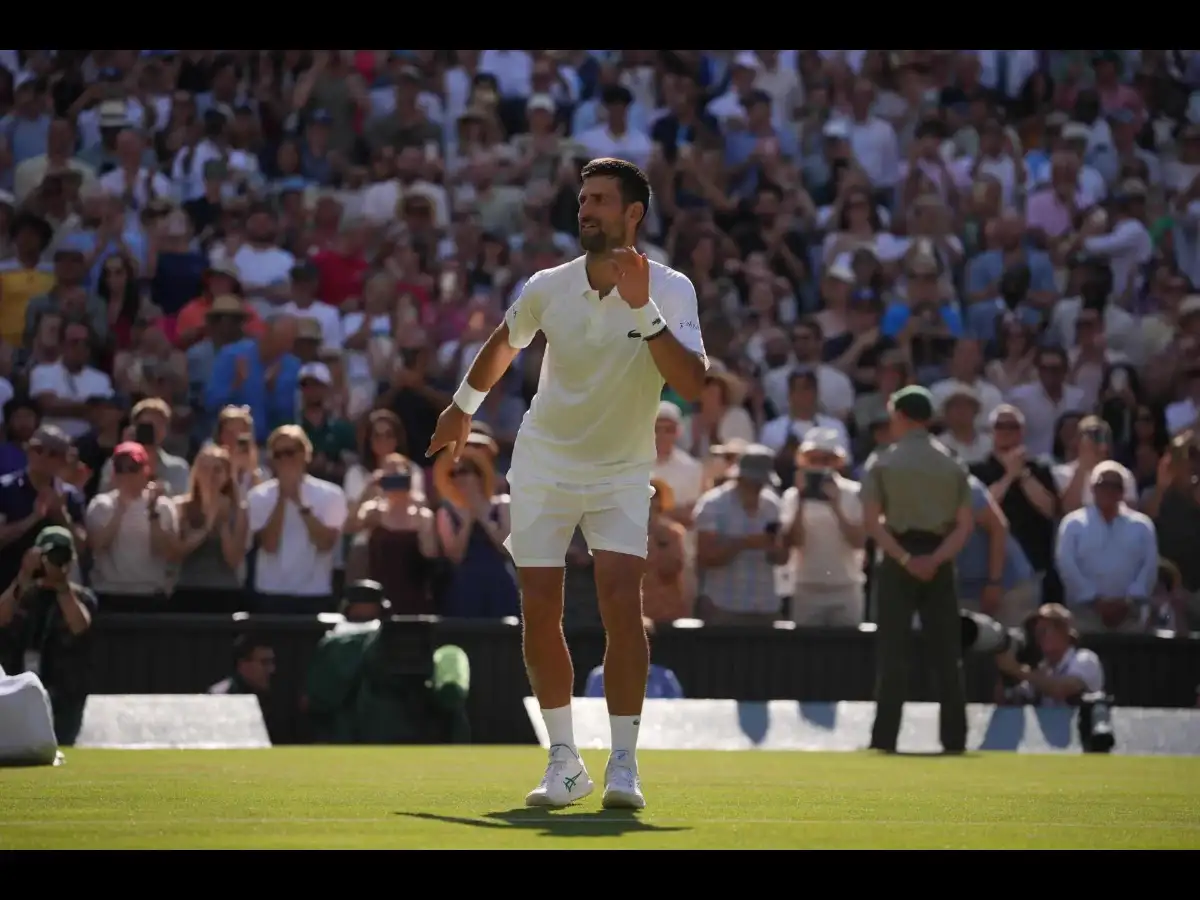
As the match clock ticked over the three-hour mark, Novak Djokovic hurled his body towards a ball to execute a volley. He connected, sending it sailing over his French opponent, Arthur Rinderknech, who also lay prostrate on the other side of the net. His day was done. Djokovic raised his arms in celebration before turning to his daughter in the stands, breaking into a celebratory jig that instantly became a viral social media moment.
The Djokovic story at this year’s Wimbledon is trapped in the remarkable numbers that surround it. He is 39. He has won this thing seven times already. If he does it again, he will become the only human, in all of tennis history, male or female, to win 25 major titles.
Yet, the data points, jaw dropping as they are, only tell part of this borderline miracle playing out in the full glare of the sporting world. In the first six months of the year, Djokovic played a mere 13 matches, losing four of those. He arrived at Wimbledon, having not played a professional match for over a month. Yet, over his first three rounds, Djokovic has executed grass court tennis with the surgical precision of an established master.
Laser focused on protecting his supremely fit, yet ageing body, Djokovic has been efficient and clinical. In the second round, against former world No. 3 Stefanos Tsitsipas, Djokovic pounced on the Greek’s vulnerability with a flawless performance — 33 winners and just seven unforced errors — enabling him to get off court in just over 90 minutes.
In the third round against big-serving Rinderknech, the Serb found himself confronting a sterner challenge. He actually lost more points than he won (108-117), trailed on both the winners (40-67) and aces struck counts (15-21), yet outwitted his rival at critical junctures in the contest to get the win. “Today, I was quite stressed out,” he later admitted. “There was more tension than usual. I knew it was going to be a very challenging match for me. I am just happy to overcome this. It was a really tiring, really close match. Sometimes you have to find a way to win, and I’m happy that I did that today.”
Over the last few years, as Jannik Sinner and Carlos Alcaraz have dominated the circuit, Djokovic has remained resolute in the chasing pack, determined to “find ways to win”. This last week, on the familiar grass terrain, there appears to be an intentional ease in his methods. In an earlier round, Djokovic pranked a ball kid, pretending the scissors she was using to cut material from his shirt had stabbed him. When asked about equalling Roger Federer’s mark of 105 match wins at Wimbledon, he joked, “I propose a match-up between me and Roger for 106. Let’s just stop it here and call Roger to come.” Then of course, there is the “dad dancing”!
Quite visibly, the burden of chasing statistical history does not appear to weigh heavily on Djokovic, who seems to be relishing the opportunity to tackle younger opponents to the ground. He’s having fun while doing it. Now as the tournament enters its latter half, Djokovic looks to have settled on a clear formula: expend as little energy as possible, attack selectively, rely on placement and depth in shotmaking, and move up to the net with more regularity than in the past.
Later today, 29-year old Russian Roman Safiullin, ranked 132 in the world, will attempt to deny Djokovic a place in the quarterfinals. However, the stars appear to be aligning for an almighty scrap in the semifinals against Sinner later in the week. There are still a couple of steps though before that mouth-watering clash is confirmed. Before that, Novak Djokovic will be aiming to get some more “dad-dancing” practice in!