Is there a busier figure in the dance world than Sidi Larbi Cherkaoui? The Flemish-Moroccan choreographer directs his own company, Eastman, which oversees a diverse range of projects and collaborations, and earlier this year he was appointed artistic director of the Royal Ballet of Flanders. Cherkaoui is also a unique performer. Slight and balding, as bonelessly flexible and collapsible as a string puppet, he is a chameleon of physical theatre. In the past he has shared the stage with, among others, flamenco bailaores, Shaolin monks and Japanese anime performers.
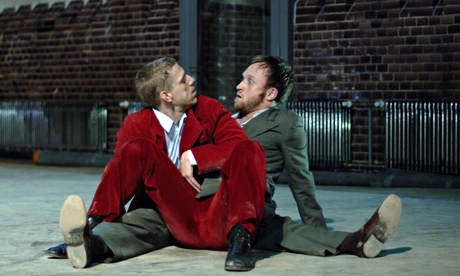
In D’avant, Cherkaoui teams up with the Belgian choreographer and performer Damien Jalet, his former offstage partner, and Luc Dunberry and Juan Kruz Díaz de Garaio Esnaola of the dance ensemble Sasha Waltz and Guests. What the four have in common, apart from dance, is a passion for the vocal music of the seventh to 12th centuries, a form of plainchant in which they have all trained. The piece takes the form of briefly flaring tableaux, in which a catholic variety of male rituals is enacted in front of Thomas Schenk’s set. Perhaps influenced by Peter Pabst’s more desolate designs for Pina Bausch, this takes the form of a gritty, dusty building site with scaffolding and ladders.
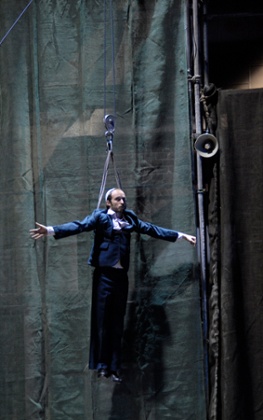
There’s a farcical sequence involving dropped trousers, a procession of medieval flagellants, a skirmish of football hooligans, a straight-faced rendition of Bonnie Tyler’s Total Eclipse of the Heart, an air-raid, and a cross-dressed bride who turns into a corpse and is entombed. The four men struggle, often bruisingly, towards mutual understanding. At the end of the piece, like a giant Manneken Pis, Jalet faces upstage and delivers himself of a 10-minute stream of what looks like urine but hopefully isn’t, given that Cherkaoui washes his hands in it. It’s an eloquent and melancholy expression of the infantile nature of male competitiveness. Through all of this wreathes the hypnotic sound of the four’s chanting, rising and falling in often absurdist counterpoint to the physical performance.
All four are arresting movers, but it’s Cherkaoui to whom your eye repeatedly returns. Ranging the stage with the mooncalf guilelessness of a 21st-century Buster Keaton, he appears to invite every imaginable physical catastrophe, from which he recovers good-humouredly, dusts himself down, and sets out to look for more. This is clowning of a very high order indeed. There’s a tenuous theme mocking religious and cultish extremism through the ages, but these elements have a dutiful feel to them, and never quite cohere into a theatrical statement. D’avant is more engaging as a study of men in incomprehending, ego-fuelled collision. A pissing contest, basically.