He may be a soulful innovator, but there has always been a strong traditionalism in D’Angelo’s music, and he begins tonight by tapping into a time-honoured archetype. Dressed in a beaten-up biker jacket with his face obscured by a wide-brimmed hat, D’Angelo summons an incantatory croon as he plays both sinner and preacher man. “I believe in love,” he sings, as spotlights sweep towards the sky. “You got to pray for redemption,” he adds, pleading, “Lord, keep me away from temptation.”
D’Angelo is an object lesson in redemption. For much of the last decade he was lost, reeling from an unwanted sex-symbol status following his shirtless appearance in the video for Untitled (How Does It Feel?). Drifting into alcoholism, he lost his six-pack and was arrested for drug possession. An oft-promised, oft-delayed follow-up to 2000’s Voodoo, meanwhile, seemed unlikely to reach fruition. Until, that is, the unheralded arrival of his third studio album, Black Messiah, to instant acclaim in the runup to Christmas last year.
Continuing a theme, D’Angelo has dubbed this first run of European dates in support of Black Messiah the Second Coming Tour, a gesture that soon proves anything but hubristic. Midway through second song 1000 Deaths – an electrifying percussive assault reimagining Sly Stone’s Thank You (Falettinme Be Mice Elf Agin) as industrial funk-rock – he halts the band and holds his arms out in a crucifixion pose, and is greeted by a deafening ovation: he is not only back from the wilderness, but he is sharper and stronger than before.
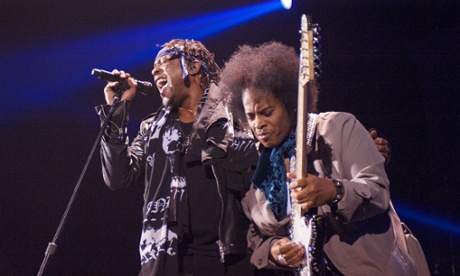
He also seems more at ease with being a sex symbol, stripping down to his vest with a knowing grin and provoking lustful screams, even if he is no longer gym-toned. He prowls the stage during Really Love, flashing bedroom eyes, singing with a voice that is straight-up church and a heart that is pure desire. For all his songs’ steamy, carnal qualities, they possess a purity, an almost-holy faith in the power of the erotic that he shares with Prince. Still, D’Angelo is no one-note lover man; the sad-eyed, bittersweet Charade is a protest song with subtle power, its imagery of bodies “outlined in chalk” alluding to the killings of two unarmed black men by white police officers in Ferguson, Missouri, and in New York that prompted him to rush-release Black Messiah.
D’Angelo’s band the Vanguard – including the Time’s Jesse Johnson and British bass virtuoso Pino Palladino – prove crack musos who eschew solo showboating in favour of fiendish, fluid funk, be it the seamy grind of Chicken Grease, the dreamy squelch of Ain’t That Easy, or the playful, bristling strut of Sugah Daddy. The latter stretches into an insane, breathtaking epic, its syncopated, irresistible groove led through false endings and wild detours with a skill and giddy audacity that raises the question, just how tight does a band have to be to play this loose? D’Angelo dictates the delirious twists and breakdowns with grins and finger signals, indulging in mic-stand acrobatics straight out of the James Brown book of show business.
He closes with Untitled, the slow jam that elevated him to such an uncomfortable kind of fame. Tonight, he seems to live every word, every note conjuring a sense of yearning that is palpable, sounding in places like Al Green, fusing sacred gospel with something more guttural and touching the sublime. But as with all of the greats he references – Sly, Prince, Parliament – his nods to the past are more than mere hero worship. Black Messiah proved D’Angelo worthy of his place in the soulful pantheon, a message he drills home here, with every blissful crescendo, wrenching climax and time-bending funk excursion. This Messiah is risen: don’t miss him this time round.