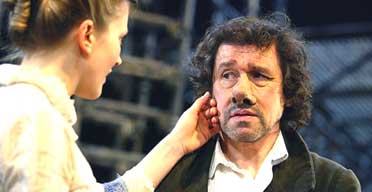
It just about works because the play is indestructible. But I can't help feeling there is something a touch perverse about a rough theatre version of Rostand's romantic melodrama in a theatre the size of the Olivier: for once, I found myself craving a bit more colour and spectacle.
The fact is that Rostand wrote his play in 1897 in reaction to the growing realism of Ibsen and Zola: "tendencies", he wrote, "which infuriated and revolted me". But here we get a stripped-down version of the play set roughly in Rostand's own time and staged in and around a massive William Dudley steel climbing-frame with two vast walkways extending over the stalls. It would, you feel, make an exciting design for West Side Story. But it has an oddly functional feel for a play that glories in rhetoric, rodomontade, swagger and swordplay.
Derek Mahon's version also does everything to bring the play down to earth. It bulges with four-letter words, calculatedly anachronistic references to "Schnozzle" Durante, euros and breezeblocks and jokey improprieties. "The pompous windbag has a waist so thick," says Cyrano of the detested Montfleury, "I doubt that he has ever seen his dick". Mahon's rhymes often click wittily into place and his language is full of demotic verve but when Roxane cries, "we've had too much of beauty" you feel she speaks as much for the translator as herself.
Yet you can't suppress the play's inherent energy or the pathos of Cyrano's self-sacrificing love for Roxane. Howard Davies's production also fills the stage with hectic activity. There's a stirring moment, very well choreographed by Christopher Bruce, when we first see the Gascon cadets fencing and fighting like immaculate toy soldiers. This also gets its pay-off in the battle scenes when they become ragged, starving, wearily besieged figures who might almost be fighting on the Somme.
Stephen Rea inhabits the title role with great skill. I'm not sure the text quite sustains his attempt to portray Cyrano as a truth-telling equivalent of Molière's Alceste. But Rea gives the rhymed lines a feeling of spontaneity and is infallibly moving in his proxy wooing of Roxane and in his final revelation of long-nurtured passion. Claire Price's duped Roxane, Zubin Varla's doltish Christian and Malcolm Storry's Machiavellian Count de Guiche also offer strongly defined performances in a deromanticised production in which Rostand finally wins out.
· In rep until June 24. Box office: 020-7452 3000