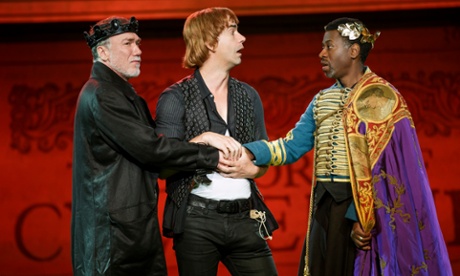
Cymbeline is a hodgepodge of a play: comedy, tragedy, history, pastoral, fairytale. Samuel Johnson, an avowed Shakespeare fanboy, wrote that to nitpick the play was “to waste criticism upon unresisting imbecility, upon faults too evident for detection, and too gross for aggravation”.
In Shakespeare in the Park’s Cymbeline, starring Hamish Linklater and Lily Rabe – with assists from Broadway stalwarts Patrick Page and Raul Esparza – the ace director Daniel Sullivan doesn’t make much of an effort to paper over the play’s insufficiencies.
Some parts are set in a timeless present, some in the present present, some in the 1960s, some whenever it was that people wore leather jerkins on a regular basis. Some scenes are hilarious, others are tear-jerking, others just keep the plot turning over. There’s a Sinatra-style song-and-dance number and a couple of pop ballads. The set is an uninspiring jumble. The lighting isn’t much better. The costumes are all over the place. It doesn’t work. Except of course, it does.
In ancient Britain, right around the time of Christ, King Cymbeline (Page) banishes his daughter Imogen (Rabe) for marrying a commoner (Linklater) when she should have wed the queen’s idiot son (Linklater again, with awesomely horrible wig and stoner drawl). Then there’s a battle and cross-dressing and Esparza hides inside a trunk and one of Linklater’s characters gets beheaded and the queen seems to be drinking a lot until suddenly it all ends happily ever after.
Sullivan stages the play with just eight actors. They’re either onstage or at the back of it, getting ready to go on in their next guise. (Even Rabe shrugs off Imogen for long enough to appear as a sassy cocktail waitress.) It’s this sense of imagination that makes you forgive the play its faults and celebrate it for what it does provide: romance, sex, poetry, song parody and the chance to see Rabe embracing a headless corpse even before the next season of American Horror Story kicks off. Meanwhile, Sullivan has a lot of nifty tricks to draw the audience into the unlikely action, especially those ticket holders seated onstage.
Rabe is as emotionally resonant as ever, unable to say a line of Imogen’s without feeling it deeply. Linklater luxuriates in Cloten’s fantastic awfulness, but finds plenty to amuse himself with worthy Posthumus, too. Perhaps he doesn’t deserve his happy ending, but you’re glad that he gets it. Of the other players, Esparza’s magnificently sleazy Iachimo is the clear standout, a villain to adore. After the final dance, when they all stand at the lip of the stage, their worldly task done, you can’t help but jump up and applaud them.