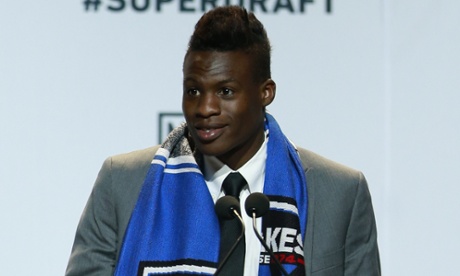
MLS officially launched its 20th season with the college SuperDraft in Philadelphia on Thursday afternoon, though even this annual celebration of the future of the league could not resist one last celebration of the player who’s been a huge part of how it got here.
Before the University of Connecticut’s Cyle Larin was drafted as No1 pick by Orlando City, his new team’s time on the clock was announced with some glee by the self-described “big sports fan” Landon Donovan, who had just had the league’s new MVP trophy named in his honor.
Donovan was at pains to emphasize to the current draft crop that the league they are entering is a very different one from the one he made his name in and encouraged them to embrace “every possibility” in front of them – including, presumably, building a career in MLS.
Donovan, of course, was the first significant US player to elect to stay and build his career in MLS rather than pursue a European career. A cynical take on the league’s foregrounding of Donovan might note that his career ran counter to the alternative trajectory being pushed by US national team coach Jürgen Klinsmann.
Klinsmann’s encouragement of players to test themselves in Europe brought him into open conflict with MLS commissioner Don Garber at the end of last season, as the league supremo grew impatient with what he saw as an undermining of the league’s position by the technical director of US Soccer (a role Klinsmann holds in conjunction with being national team head coach).
The US coach’s handling of Donovan’s omission from the World Cup squad was also invoked by Garber during a vigorous public defense of the league, and anyone who thought the player’s MLS Cup victory and official retirement marked the last we would hear of him, has underestimated the league’s belief in Donovan’s ongoing symbolic significance as “the one who stayed”.
But even with a raft of US internationals belatedly following Donovan’s example and coming back to the league (Mix Diskerud was the latest, when he joined NYCFC this week), the route young players take has arguably never been more contentious than right now. Several top college talents have grumbled about lowball MLS offers this year, with some rejecting MLS offers in order to continue college careers and others choosing to start their careers overseas. That number includes the German born Leo Stolz, who won the MAC Hermann award as the top player in college soccer, but has elected to start his career in the country of his birth rather than accept an offer from MLS (Stolz was still drafted by the New York Red Bulls late in the first round — and the side will hold his option if he does elect to play in MLS).
It’s emblematic of an ongoing headache for the league and US Soccer. The college system is seen as deeply unsatisfactory in producing a consistent supply line of talent, yet in lieu of any sort of significant club academy progress or national scouting network that comes remotely close to the scale of the college infrastructure, it’s here for the forseeable future.
That status persists even as top officials privately (and Klinsmann publicly) acknowledge that US players who arrive in professional teams after college are at a significant developmental disadvantage compared to those who turn pro in their mid-teens.
The academies and USL Pro partnerships MLS teams are developing will gradually offer other more consistent routes into the pro game, but growth is slow and painstaking, and as even top international clubs have found out, there are limited guarantees with academy players too.
And with MLS continuing to expand and more professional opportunities opening up, the SuperDraft, battered as it is, will continue to be an option for the ones who stay.
Notable first-round moves
Other than Larin going to Orlando, the other expansion team, New York City FC also went for a forward, when they drafted Oregon State’s Khiry Shelton at No2, while Montreal too went for striking talent in Romario Williams with the third pick.
The first midfielder off the board was Michigan State’s Fatai Alashe, who went to San Jose with the fourth pick, while the first notable climber from his projected draft position was Notre Dame’s Nick Besler, another midfielder, taken fifth by Portland Timbers. Perhaps Besler was helped by his bloodline – he’s the younger brother of US international Matt Besler – but as a promising defensive midfielder he’d been on a lot of teams’ radars as someone who could potentially contribute immediate minutes for stretched rosters.
Another midfielder originally expected to go high in the draft (most mock drafts had him as high as No2) found himself a victim of his chosen position. Attacking midfielder Cristian Roldan showed a lot of potential and talent at the combine, but is still small and perhaps it was always unlikely he’d be given a chance to become a playmaker for any of the 2014 strugglers who made up the high pickers in the 2015 draft. Roldan eventually went to Seattle, who traded for RSL’s 16th pick to land him.
The highest picked goalkeeper was also one of the stories of the draft. Alex Bono was not in Philadelphia as he recently became the first undrafted keeper to be called up for the national team. He is currently at team camp in California, where he heard of his selection by Toronto, with the sixth pick.
Along with Besler, the seventh pick saw another player jump up the provisional rankings as defender Matt Polster went to Chicago. Beyond that there were few big surprises in the first round, which was marked by numerous time outs, but no significant trades until Colorado negotiated with Columbus to land Axel Sjoberg with the 14th pick.