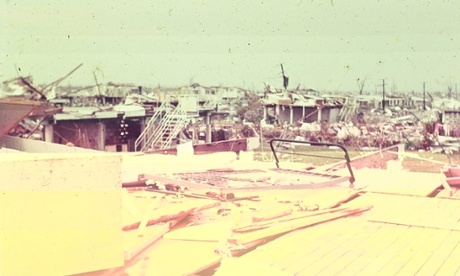
As the 40th anniversary of cyclone Tracy approaches, documentary filmmakers have adopted a unique approach to tell many previously unheard stories of what happened in Darwin on Christmas Eve, 1974.
Blown Away, airing on Tuesday night on the ABC, has sought to explore myths and different perspectives regarding cyclone Tracy, which killed 71 people according to the official death toll and destroyed 90% of the city’s houses.
There is very little footage and few photographs of the storm hitting, so the filmmakers have weaved animation by Darwin-based Huni Bolliger through numerous interviews with people who lived through that night.
“We wanted to approach it as a film, not a piece of journalism. We don’t have a presenter or narrator, we let people speak for themselves,” the producer, James Bradley, told Guardian Australia.
“The point was we were interviewing people and there were really amazing stories and we didn’t want to have talking heads the whole film, but there isn’t any footage ... of the cyclone itself. To do the cyclone and do it properly [in re-enactment] would have been a big task,” he said.
The cyclone had been predicted to miss the city but changed direction as Christmas celebrations began. Its eye was just 12km across, small by tropical cyclone standards, but it cut through the middle of Darwin’s built-up area.
Winds up to 217km/h were recorded before instruments broke.
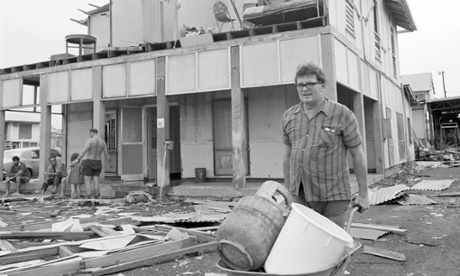
Eddie Josephs, a former Northern Territory police officer, is featured in Blown Away and described standing in the passageway of a house with eight others.
“There was a flash of lightning and I looked to the right down the passage and in that flash of lightning I saw the neighbour’s house and I thought, that’s unusual, because I don’t have a window there,” he said.
Kathy Mills, a local Aboriginal poet, musician and singer, said: “I wasn’t prepared at all for the cyclone.”
Mills’s partner came home and got the family to hide in the storeroom. “He was trying to hold the wall, the wall was pressing in,” she said.
When morning broke, the city emerged to scenes of devastation. In a memorial service held this month, the Northern Territory administrator, John Hardy, likened the aftermath to Hiroshima.
Dawn Lawrie, then a local MP, remembered sheltering in a house with her family. “When daylight came … I looked around and said: ‘Everyone’s dead, we’re the only ones left alive.’ Apparently a lot of people said that,” she told Blown Away.
“I came down to look at our block … and the house had completely disappeared. It had fallen in the pool and we were just lucky we had got out when we did. I went around the neighbourhood and everywhere I looked it was just desolation. It was a terrible feeling,” she said.
In the immediate aftermath, Josephs came across two people trapped in the rubble of a house. He sent out groups to break into cars and bring back the jacks.
“So with the aid of 13 carjacks, we actually jacked this house up off these two people. An ambulance came down the road and we put these two people in the ambulance,” he said.
The prime minister, Gough Whitlam, ended his overseas tour to return to Australia. The clean-up and recovery was controversial. There were complaints of mismanagement and insensitivity. The military were sent in, led by General Alan Stretton. Police – and, it is rumoured, the mayor Tiger Brennan – were shooting pet dogs which were eating anything they could find, including bodies.
People running the recovery were either “traumatised” or blow-ins from Canberra, said Bill Wilson, a historian and former NT police officer. “[We] all recognised that was a problem. On the other hand you had this imposition of an outsider [Stretton] without any consultation.”
With no supplies coming in and stocks running low, it was decided to reduce the population, and more than 30,000 people were evacuated over 11 days. An estimated 5,000 to 10,000 more left by road in any car that was drivable. Soon it was decreed that if you had left Darwin you could not return without getting a permit by proving you had somewhere to live.
“They wanted to come back to rebuild their lives,” Lawrie said. “That is a very human instinct, just to come home. And people did. A lot of women had gone south with the families and the men had stayed. When they wanted to come back the man would be asked if he wanted his wife back. Absolutely iniquitous. I was a member of parliament at the time and I railed against it and finally it was abolished.”
Survivors were incredulous that so few people were officially recorded as victims of the cyclone, suspecting bodies may have been gathered up along with debris by tractors and buried, or not registered by traumatised workers who may have buried the dead in temporary graves.
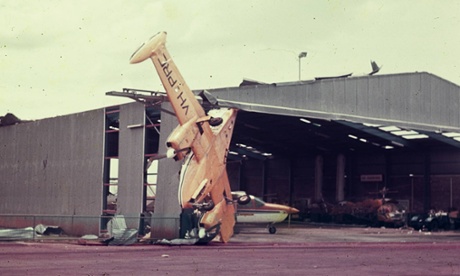
Given the city’s shifting population – including hippies who had travelled north to live on the beach, itinerant people, Indigenous long-grassers – it is believed many people might have disappeared in the storm who were never accounted for.
The storm arrived amid brutal fights over Indigenous land rights claims between developers, the government and potential traditional owners. A recent government report had recommended Aboriginal lands, including nearby One Mile Dam and Kulaluk, should be returned to Indigenous people, the anthropologist Bill Day told Guardian Australia.
Some local Larrakia people believe the cyclone was brought by the Nungalinya spirit, also known as Old Man Rock, because the authorities were not listening to the traditional owners.
When the storm hit, Day, who had been heavily involved in the land rights movement, took shelter in the office of the Department of Aboriginal Affairs. He said he saw a telex come through which said the hand-back of Kulaluk land had been approved, though it would be several months before that officially happened.
After the storm came through, much of the land had been cleared and authorities drew up surge lines where nothing could be rebuilt. As a result those areas became open to land rights claims.
“All of our organisation was disrupted [by Tracy] of course,” Day said. “But the homeless people had it pretty good because they could shelter in old buildings and food was free. Just as in wartime, Aboriginal people experienced equality for a while.”
- Blown Away airs on ABC TV on Tuesday night at 8.30pm.