
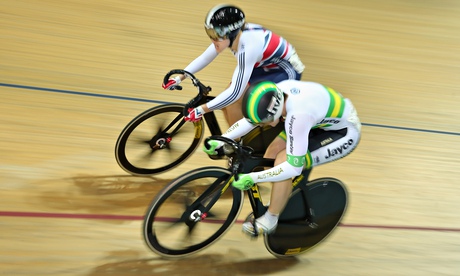
The new Great Britain sprint coach Justin Grace insists his riders have sufficient time to turn their performances around before the Rio Olympics in spite of Jason Kenny’s early departure in the keirin and the two team sprint squads – men and women – both managing only eighth place in their events.
“Look at where New Zealand was 18 months from London, have a look at where France were two years ago,” said Grace, who coached both those nations before being hired this summer by Great Britain. “It’s possible to turn things round pretty quickly. I’m inheriting what we have and trying to figure out the riders’ strengths and weaknesses. We have a little gap here at the moment, but with the plan we have for Rio we’re still in a pretty good place.”
On Friday afternoon, as if to inject a little optimism, Jess Varnish and Victoria Williamson both qualified for the women’s match sprint; Williamson fell short in the eighth-finals while Varnish clinically disposed of Victoria Pendleton’s old sparring partner, the London Olympic champion Anna Meares, to win through to the last eight.
The biggest questions are being asked about the men’s team sprint, where the absence of a replacement for Sir Chris Hoy is being keenly felt. Since London, starter Philip Hindes and man two Jason Kenny – London gold medallists both – have been at medal-winning speed at three world championships, but the team has stumbled when it comes to man three.
At this stage of the last Olympic cycle, Hoy, Jason Kenny and Matt Crampton qualified third fastest at the world championship in Apeldoorn, less than 0.2sec behind a French trio who were eventually disqualified from the gold medal position. In 2007, Hoy, Ross Edgar and Craig MacLean qualified fastest and were beaten into silver by an minute margin. Intriguingly, however, of that trio, only Hoy ended up riding the team sprint in Beijing, proving how rapidly things can change in the run-in to an Olympic Games.
“The GB team today is not the same as 2004, 2008 and 2012,” insists Grace, who makes the point that his current riders are probably ahead of where Hoy was at a similar age. “You are not comparing apples with apples. Sir Chris took 10 years racing to get to the level he did, to have someone to step in [for him] you would have to be an exceptionally lucky programme. It takes time to build those riders.” The current shortlist is Kian Emadi, Callum Skinner and Lewis Oliva, who did not make the squad here.
Great Britain were fortunate to recruit Kenny and Hindes at a very late stage before the Beijing and London games, and Grace will not rule out that happening for a third time. “We’re not casting the net, we know the squad, we have a long list, but you never know if someone will pop up. We’ve got a bunch of young guys up in Scotland who are training very hard – there is still 18 months to go, we’ve got time to identify someone. We’ve got enough time and we’ve got the talent there, it’s just a matter of putting it together.”
In the early action on the Paris velodrome on Friday, Joanna Rowsell looked to be feeling the effect of the women’s team pursuit quartet’s defeat on Thursday evening as she proved unable to defend her individual pursuit title, finishing fourth in the qualifying round and winning through to the bronze medal ride-off. In the opening rounds of the men’s omnium Jon Dibben rode a perfectly calcuated and patient scratch race to get off to a fine start with second place.






.jpg?w=600)



