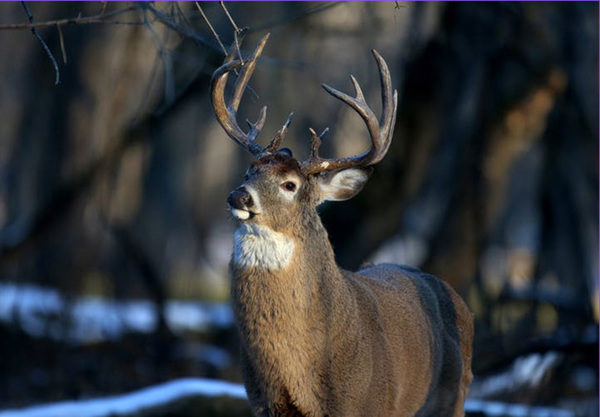
MINNEAPOLIS — COVID-19 will deliver a costly setback to Minnesota's fight against chronic wasting disease (CWD) if hunters don't substantially increase participation in a voluntary deer testing program.
The Department of Natural Resources eliminated mandatory testing for 2020 to avoid large gatherings of hunters and staff at designated sampling stations. But since archery season opened Sept. 19, more than 70 % of eligible hunters have skipped free testing, state wildlife officials confirmed this week.
A year ago, when CWD testing of hunter-harvested deer was mandatory in five designated zones around the state, compliance was better than 93%.
"We are barely hitting 30%," said Michelle Carstensen, DNR's wildlife research team leader. "I'm concerned from what I've seen so far that it might not be enough information to find out what's going on with the disease."
Losing a year of data to track fine-scale information about disease presence and absence will mean that biologists can't implement the next increment of safeguards to contain the spread. "It reduces our ability to get our arms around this thing," Carstensen said.
Barbara Keller, DNR's big game program leader, said the agency is sending postcards to hunters before the mainstream firearms season opens Nov. 7. It's part of a larger communications effort to ignite more participation in CWD testing.
"It's lower than what we would like, and it's a very important part of our CWD surveillance," Keller said.
DNR officials are still hoping for at least 50% participation to avoid reverting to mandates. Last year's system was expensive, featuring 207 wildlife and fisheries staff members who worked more than 25,000 hours at sampling stations. College students boosted staffing on weekends. As hunters arrived with whole carcasses, crews gathered information, removed lymph nodes from the animals and prepared them for the lab.
The 31-station operation and other CWD controls last year required a $1.6 million General Fund appropriation from the Legislature and $550,000 from the DNR's core Fish and Game Fund. The full expense for CWD control was $2.7 million.
Carstensen said the financial burden could be eased if enough hunters from CWD zones go along with voluntary submission of deer heads at drop-off locations. At those DNR collection boxes, hunters mark the samples to identify the hunter, characteristics of the deer and the time and location of the kill. Test results are conveyed online and the DNR contacts individuals when screening tests come back positive.
Because 80% of Minnesota's annual deer harvest occurs during the firearms season, there's still time for the pendulum to swing in favor of keeping CWD testing on a voluntary basis. The answer should be known after the opening weekend. That's when hunters typically take more than half of the deer harvested throughout the whole firearms season.
"We are highly encouraging hunters to participate," Keller said.
The drop-off boxes are located in five areas of the state, including a new territory in Dakota County established in March with the discovery of an infected wild deer near Farmington.