
Australians should be able to withstand higher interest rates but the economy could still tip into recession, the boss of the nation's oldest bank has warned.
Westpac has forecast the central bank cash's rate will hit an 18-year high of 4.85 per cent in 2026, meaning two more hikes after Tuesday.
But chief executive Anthony Miller says the economy has capacity to absorb the increases, even if it leads to unemployment rises.
"I do think the uncertainty is the bigger issue here, because the thing that I'm more worried about, that we are more worried about, is that business and investment decisions are put on hold," he told a media briefing.
"(It might become) impossible to make an investment decision that you will build, or you will invest in, or you will construct something."
The risk was that those delayed decisions could lead to a fall-off in domestic economic activity, he added.
And that's what Westpac is focused on: seeing that people are still able to make future investment plans to ensure economic activity remains at a sustainable level.
"That's the worry in the context of a potential recession," Mr Miller said.
Westpac isn't currently forecasting a recession and its chief believes those who talk about the prospect with certainty are misinformed because there are too many competing forces at play.
The bank has a solid pipeline of enquiries from its business lending clients and has found that smaller companies are slowing economic activity a little, while larger businesses are still "pretty robustly going after it".
"The larger end is very clear and very much of the view that, notwithstanding the uncertainty, they can see a way through it," Mr Miller said.
"They feel they can absorb and/or pass on the price or other disruptions that are flowing from the Middle East."
Still, Westpac intends to keep a close eye on the knock-on effects that disrupted supply chains could have on the broader economy.
The federal budget, which will be handed down by Treasurer Jim Chalmers in a week, will play an important role in helping Australians through these "particularly interesting times" as well as sustaining future economic activity, Mr Miller said.
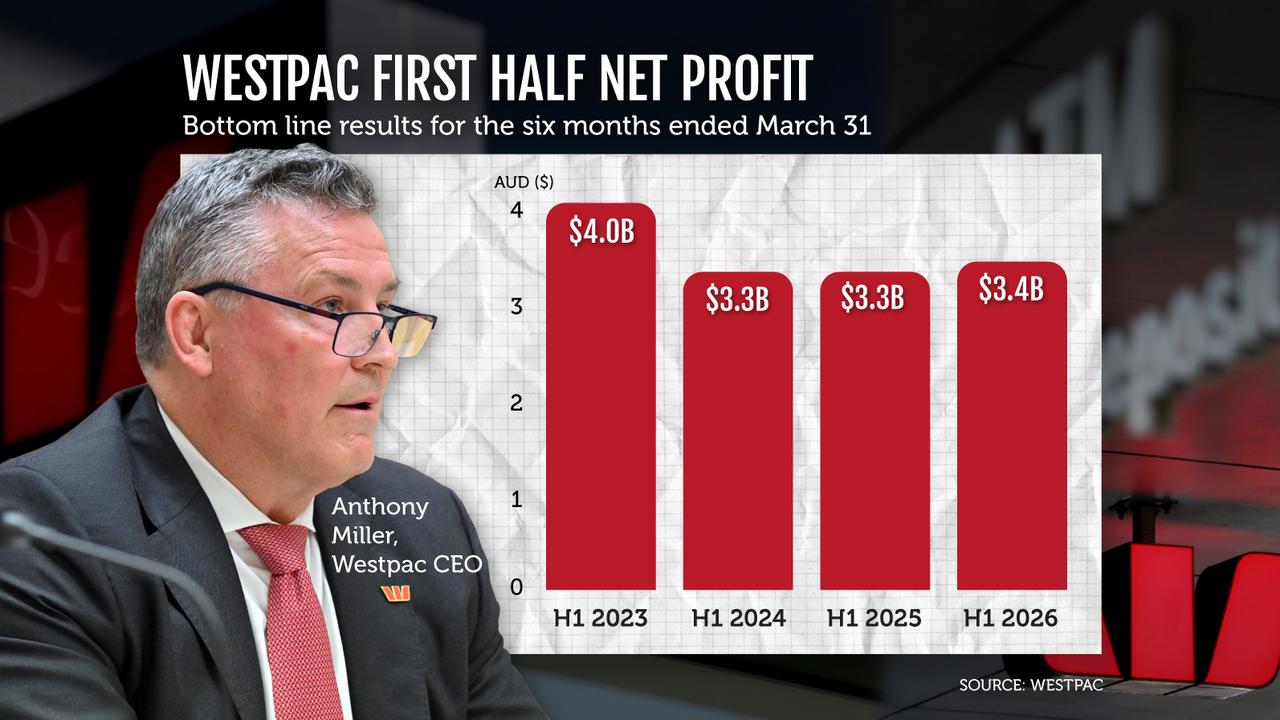
Westpac on Tuesday delivered a slight increase in interim earnings, with its headline profit rising three per cent to $3.4 billion in the six months to March 31.
Its net profit excluding big items rose one per cent to $3.5 billion on revenue of $11.3 billion.
In April, Westpac warned the Middle East conflict, which began on February 28 when the US and Israel attacked Iran, had dented earnings from its treasury and markets trading division as global volatility increased.
But during the half year, more Australians turned to Westpac for their mortgage needs, with housing loans rising seven per cent year-on-year.
Business lending also increased by 16 per cent.
The bank's core net interest margin, which reflects the profitability of its lending business, dipped slightly as the performance of its treasury division weighed.
Westpac will pay shareholders an interim dividend of 77 cents, up one cent from the previous corresponding half.
In afternoon trading, Westpac shares were down almost two per cent to $38.76.