Not so long ago, in the early 1990s in fact, art cinema actually mattered – far more than thrillers with TV-show-quoting hitmen or superheroes in tight trousers. Polish director Krzysztof Kieślowski was then the leading figure in what we now realise was the last gasp of a certain kind of high-minded, unapologetically intellectual film-making; its cut-off point, in retrospect, was the defeat of Kieślowski's Three Colours Red by Pulp Fiction at the 1994 Cannes film festival.
Perhaps, if we analyse the period more closely, this 1991 film is where the long swoon began. Kieślowski, having made his name alongside Andrzej Wajda as one of the masters of Polish cinema in the 80s, brought his thematically ambitious dream-fables to huge international prominence with the Ten Commandments cycle The Dekalog, bolstered by two feature-length releases, A Short Film About Killing and A Short Film About Love. Poland, in the transition to democracy, was no doubt an uncertain, difficult place to work, and the seismic political changes of the time held out the promise of a new era of pan European harmony.
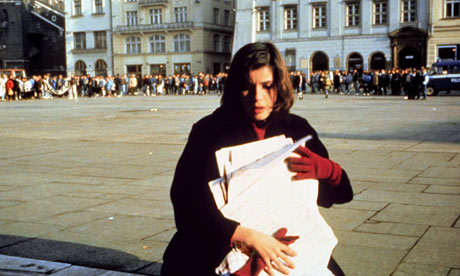
All this is a roundabout way of explaining why The Double Life of Veronique feels, more than anything, like a bridge between two worlds: the old Poland of disintegrating communism, and the new France of European harmony. In that it's undoubtedly prescient: Kieślowski, and his scriptwriter Krzysztof Piesiewicz, came up with this elaborately constructed drama of identical women living simultaneously in Poland and France, with near-identical names and personalities, and of course embodied by the same actor, Irène Jacob. They almost seem like ghosts of each other – most obviously in a scene where they nearly meet, during a riot in Krakow where Polish Weronika spots French Veronique taking pictures from a tourist bus.
In truth though, the weight and warmth is all on the French side: the Polish woman is dying – it happens dramatically, mid-aria, on stage – and her spirit seems to somehow transmit itself to Paris and can live again, infecting her double with strange emotions and unexplained impulses.
I have to admit, when I first saw the film when it came out, I found the arbitrariness of this transfer a bit annoying – all my admiration for Kieślowski had been invested in his harder, Polish cinema, and this convoluted fable seemed to attempt to give a gloss to a rather obvious move to a land of plenty and safety. (Think Auden and Isherwood heading off to the US in 1939, as the second world war loomed.)
But seeing it again, I feel more generous: essentially, Kieślowski is appealing to the future, and making manifest the way we try to – but can't – control our own destinies. It is a theme he had explored before, in Blind Chance, and would return to in the Three Colours films, particularly Blue, which held the same promise of transcendence through music. And strangely, the marionette theme is an unexpected foreshadowing of Being John Malkovich: a less satirical use of the puppet as a metaphor for the manipulated consciousness.
What also comes across strongly is the brilliance of the image-making, again foreshadowing the Three Colours films, but here expressed in a pure, concentrated form. The swooping point-of-view shots when Weronika collapses, the shimmering distortions reflecting the women's inner disturbances, the highly colourised lighting and design: all these are perhaps not what you'd remember best about such a cerebral film-maker. But they give his work a tremendously sensuous dimension; perhaps actually encouraged and fed by his shift to France.
In truth, Kieślowski is not currently the most fashionable of directors; art film these days tends to rely on shock tactics and remorseless grimness to get noticed. But time rolls on, and his films may well find a new audience; now is a good time to start.