This is an article from Curious Kids, a series for children. The Conversation is asking kids to send in questions they’d like an expert to answer. All questions are welcome – serious, weird or wacky!
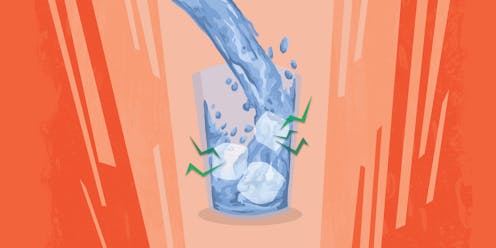
Why does ice makes a cracking sound when water is poured on it? - Valeska, age 7, Brisbane, QLD.
Water is an amazing thing, and without it life as we know it would be very different. Water is one of very few chemicals that is found as a liquid (water), solid (ice) and gas (steam) at any time on Earth. And it’s for this reason that it’s so very important to us.
What you need to know about water
There are three things water can do that are important in explaining why you can hear ice cracking when it warms up.
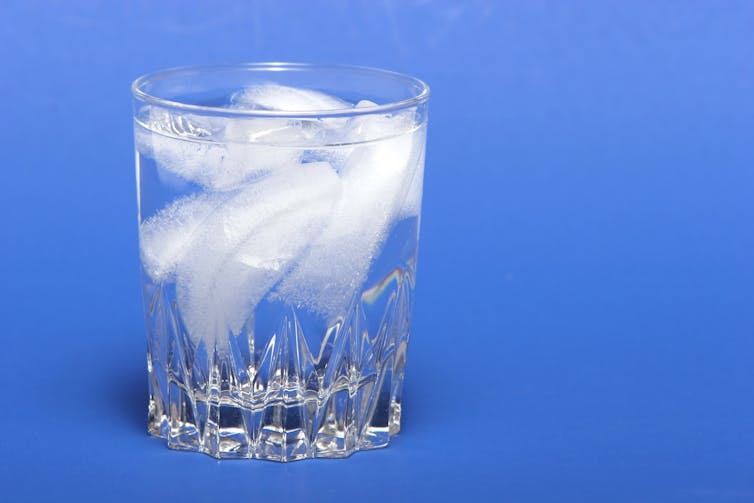
First of all, ice floats on water because it has less density than liquid water. Density is the word used to describe how compact or thick a substance is. This means that ice floats on the surface when you’re having a drink, so you can see and hear what is happening to it. It also means that when solid ice turns to liquid water it gets more dense, this is quite an unusual thing to happen.
Read more: Curious Kids: If Australia is at the bottom of the world, why are we the right way up?
Secondly, it takes a lot of heat to turn solid ice into liquid water. So it takes time for enough heat to come from the slightly warmer drink to the cooler ice — long enough for us to see the ice changing into a liquid.
Lastly, ice is good at protecting itself from changes in heat. So, the outside of the ice cube will be at a higher temperature than the inside of the ice cube.
Read more: Curious Kids: What causes windy weather?
That cracking sound
All together these three properties of ice help explain why ice cracks and how we can hear it.
The warming of the outside of the solid ice cube happens faster than the warming of the inside of the ice cube. The solid ice cube can’t handle the differences in the density caused by the varying temperatures. The pressure of this causes the solid to crack. We can hear the sound from this cracking because the ice cube is floating on the top of the drink, and it happens over many seconds or even minutes as we’re enjoying our cool drink.
Hello, curious kids! Have you got a question you’d like an expert to answer? Ask an adult to send your question to us. They can:
* Email your question to curiouskids@theconversation.edu.au
* Tell us on Twitter by tagging @ConversationEDU with the hashtag #curiouskids, or
* Tell us on Facebook

Please tell us your name, age, and which city you live in. You can send an audio recording of your question too, if you want. Send as many questions as you like! We won’t be able to answer every question but we will do our best.

Daniel Southam receives funding from the Australian Government and the Qatar Foundation.
This article was originally published on The Conversation. Read the original article.