Curious Kids is a series by The Conversation, which gives children of all ages the chance to have their questions about the world answered by experts. All questions are welcome: find out how to enter at the bottom of this article.
What causes the northern lights? – Ffion, age 6.75, Pembrokeshire, UK.
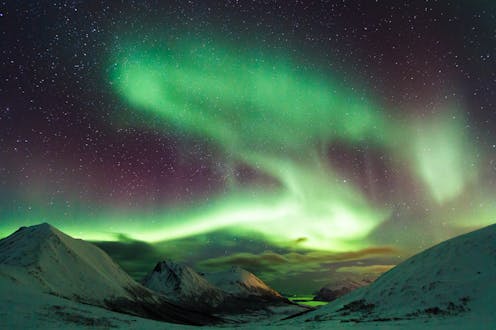
I first saw the northern lights three years ago, while driving home one night. They were so beautiful, I had to stop the car and get out to have a proper look, even though it was cold. Although the northern lights might look like magic, they can actually be explained by science – with a bit of help from the Sun, birds and fizzy drinks.
The energy for making the northern lights comes from the Sun. The Sun creates something called the “solar wind”. This is different to the light that we get from the Sun, which keeps us warm and helps us to see during the day.
This solar wind drifts away from the Sun through space, carrying tiny particles called protons and electrons. Protons and electrons are some of the tiny building blocks that make up most of the stuff in the universe, like plants and chocolate and me and you.
Think of the smallest Lego bricks you have in your toy box, which can be stuck together to make bigger things - these are what protons and electrons (and neutrons too) are to the universe. These particles carry lots of energy from the Sun, on their journey through space.
The solar wind
Sometimes the solar wind is strong, and sometimes it’s weak. We can only see the northern lights at times when the solar wind is strong enough.
When the solar wind reaches planet Earth, something very interesting happens: it runs into the Earth’s magnetic field. The magnetic field forces the solar wind away, and makes it travel around the Earth instead.
The magnetic field is what makes the needle on a compass point north, and is how birds know where to go when they migrate – it’s also why we have the north and south poles at all.
But the magnetic field is also weaker near the north and south poles. So, as the solar wind is pushed around, it can work its way down towards Earth along the weaker parts of the magnetic field, at the north and south poles.
Because of this, we get both northern and southern lights – also known as the aurora borealis and the aurora australis.
Shake it up
When the solar wind gets past the magnetic field and travels towards the Earth, it runs into the atmosphere. The atmosphere is like a big blanket of gas surrounding our planet, which contains lots of different particles that make up the air that we breathe and help to protect us from harmful radiation from the Sun.
As the protons and electrons from the solar wind hit the particles in the Earth’s atmosphere, they release energy – and this is what causes the northern lights.
Here’s how it happens: imagine you have a bottle of fizzy drink, and you give it a good shake. This puts lots of energy into the bottle, and when you open it, this energy will be released in a big stream of fizzy bubbles.
In the same way, the protons and electrons from the Sun “shake up” the particles in the atmosphere. Then, the particles let out all that energy in the form of light (instead of bubbles).
Different types of particles in the atmosphere make different colours after they’re shaken up – oxygen makes red and green light, and nitrogen makes blue light. Our eyes see green best out of all the colours, so we see green the brightest when we look at the northern lights.
It is easiest to see the northern lights in winter when is it very dark at night, and also outside of cities and away from street lights. You are more likely to see them the further north you are too. Check out this great website Aurora Watch from Lancaster University – it might just help you find them!

Hello, curious kids! Have you got a question you’d like an expert to answer? Ask an adult to send your question – along with your name, age and town or city where you live – to curiouskids@theconversation.com. Send as many questions as you want! We won’t be able to answer every question, but we’ll do our best.
More Curious Kids articles, written by academic experts:
Why do spiders have hairy legs? - Audrey, age five, Melbourne, Australia
Why do we have different seasons at specific times of the year? – Shrey, age nine, Mumbai, India

Paul O'Mahoney does not work for, consult, own shares in or receive funding from any company or organisation that would benefit from this article, and has disclosed no relevant affiliations beyond their academic appointment.
This article was originally published on The Conversation. Read the original article.