The cultural scene supported by secondhand bookstores, movie theaters and the like is in a quagmire due to business suspension requests that have arisen from the spread of the new coronavirus.
It has been three weeks Tuesday since the government declared a state of emergency in seven prefectures, including Tokyo, and some businesses in these fields are facing increasing difficulties.
They are not categorized as directly supporting people's lives, as medical care and some retail categories are. A person in the field expressed concern, saying, "If this situation continues for a long time, people [working in the relevant businesses] will be in pieces, and the culture will decline."
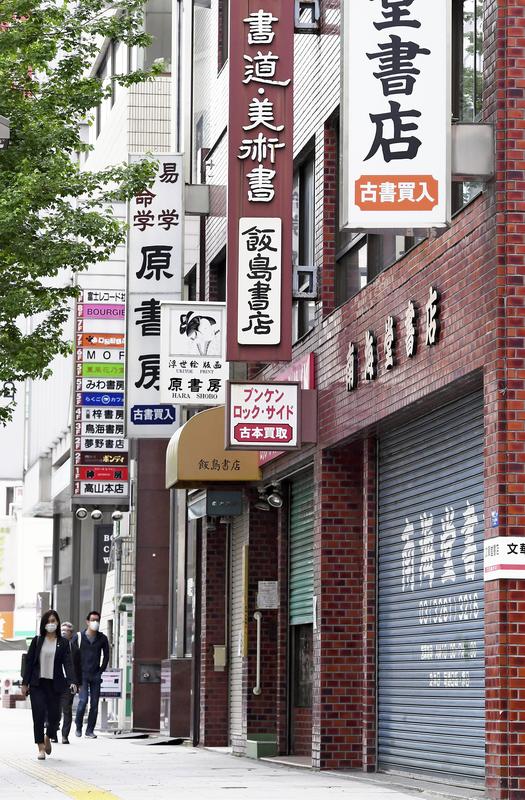
Tokyo's Jimbocho district, where about 150 secondhand bookstores can be found, is usually crowded with students and enthusiasts. But now one of the nation's most popular book districts is nothing but streets of shuttered stores.
The Tokyo metropolitan government has asked secondhand bookstores to close while excluding general bookstores from the list of industry categories subject to temporary business suspensions. Stores with a floor space of 100 square meters or less are allowed to stay open, but with many customers being elderly, 90% of such bookstores in the district have closed voluntarily.
"It's true that secondhand bookstores are deemed nonessential and nonurgent businesses, so I understand why we were asked to close," said Tetsuya Yaguchi, 56, chairman of the Kanda Koshoten Renmei (Secondhand bookstores association), expressing his understanding of the metropolitan government's policy.
His store is not subject to the closure request, but to ensure customers' safety, it will be closed through May 6, the last day of the Golden Week holiday period, which normally draws many customers from across the nation. "I think some owners will have to close down their businesses for good in the future," he said.
According to Takayuki Kono, 70, managing director of the Japanese Association of Dealers in Old Books, secondhand bookstores usually purchase stock separately before bringing them to exchange meetings so that booksellers can expand their distinctive lineups and help one other earn money.
Many secondhand bookstore owners across the country often participate in such meetings in Tokyo, but there is no prospect of holding the next one as major venues are subject to the closure request.
"It's a big blow that we can't hold exchange meetings, which are a lifeline for stores. To maintain secondhand book culture, I hope the pandemic will be contained soon," Kono said.
Movie theaters are being asked by local governments to close because they are likely to create the so-called "Three Cs" -- closed spaces, crowded places and close contact. In particular, many mini theaters that screen niche films are usually small businesses, so suspension has a significant impact on them.
Hotoriza, a mini theater in central Toyama, has been closed since April 6. The 20-seat venue was popular among young people for its music and talk events, but it is empty now. Although its new building with a capacity of 90 seats was scheduled to open on April 25, it has been postponed for a month.
Rent and personnel costs among other expenses total about 1 million yen a month. "It's possible I'll have to close our theater for good if the temporary closure becomes prolonged," said Kazuhiro Tanabe, 41, president of the company that manages Hotoriza.
Uplink, Ltd., which operates several mini theaters with a total capacity of 440 seats in Tokyo's Shibuya district and other locations, closed all of its theaters on April 8. As a result, the company's sales have plunged to zero.
Against this backdrop, the company is looking ahead to the post-coronavirus period by making such efforts as selling prepaid tickets that include soft drinks and come with a tote bag.
"The situation is very severe. But still, I want to support film culture while doing what I can," said Takashi Asai, 65, who heads Uplink.
Nonfiction writer Kunio Yanagida commented on the situation, saying, "In contrast to Germany and France, which are eager to provide economic assistance for the cultural and artistic fields, Japan as a nation has revealed its disregard for such fields.
"Culture and art, which inspire and soothe people, are indispensable. In times like this, we need to share awareness of cultural protection throughout society," the critic added.
Read more from The Japan News at https://japannews.yomiuri.co.jp/