Fifty-three years and one month ago, on a Monday a little like this one, the Guardian ran a cricket story on its front page, alongside a piece on British naval bases in Ceylon and a story about two ships colliding in the English channel.
"England Test Changes" ran the headline. "Washbrook back".
"The selectors' single aim is to strengthen England's batting," opined Denys Rowbotham underneath, "which at Lord's for the most part was as lacking in determined spirit and sustained concentration as it was on Test match standards technically."
Sounds familiar, doesn't it? At Lord's England had lost by 185 runs after being bowled out for 171 and 186. Cyril Washbrook was five years retired from Test cricket, and was acting as a selector for the side at the time. Aged 41, he was still playing for Lancashire. His top score that season was only 95. The weekend before the selectors convened he had spent 45 minutes scoring three runs against Derbyshire, before getting caught out on the cut after a rain-break.
"He is in tremendous form and temper at present," Rowbotham assured his readers, "and in any form will bring to England's batting a maturity of judgment from experience and a comprehensiveness of technical accomplishment."
Washbrook was becomingly reluctant about the recall. But three days later he was again on front page of the Guardian, this time under the headline "Foundation Of Victory? The Genius of Washbrook". The previous morning England had won the toss, and stumbled to 17 for three. Then Washbrook and May put on 187 for the fourth wicket, Washbrook's share being 90.
"Washbrook not only salvaged England's fortunes but played the greatest innings of his life," Rowbotham had the pleasure of recounting. "He brought to England's batting that quality without which the best technique must be in vain: he brought it, in a single word, judgment. He brought also a technique that commands all the shots. And from all the maturity of his long experience he brought England confidence and calm. And, above all, he transferred to May his greatest personal quality this day – self-mastery."
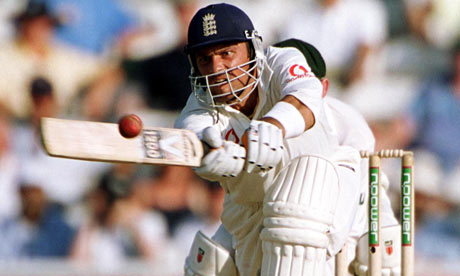
Much as the many who think it's a good idea may clamour, there is surely not going to be a similar story about Mark Ramprakash to end the summer. The only people calling for Ramprakash's return are the public, and they do not get to pick the team.
It is not that his recall would necessarily fail. His accomplishments in Test cricket may be slighter than Washbrook's were, but Ramprakash is still the finest English middle-order batsman in the County Championship. He too possesses the self-mastery which Rowbotham mentioned. A man cannot extend his playing career into his 40s without it.
Those who think the old scars would split open anew and imagine he may crack under the pressure of stepping from the second division into Test cricket are, I think, wrong. At 39, Ramprakash has a maturity that leaves him little to fear. He has faced, overcome and succumbed to far finer bowlers than any playing for this Australian team in his time. But the question of how he would handle his comeback is a matter for idle speculation. I just like to imagine fairytale endings are possible. It is equally likely that he could get a good ball early in his first innings, and a poor decision in his second.
Recalling Ramprakash appeals to an odd combination of romantics, who still pine over the idea that the man can prove he was dropped too soon, even after 52 Tests, and pragmatists who see the fifth Test as a one-off match which must be won and think Ramprakash, on his home ground, may be the best man for the job. The selectors, I'd wager, won't fall into either camp. English cricket is still leery of its hapless pick-and-mix strategies of the 1990s. The culture of consistency has been growing ever since Duncan Fletcher first took over.
The shock decisions they have sprung in recent seasons have been bowlers – Darren Pattinson, Ryan Sidebottom, Amjad Khan. Injuries to their first-choice picks have seen others given an opportunity, and consequently England's attack has a strength in depth that has prevented Sidebottom from playing a single Test in the series so far. When people talk about the changing room being a "closed shop" they refer to the top six.
That conservatism means that we are no closer to knowing whether Joe Denly, James Hildreth or Jon Trott are capable of succeeding in Test cricket. Now is not the time to give such a player a debut. But there are other candidates. Quite how Ed Joyce managed to take a one-day century against Australia in Australia and go on to play only another eight international matches remains something of a mystery. A similar thing could be said for Rob Key and his 174 against Australia A. Owais Shah came nearest to having a fair crack, yet he has slipped from contention this season, despite showing some form for Middlesex.
This confusion over the batting was evident in the England Lions match against the tourists, where Stephen Moore made 120, Denly 66, and Trott did not even play. England are suffering now for the lack of conviction they have shown in their selection. England have a developed a squad of bowlers to choose from, but have failed to do so with their batsmen, and that has left them with one unenviable headache. How they must wish they had a Washbrook in their ranks now.