PITTSBURGH _ Workplace culture can make the difference between feeling amped about your job or dreading every hour.
Not enough employers pay attention to the bottom-line benefits of having an engaged workforce, said Rachel Brecht, talent and organizational performance consultant at Tier1 Performance Solutions, a workplace consultancy based outside Pittsburgh. The result can be workers who spend more time looking over their shoulders than driving the company forward.
The way some companies handle their workforces can offer insights for both job candidates and business owners. Take Lucas Systems Inc., a software development company tucked away in an unremarkable strip mall outside Pittsburgh.
Lucas was founded in 1998 and was profitable its first year. The company is privately held and doesn't disclose financials, but officials said Lucas has exceeded 50 percent revenue growth annually in the past few years as the company continued to find ways to innovate and roll out new products that help warehouses efficiently track and ship products. It now employs a diverse workforce of about 65 people.
"We are problem solvers," said president and CEO W.R. "Rick" Brown, who prefers that his employees speak for themselves.
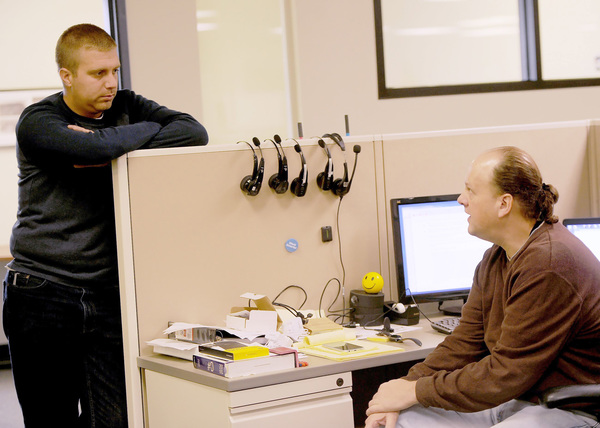
Many were eager to do just that. "Everything is very open," said Michael Brookhart, 23, who has worked in marketing at Lucas for a year and a half. "Everybody is accessible."
Forty-seven-year-old Scott Steele, who works in quality assurance, came to Lucas from a company that fostered confrontation among employees as a managerial strategy.
It didn't work well, he said.
"It's a lot more productive here," Steele said. "There's no ego. We have a common goal. People are willing to help each other."
Creating an engaged workforce begins with the job candidate's first interview, said Anne Papinchak, vice president, business transformation.
"We like people who ask questions," said Papinchak, who oversees human resources at Lucas. "We ask, like, what situation made you feel really uncomfortable _ and what did you do about it?
"We look for people who learn and know themselves well."
Workplace culture is an important recruiting tool in a field like software development, where demand for such skills is expected to grow 17 percent through 2024, according to the Bureau of Labor Statistics.
Lucas isn't perfect, but it has made employee engagement a priority. For example, employees are invited to periodic free pizza lunches on the condition they sit near someone they don't know. The idea is to smooth the way for improved workplace collaboration, Papinchak said.
Employees are regularly briefed on the company's financial performance, creating transparency, and are encouraged to get up and walk around after long periods of sitting because Brown believes it improves productivity.
Foosball, pingpong and other tabletop games are available during breaks, amenities that might be expected at tech companies.
On the other side of the table are job candidates who are looking for a good work culture fit. The key is to ask questions _ lots of them, according to Brecht at Tier1.
Times were when the employer held the upper hand in the screening process, but the balance has shifted, giving job candidates a better footing to ask hard questions about the company that's considering hiring them, she said.
"I can't emphasize enough the importance of interviewing the potential employer with the same rigor they interview you," she said. "It's critically important for employees to ask rigorous questions: How do you get promoted? What's the performance management process?
"Don't be afraid."