Land-based aquaculture, rather than fish farming in seas or lakes, is becoming widespread. Among the fish raised in this way are sturgeons that produce caviar and mackerel that can be consumed raw.
This type of cultivation is not susceptible to weather and makes it easy to control water quality and feed. For these reasons there are high expectations, with people related to the issue saying that land-based aquaculture makes it possible to raise safe and high-quality fish in a stable manner. An increasing number of restaurants are also procuring such fish.
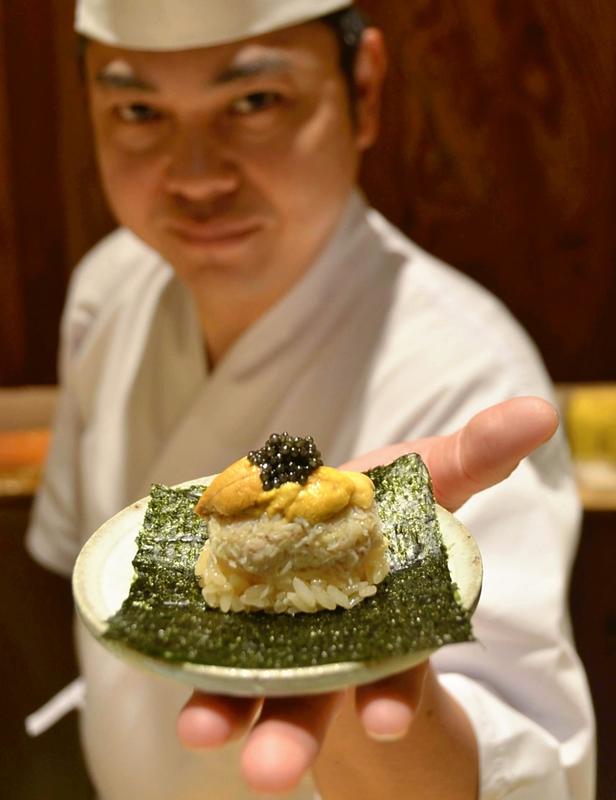
Fresh caviar
At Sushi Yu in the Roppongi district of Tokyo, listed in the Michelin Guide as a one-star restaurant, a popular item is caviar sushi, which is part of its 20,000 yen course (excluding tax).
This caviar is made from the salted roe of sturgeons raised at a land-based aquaculture facility in Hamamatsu. While caviar from abroad are produced through a heating process, the caviar offered at the restaurant only uses salted raw roe.
"Since it is not heated, it does not have that popping texture in the mouth. It is so creamy that customers can enjoy the original flavor of fish eggs," owner Jun Ozaki said. "It goes well with other ingredients because it is so mild and is so popular that some customers visit my restaurant just to eat the caviar."
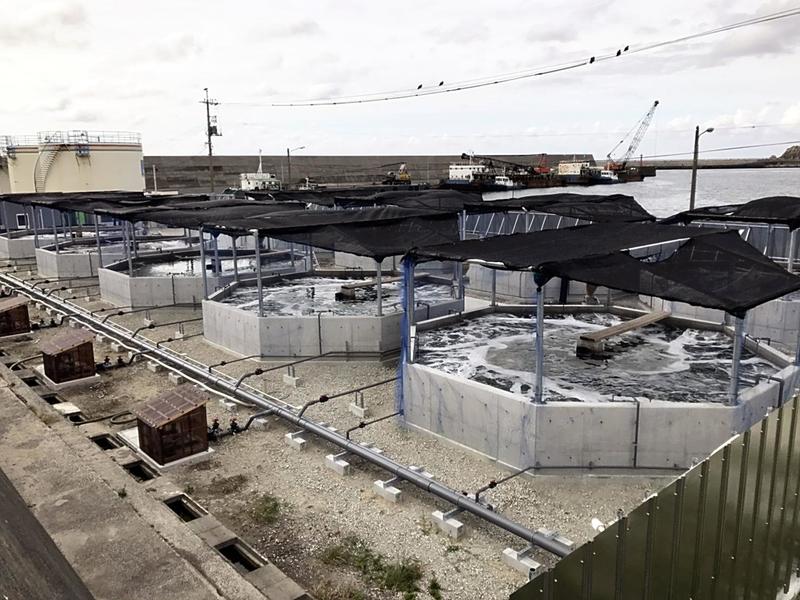
Tokyo-based Kaneko Cord Co. runs the facility cultivating the sturgeons. The company's core business is the manufacturing of electric wires and medical tubes. It began fish farming in 2014 as a new business and constructed a fish farming facility near a river, using clean underground water to raise the sturgeons from eggs or fry. Currently, the company is raising 25,000 sturgeons, which means about 150 kilograms of caviar.
"The price is similar to those of expensive imported caviar, but our caviar is of a higher quality," said company President Tomoki Kaneko.
Pros and cons
The volume of domestic fisheries and aquaculture production has declined to 4.39 million tons in 2018 from its peak of 12.82 million tons in 1984. Climate change and a decline in the number of fishermen are among the reasons for the drop.
Land-based aquaculture has the following advantages: It is not susceptible to climate or weather and easier to raise fish thanks to adequate control of water quality and feed; it is possible to cultivate fish with a limited number of workers because ships or other such equipment are not necessary; it is possible to produce fish at locations close to consumers.
On the other hand, installation, electricity and other costs are an issue at present. To address this issue, some companies have engaged in land-based aquaculture of high-value fish including sturgeons. Furthermore, the method is spreading for fish in high demand such as mackerel and salmon.
Raw consumption
West Japan Railway Co. (JR West) cultivates mackerel on land jointly with the Tottori prefectural government. Since 2018, they have offered to restaurants, hotels, department stores and other facilities in the Kansai and Kanto regions this mackerel under the name Ojo Saba (lady mackerel) as fish that can be eaten raw.
Mackerel from the sea can contain parasitic worms called anisakis so they usually cannot be eaten raw. With land-based aquaculture, mackerel are raised in naturally filtered underground seawater so the parasite cannot easily enter the fish. Even the mackerel's milt and liver, usually thrown away, can be eaten.
Itochu Corp. will be involved in land-based aquaculture of salmon with plans for sales to start from 2023. The salmon raised in Japan will be handled by a company engaged overseas in land-based fish farming of Atlantic salmon. The expected production is about 10,000 tons a year.
Currently, much of the salmon imported to Japan is cultivated in countries such as Norway and Chile.
"By raising them in Japan, it is possible to deliver fresh, low-priced salmon," said a person in charge of the matter.
Ikuo Hirono, a professor at Tokyo University of Marine Science and Technology, said cultivated fish tends to be more appreciated abroad than wild-caught fish from the perspective of nature conservation. "While Japanese consumers have for many years considered cultivated fish as inferior to wild-caught fish, they may need to change this view," he added.
Read more from The Japan News at https://japannews.yomiuri.co.jp/