Nominating commissions across Cuba have chosen their candidates for the National Assembly of People's Power, Cuba's parliament, which in turn will select Cuba's next president in April.
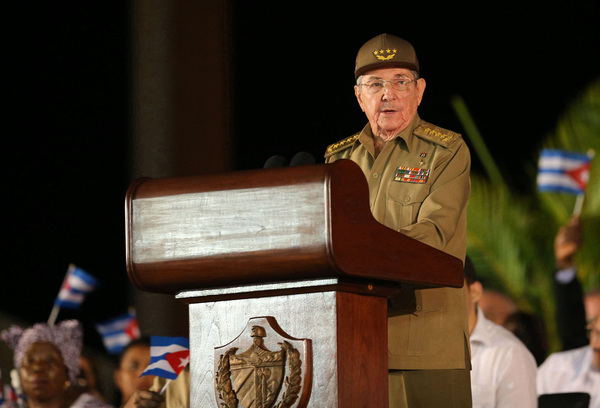
Although the election has been viewed as a generational shift with Raul Castro, 86, expected to retire as president of the Council of State and Council of Ministers, it appears he will remain in the thick of Cuban political life. Not only has he made no mention of retiring as head of Cuba's powerful Communist Party but on Sunday he was selected as a candidate for the National Assembly from the Segundo Frente municipality in Santiago de Cuba, the cradle of the Cuban Revolution.
Cuban voters will ratify the National Assembly slate in a March 11 election.
"No nominating commission is going to bypass Raul. Remember the notion of stepping down after two terms is not yet law in Cuba. It is just an understanding," said Domingo Amuchastegui, a former Cuban intelligence analyst who now lives in Miami.
In 2013, Castro told the National Assembly that he planned to retire in 2018 after serving two five-year terms as president and suggested that other leaders needed to follow his example of term limits. Castro took power provisionally in 2006 after his brother Fidel became ill and then officially in 2008.
Castro wasn't the only octogenarian selected from Santiago. Jose Ramon Balaguer Cabrera, 85, a member of the Central Committee secretariat, also was nominated as a National Assembly deputy candidate.
The National Assembly was originally expected to select Castro's successor on Feb. 24, but recovery efforts after Hurricane Irma slammed the island in September delayed the electoral process and now the National Assembly is expected to vote on the country's next leader on April 19.
Most observers assume that First Vice President Miguel Diaz-Canel is the heir apparent, but if he is selected, it remains to be seen how much real power he will wield.
When Osvaldo Dorticos formally served as president of the republic from 1959 to 1976, the late Fidel Castro, who was then prime minister, still called the shots. From 1976 on, the posts associated with the presidency were occupied either by Fidel or Raul.
The photos and biographies of those nominated as National Assembly deputies will be displayed in public places in anticipation of the March election where voters will be asked to ratify the slate for 605 National Assembly seats.
In November, Cuba held the only portion of its electoral process in which voters actually had a choice. Voters chose among nearly 27,000 candidates vying for 12,515 municipal assembly seats. Fifty percent of the deputies in the National Assembly must be chosen from municipal assembly delegates.
Opponents of Cuba's one-party system launched an effort to get themselves on the ballot in the November election but not one of the 175 dissident candidates who were part of the #Otro18 campaign made it to the ballot. Some complained the government used quick trials, arrests and intimidation to block their candidacies.