CSKA Moscow have informed Uefa of their intention to appeal against the three-game stadium ban for racist behaviour of fans, which raises the possibility Manchester City’s Champions League match against the Russian club may not take place behind closed doors on 21 October.
Uefa told the Guardian: “CSKA Moskva have declared their intention to appeal against the decision of Uefa control, ethics and disciplinary body of 3 October. They now have five days until next Wednesday to submit their appeal’s statements.
“Since this is not an official appeal yet, we do not have any date of hearing for the time being. We will have more information on this by the middle of next week.”
Roman Babaev, CSKA’s general manager, is confident the sanction, which applies to their next three home European matches, can be reversed. Uefa has also banned CSKA from selling tickets to supporters for the return fixture at the Etihad Stadium on 5 November and fined the club €200,000 (£157,000).
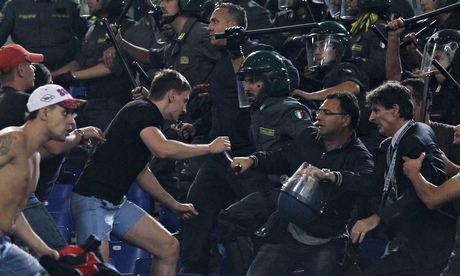
CSKA were given the punishment following supporters’ conduct during the 5-1 defeat at Roma in September. After 70 minutes of the game at the Stadio Olimpico CSKA fans let off flares and threw them at their rival section, with racist banners also unfurled.
This led to a third Uefa charge of racism in less than a year. Last season’s Champions League group match between CSKA and City at the Khimki Arena featured racist chanting aimed at Yaya Touré. For this, CSKA had a partial stadium closure but a repeat offence against Viktoria Plzen moved Uefa to order September’s Group E match against Bayern Munich be played behind closed doors.
After taking only one point from their opening two matches City must beat CSKA to retain a realistic hope of qualifying for the knockout phase.
Uefa has confirmed a change to the seedings from next season that will please City. Manuel Pellegrini and club executives were unhappy that, despite being English champions, City were placed in pot two for the draw.
The Uefa general secretary, Gianni Infantino, confirmed the title winners from the seven strongest leagues, plus the European Cup winners, would make up the eight top seeds. He said: “It will be ratified later on by the executive committee but it’s a clear recommendation of the club competition’s committee that the seeding system changes in this respect as from next season. People had difficulties in understanding how the champion of a country is in a lower pot than the third-ranked in that country. This will give another dynamic with the draw and in the way the groups are composed. It will be approved with the regulations at the start of next year.
“The club committee felt that there should be somehow an additional award given to the winners of the different national competitions. Football is about winning, it’s about competition, it’s about sporting merit. I think it’s kind of a natural thing to give to those who have won a competition a special treatment like this.”