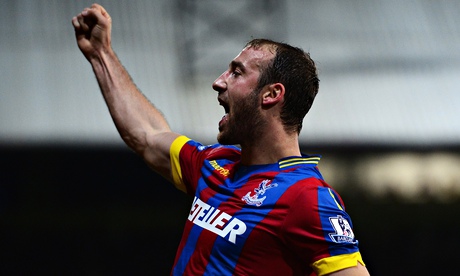
Glenn Murray’s progress over recent seasons has been garnished by statistical quirks. Rewind a little more than two years, when his goals were sustaining Crystal Palace’s promotion charge in the Championship and there was a period when the Cumbrian was sandwiched between Lionel Messi and Cristiano Ronaldo in the scoring charts for the top two divisions across Europe’s five leading leagues. Zlatan Ibrahimovic and Radamel Falcao traipsed in behind that trio.
Now comes another apparent anomaly. Monday’s opening goal against Manchester City was a fifth in five Premier League games for Murray, his tally realised from only 447 minutes of football to ensure he has the best minutes-per-goal ratio (89.4) of any striker in the top flight. Those at Murray’s shoulder are Papiss Cissé, Olivier Giroud, Diego Costa and even the division’s player of the moment, Harry Kane.
The clamour of “Murray for England” is unlikely to go up any time soon but Roy Hodgson was at Selhurst Park to witness the bedlam of the club where the England manager began his playing career take their latest prize scalp. He will have appreciated the performance offered up by the journeyman leading the pack as well as the line.
These are heady days for a player whose nomadic career has taken in spells from Workington Reds to Wilmington Hammerheads in North Carolina, Barrow to Brighton & Hove Albion. He is a throwback, a targetman to whom the ball tends to stick and whose link-up play liberates team-mates. There were precious few opportunities for Yannick Bolasie and Wilfried Zaha to make inroads on Monday but they have each benefited from the presence of a central pivot of a striker around whom to buzz, just as they did in the second tier in that 2012-13 promotion season. Murray is not blessed with pace, even if he can rarely have been fitter than he currently appears, but he is canny. His movement is shrewd.
Experience earned from years muscling in among gnarled centre-halves in the lower leagues has brought the 31-year-old to the elite level. He drove Martín Demichelis and Vincent Kompany – a seasoned pair who boast a combined three Premier League titles, four Bundesligas, an FA Cup, four German Cups, three German League cups, two English League Cups and two Belgian league titles – to distraction, positioning his body cleverly to earn a flurry of free-kicks and relieve some of the pressure on Palace.
The tap-in, however disputed by City over Scott Dann’s perceived offside in the buildup, provided personal reward but Murray’s game is selfless, his onus constantly on the collective. “I suppose it is one of the my best nights here,” he said with a monotone – the sentiment about as publicly emotive as the striker offers. “But it’s a good night for the club. Ever since Alan Pardew has come in he’s been uplifting results and the boys have reacted to that. We’re a happy group. I’ve had to work hard to get back into this position and I’m enjoying things at the moment.”
It is hard to begrudge him this success. Murray, like Grant Holt and Rickie Lambert before him, is making the most of a belated opportunity.
Unlike the Indian summers to lengthy careers that pair enjoyed at Norwich City and Southampton, however, Palace’s No17 appeared to have been denied a chance he had earned. In May 2013, Palace hosted Murray’s former club, Brighton, in the first leg of their Championship play-off semi-final when the 31-goal striker twisted in the visitors’ penalty area under a vague challenge from Wayne Bridge and fell awkwardly, feeling the ligaments in his right knee wrench. The cruciate was ruptured, the team’s talisman retiring in agony on a stretcher to the taunts of those in the away section. He watched the second leg and the Wembley final on crutches, and was then helpless as forwards were recruited in his absence while rehabilitation dragged on for almost 10 months.
His return under Tony Pulis last season yielded one goal, from the penalty spot at Swansea City, and signs of a partnership with Dwight Gayle but Murray was a player down the pecking order. Fraizer Campbell, Marouane Chamakh, Gayle and, for a while in January, potentially Yaya Sanogo or Shola Ameobi were all preferred in a team who tend to play only one up front.
Even Andrew Johnson was technically more in contention for involvement. Back on deadline day in September, Neil Warnock had sanctioned Murray’s departure to Reading on a six-month loan, recruiting Kevin Doyle from Wolverhampton Wanderers’ reserves to play the role of third-choice back-up instead. The Irishman scored once in five appearances, at Dover in the FA Cup, was released back to his parent club and will move to Colorado Rapids in Major League Soccer in July.
Reading would have recruited Murray in January had Pardew not taken over, impressed as Reading were after eight goals in 18 games. Instead Murray signed a new deal at Selhurst Park, potentially extending his stay until 2017, and has been welcomed back into a team that is revived. He was the answer to the forward-line quandary all along. It just required a little faith to recognise as much.
The last five games have provided rewards aplenty: a stoppage-time goal and a header against a post in the seconds that still remained against Arsenal; two goals – and a sending off – when he was still rather rusty at West Ham United; key involvement as a central pivot as the wingers ran riot against Queens Park Rangers; a penalty and an assist at Stoke City; a tap-in and the free-kick from which Jason Puncheon scored the winner against the champions.
“His was the performance of a No9 in the modern game,” Pardew said. “He won free-kicks, won virtually every header, got a goal again. We knew we’d need him to buy us fouls, work hard for us, and that was exceptional. He’s had a terrible time with injuries and should have been in the Premier League years ago but he has forged himself a great reputation in the game. I’m so pleased for him. He deserved this a lot earlier in his career but now he’s getting the reward for the quality he has.” This Indian summer has time still to run. Murray has his opportunity at last.
Top minutes per goal ratio in the Premier League 2014-15
1. Glenn Murray, five goals from 447 minutes (89.4 min per goal)
2. Papiss Cissé, 11 goals from 1,014 minutes (92.18 min per goal)
3. Olivier Giroud, 14 goals from 1,345 minutes (96.07 min per goal)
4. Harry Kane, 19 goals from 1,957 minutes (103 min per goal)
5. Diego Costa, 19 goals from 1,958 minutes (103.05 min per goal)