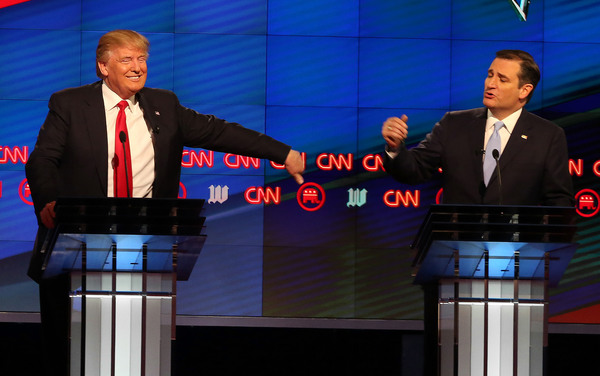
Sen. Ted Cruz announced Friday that he is backing GOP nominee Donald Trump for the presidency, setting aside their bitter rivalry because, he said, Hillary Clinton must be defeated.
"Our country is in crisis. Hillary Clinton is manifestly unfit to be president, and her policies would harm millions of Americans. And Donald Trump is the only thing standing in her way," Cruz wrote on Facebook.
"A year ago, I pledged to endorse the Republican nominee, and I am honoring that commitment. And if you don't want to see a Hillary Clinton presidency, I encourage you to vote for him."
That rationale _ that Cruz did anything possible to stop a Clinton presidency _ was widely viewed as an armor for any flack Cruz would get for abandoning what he previously argued was his principled opposition to the Republican standard-bearer. The endorsement was also seen as a predictable act of political expediency by a candidate known to be eyeing the 2020 presidential campaign if Trump loses.
Still, it was remarkable given how brutal the contest became between the Republican standard-bearer and the man who came in second in the race for the nomination.
Trump and Cruz initially got along in the unusually large field of Republicans vying for the nomination, but as the race intensified, Trump grew increasingly vicious. He dubbed Cruz "Lyin' Ted," mocked his wife's appearance and falsely insinuated that the senator's father might have been involved in the assassination of President John F. Kennedy.
By the end of the primary, Cruz, in turn, was calling Trump "utterly amoral," a "pathological liar," "a serial philanderer" and a "narcissist at a level I don't think this country's ever seen."
The tension came to a head at the Republican National Convention. Cruz, speaking in prime time, pointedly refused to endorse Trump and infuriated the crowd when he urged delegates to "vote your conscience," echoing a slogan used by anti-Trump delegates. In response, Trump said he didn't want Cruz's endorsement and threatened to launch a super PAC to take down Cruz when the Texas senator ran for re-election.
As the summer wore on and Republicans lined up behind Trump, Cruz began facing pressure from fellow Republicans who noted that at the start of the primary season he pledged, along with the rest of the GOP field, to support the party's eventual nominee.
Evidence of a thaw began emerging in recent days. Trump's running mate, Indiana Gov. Mike Pence, met privately with Cruz last week in Washington. Cruz's campaign manager, Jeff Roe, told reporters Wednesday that Cruz found Trump's recent campaigning encouraging.
"Watching Donald run a better campaign lately has been helpful to him," said Roe.
Hours later, the Trump campaign announced its support of a legislative priority of Cruz's, stopping the Obama administration from handing over control of internet domain names to international stakeholders.
Internet freedom was among six policy reasons Cruz cited for backing Trump. The others were Supreme Court nominations, Obamacare, energy, immigration and national security.
"These are six vital issues where the candidates' positions present a clear choice for the American people," Cruz wrote. "If Clinton wins, we know _ with 100 percent certainty _ that she would deliver on her left-wing promises, with devastating results for our country. My conscience tells me I must do whatever I can to stop that."
On Friday, Trump said he was "greatly honored" by Cruz's endorsement.
"We have fought the battle and he was a tough and brilliant opponent," Trump said in a statement. "I look forward to working with him for many years to come in order to make America great again."
Even so, the 733-word announcement is not a ringing endorsement _ Cruz did not use the word "endorse" until the final paragraph. He released it on social media on a Friday afternoon, three days before the first presidential debate. But Cruz did praise Trump's expansion of his list of potential Supreme Court nominees released Friday, as well as what Cruz described as Trump's increased focus on freedom, such as emphasizing school choice to help lift minorities out of poverty.
The endorsement was described as "politically convenient" with little to no downside by Craig Robinson, an influential conservative blogger in Iowa, the state where Cruz won the first-in-the-nation caucuses in January.
"As race tightens up, you don't want someone to be able to point to you and say, 'Hey, you're the reason we lost.' Or you surely don't want a sitting president in the White House who could help fundraise for your primary opponent," he said.
Robinson added that Cruz had a ready-made defense should Clinton win and he decides to run for president in 2020 _ that he did everything in his power to stop the Democrat from winning the White House.
"I think for 90 percent of the people, that works. That's been the argument all along," he said. "The die-hard fans, I still think that they're going to have to lick their wounds a little bit but they'll probably get over it too. It just is what it is."
But some of Cruz's most devout supporters who appreciated his unwillingness to compromise worried about what the endorsement meant for his political future.
"The conservative graveyard is littered with the remains of would-be champions, who buried themselves after misspending their political capital, and choosing the wrong hills to die on," Steve Deace, a conservative Iowa radio host, wrote in Conservative Review on Friday. "... As someone that knows, respects and loves Ted Cruz, my fear is his endorsing Trump risks adding his name to that tragic list. And given the fact Cruz is one of the last remaining constitutional champions we have, if he falls he won't fall alone."